
Popcorn-ceiling removal is a finish-removal and surface-restoration project with a material-safety boundary. The quote may include assessment, protection, removal or another treatment, surface repair, skim coating, primer, paint, cleanup, and disposal.
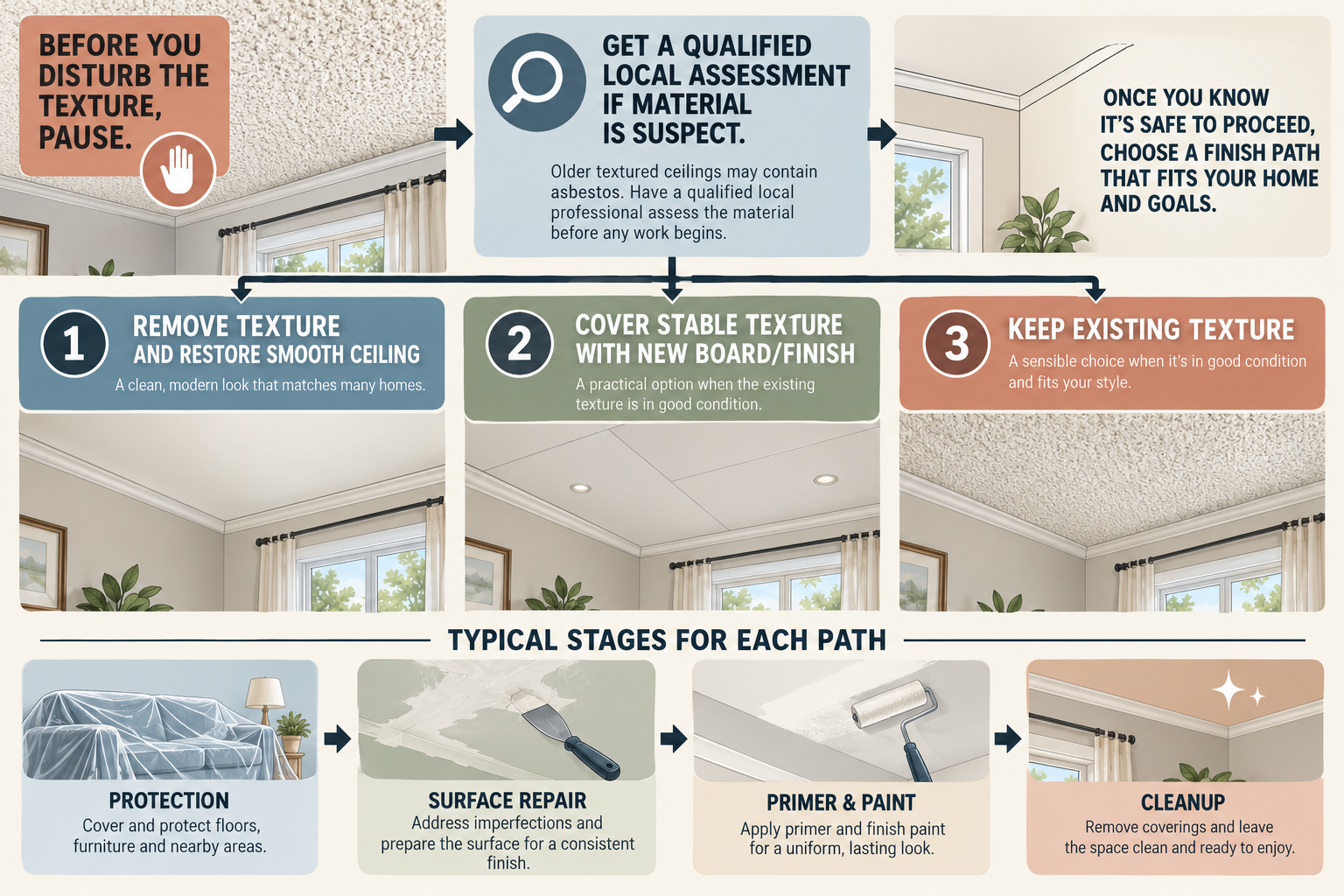
Why the price is difficult to predict
Ceiling area, height, texture adhesion, layers of paint, underlying drywall or plaster, repairs, room protection, access, and final smoothness affect labor. A contractor may recommend removal, covering, or another finish treatment depending on condition and the desired result.
An EPF Pro Services 2026 GTA guide estimates about $6–$10 per square foot for a standard-height project that includes popcorn-texture removal and a smooth refinish. Its described scope includes protection, removal or preparation, repairs, skim coating, sanding, primer, paint, and cleanup; small ceilings under about 250 square feet may be priced at a minimum instead. The contractor guide gives no independent sample and uses $ without a stated currency code. This is a local full-finish example, not a scraping-only or hazardous-material estimate.
Test before disturbing older material
Asbestos may occur in some older flooring, ceiling tiles, plaster, and related materials. Lead-painted surfaces can also create hazardous dust when disturbed in applicable U.S. work. Appearance and age do not identify a particular material. Do not scrape, sand, or demolish suspected material on assumption. Obtain qualified, jurisdiction-aware testing and handling advice before disturbance.
What the quote should state
Ask whether testing, containment, removal, disposal, patching, skim coating, primer, paint, access, protection, and cleanup are included. Keep hazardous-material abatement separate from ordinary finish work. A low removal line item is not comparable if it excludes the surface needed for repainting.
What a complete removal project includes
Popcorn-ceiling work is usually a sequence: assess the existing material, protect the room, remove or cover the texture, repair the underlying surface, create the desired finish, prime, paint, and clean up. A quote for scraping alone is not comparable with a quote for a smooth painted ceiling.
The existing texture may conceal joints, patches, stains, unevenness, or damage. Removal can expose those conditions and can require skim coating or broader board repair. Critical lighting, ceiling height, fixtures, furniture, and occupied-room protection also affect labor.
Age is a screening question, not a test result
Some older ceiling textures or related coatings may contain asbestos, and lead-painted surfaces can create a separate dust concern in applicable work. A material cannot be identified from appearance alone. U.S. and Canadian guidance have different scopes and local rules. Do not scrape, sand, or demolish a suspected material on assumption.
If qualified assessment or testing is needed, keep that step separate from ordinary finish pricing. Hazardous-material abatement is not an improvised add-on to a texture-removal bid. Ask who is responsible for work practices, containment, disposal, and clearance where applicable.
Removal, covering, and replacement choices
Full removal may make sense when the homeowner wants a different surface and the material can be disturbed responsibly. Skim coating or covering may reduce some demolition but still requires a suitable, prepared base and can leave the existing condition below. New drywall may be considered when the ceiling is badly damaged, but it adds demolition, disposal, joints, trim, fixtures, and possible cavity work.
Compare the final finish, not just the method. A smooth result may require several preparation stages, sanding, primer, and paint. If the owner wants a texture or sheen that hides minor variation, the labor may differ from a smooth high-finish ceiling under strong side light.
Cost scenarios
A simple project has a clear, accessible ceiling, no legacy-material concern, limited repairs, and a defined paint finish. A typical project includes furniture protection, texture work, surface repair, primer, paint, fixtures, and cleanup. A complex project includes testing or abatement, high access, extensive skim coating, stains, water damage, plaster, or full board replacement.
No safe universal removal price was established by the available U.S. and Canadian observations. The correct estimate depends on the condition and safety path. Request a site-specific bid with the same assumptions from each contractor.
Quote checklist
Ask for assessment and testing assumptions, containment, removal or cover method, disposal, surface repair, skim coating, sanding, primer, paint, access, fixtures, furniture, protection, and cleanup. Confirm what remains outside the finish scope, including water correction, mold, structural work, and hazard abatement.
Price the safe finish path
Popcorn removal is not only scraping. The complete scope may include an assessment of the coating and substrate, protection or containment, removal, disposal, adhesive or texture residue, repairs, skim coating, sanding, primer, paint, fixture handling, and cleanup. A low removal allowance may leave the homeowner with a ceiling that still needs most of the visible restoration.
Do not assume that a coating’s appearance reveals its composition or that a particular construction date proves what is present. In the United States and Canada, testing, worker protection, disposal, and notification requirements can vary by jurisdiction and material. Use the applicable local process before disturbing a suspect legacy coating; ordinary finish pricing is not hazard-abatement pricing.
Removal versus covering
Covering or encapsulating the texture may reduce disturbance and can be appropriate when the existing surface is stable and the resulting ceiling height, trim, fixtures, and finish are acceptable. It can also conceal damage or make future access harder. Removal may provide a cleaner reset but often exposes uneven board, old repairs, or additional preparation.
Compare both paths with the same finish target. Include surface preparation, seams and corners, access, fixture removal, protection, primer, paint, and disposal. A ceiling that looks smooth from the floor still needs a substrate capable of accepting the new finish.
Surface restoration and stopping point
The texture may be hiding fastener marks, joint variation, stains, or previous repairs. Ask how those conditions will be treated and whether the quote assumes a skim coat, multiple passes, or a full-ceiling repaint. If a water source, damaged board, mold concern, or structural movement is found, pause the finish scope and price the cause-related work separately.
The useful decision is not “remove or keep” in isolation. It is the lowest-risk complete path to the desired appearance, with the material and jurisdictional boundaries verified first.