
The cheaper-looking option is not always the cheaper project. Repair preserves more of the existing assembly but may require careful stabilization and matching. Drywall replacement can create a predictable new surface while adding demolition, disposal, framing or backing adjustments, finishing, and paint.
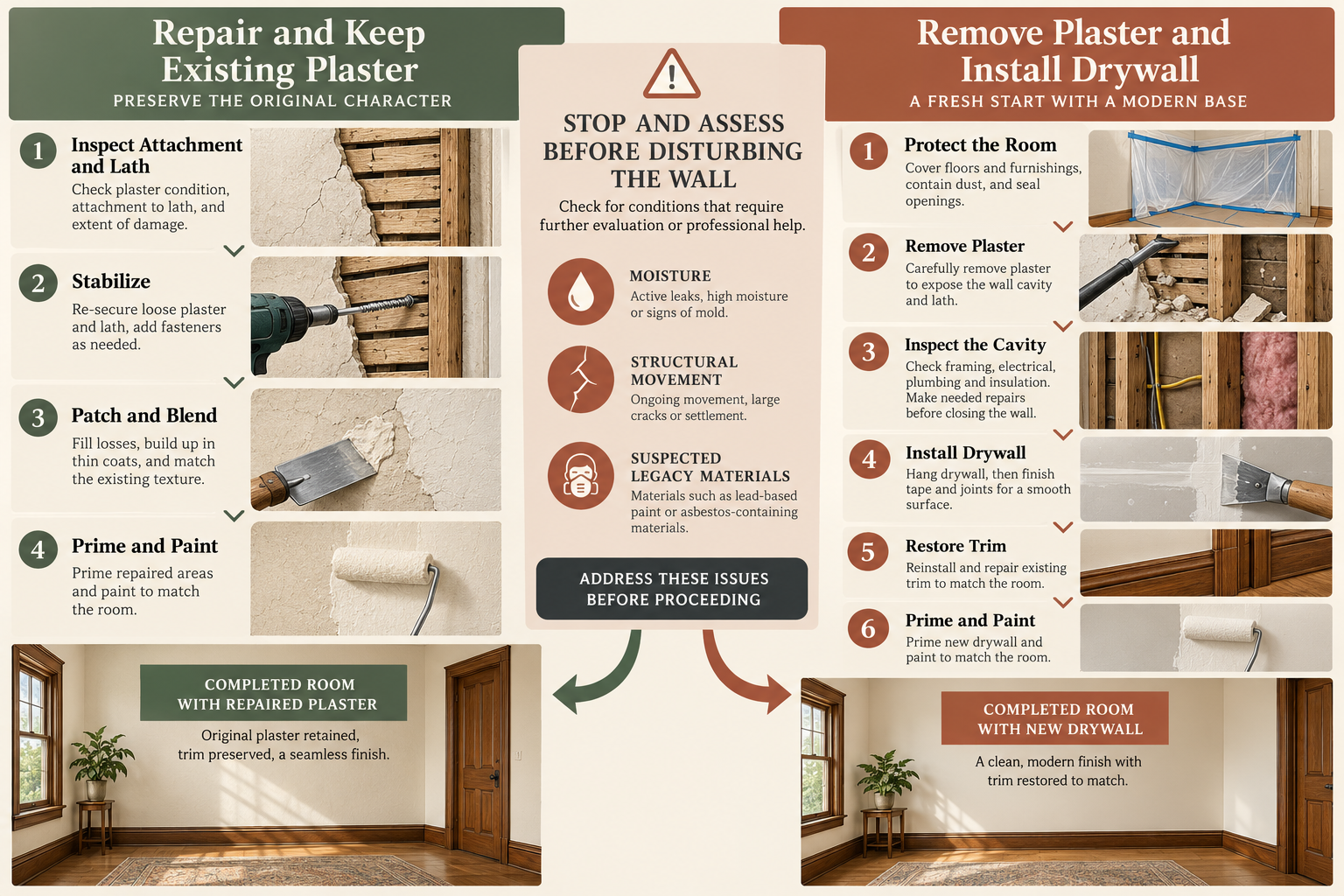
When repair may fit
Repair may be reasonable when damage is localized, the surrounding plaster is sound, the existing profile matters, or replacement would disturb adjacent trim and finishes. It may be less attractive when plaster is broadly detached, movement continues, or the desired result requires widespread resurfacing.
When drywall may fit
Drywall can be practical for larger nonhistoric areas when access, thickness, openings, insulation, electrical interfaces, and final finish can be coordinated. The scope must include removal and disposal, backing, board, joints, corners, finish level, primer, paint, protection, and cleanup. It is not automatically a quick overlay.
Safety and uncertainty
Older painted plaster and related materials may require assessment before disturbance. U.S. lead-safe renovation requirements and Canadian guidance are not interchangeable; local applicability depends on the home and work. Suspected asbestos-containing materials should not be disturbed on appearance or age alone.
Make a side-by-side decision
Ask for repair and replacement scopes with the same finish expectation. Compare access, restoration of trim and transitions, dust control, hidden conditions, disruption, and future maintenance. No universal age or price threshold decides the question.
This is a scope decision, not a material contest
Plaster may be worth repairing when the base remains attached, damage is localized, the existing thickness and trim are valuable to preserve, or demolition would create more disruption than benefit. Drywall replacement may be attractive when the plaster is broadly detached, repeatedly failing, badly out of plane, or preventing access to other work. Neither choice is correct based on age alone.
The budget should compare the completed wall or ceiling. Repair may include stabilization, patching, lath work, finish matching, primer, paint, and repeated handwork. Replacement may include demolition, disposal, cavity inspection, new board, taping, finish level, trim restoration, primer, paint, and changes around outlets, windows, doors, and baseboards.
Conditions that favor plaster repair
Repair is more plausible when failure is isolated, the plaster can be stabilized, the substrate is sound, and the homeowner accepts a visible or blended repair. It can preserve thickness, trim relationships, and room character. The contractor should explain what will happen if probing finds a larger loose area or damaged lath.
Repair is less attractive when the same cracks recur, large surfaces are detached, moisture remains, the wall is badly distorted, or access to utilities is the main reason the wall is being opened. A finish-only repair should not be used to hide movement, water, or structural damage.
Conditions that favor drywall replacement
Replacement may offer a more predictable surface when the existing plaster and lath are extensively failed or when a broader renovation already requires opening the wall. It can simplify some access and create a defined finish substrate, but it is not demolition-free. Thickness, trim, reveals, door and window casing, baseboards, electrical boxes, insulation, and floor or ceiling interfaces can all change.
The new wall may also alter sound, thermal, and visual characteristics. Ask whether the contractor is replacing only finish layers or also addressing insulation, wiring, plumbing, moisture, or framing. Those related scopes should be identified rather than implied.
Hidden cost and disruption
Demolition can expose old coatings, wiring, plumbing, damaged framing, pests, moisture, or material that needs special handling. Disposal and dust control can dominate an occupied-room project. Repair can avoid some demolition but may require more labor for matching and protection. Compare the disruption and restoration obligations as carefully as the labor total.
Historic and hazardous boundaries
If original ornamental plaster or historically significant trim is central to the decision, preserve that scope through the historic-home category. If suspected asbestos or lead-painted material may be disturbed, pause for qualified, jurisdiction-aware advice. U.S. and Canadian requirements differ, and material content cannot be inferred from appearance.
A side-by-side quote framework
Ask for separate repair and replacement bids that state:
- condition and area assumed;
- stabilization or demolition;
- lath, substrate, insulation, and utility assumptions;
- disposal and protection;
- finish level and texture;
- primer, paint, and trim restoration;
- access and furniture;
- concealed-condition allowance; and
- the point at which structural, moisture, historic, or hazard work becomes separate.
Choose the path that provides the required appearance and performance with the least unsupported uncertainty. A cheap plaster repair that fails again and a cheap drywall replacement that omits demolition or trim are both incomplete budgets.
Compare complete paths
Plaster repair and drywall replacement should be compared as finished-room projects. For repair, include stabilization, lath or substrate work, patching, finish matching, sanding, primer, paint, protection, and cleanup. For replacement, include demolition, disposal, framing or backing, board, joint finish, insulation or utility coordination, trim restoration, primer, paint, and cleanup.
The visible area is not the only measure. A ceiling, stairwell, room with ornate trim, or occupied space may make access and protection a meaningful part of either option. Ask for the same assumptions on furniture, fixtures, openings, and final coating before comparing totals.
Conditions that favor plaster repair
Repair is more defensible when the plaster remains attached, the failure is localized, the finish has value, and the supporting cause is understood. It can preserve texture, thickness, trim relationships, and the character of an older room. It is less defensible when the substrate is broadly detached, water-damaged, repeatedly moving, or impossible to access without extensive opening.
Conditions that favor drywall
Drywall can be practical when the existing surface is broadly unsound, the room is already being opened, a predictable smooth finish is wanted, or utilities and insulation need access. It still changes thickness, corners, reveals, trim, sound behavior, and sometimes the relationship to adjacent rooms. Price those interfaces rather than treating board as a direct square-foot substitute.
Hidden work and future access
Both paths need a boundary for concealed conditions. Moisture, framing movement, damaged lath, missing backing, old coatings, and utility conflicts can change the recommendation. Legacy-material or hazard questions need an appropriate local assessment; they are not resolved by choosing drywall.
Ask what happens if the selected path cannot be completed as assumed, how a future repair would be accessed, and which finish standard is included. The better decision is the complete option that fits the room’s condition and the homeowner’s preservation or performance goal.