
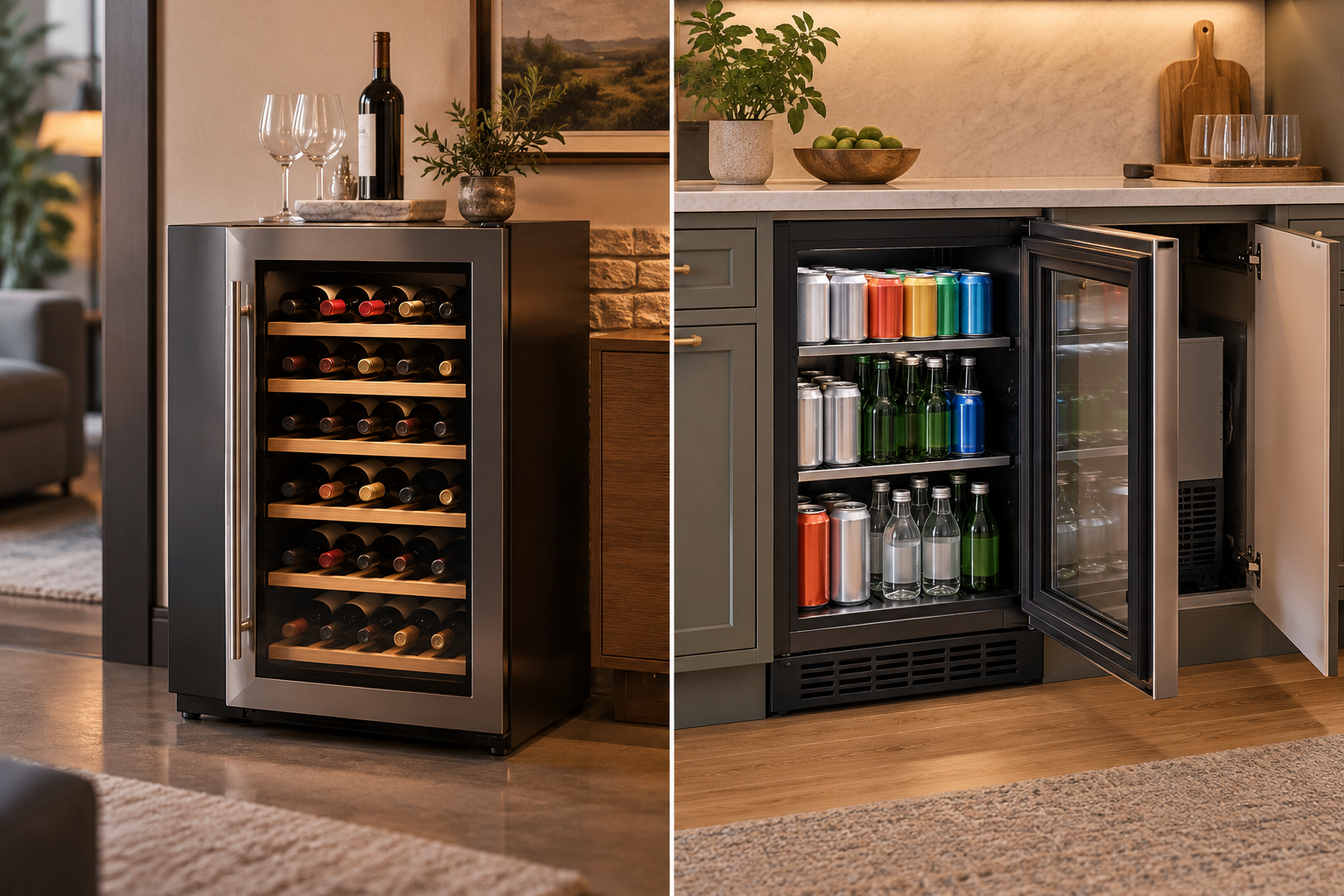
Wine chillers and beverage refrigerators are not interchangeable with standard household refrigerators. Product purpose, temperature zones, bottle or can layout, ventilation, opening dimensions, electrical connection, cabinetry, and service support can change the replacement budget. Natural Resources Canada identifies miscellaneous refrigeration and wine chillers within its appliance-label context, but the exact model and current rules control.
Define the equipment
A beverage center may be designed for cans and bottles, while a wine refrigerator may prioritize rack spacing, temperature zones, vibration control, or a particular service range. A freestanding unit can stand with manufacturer-required clearance. A built-in or undercounter unit is designed around an opening and may vent through a specified front or rear arrangement.
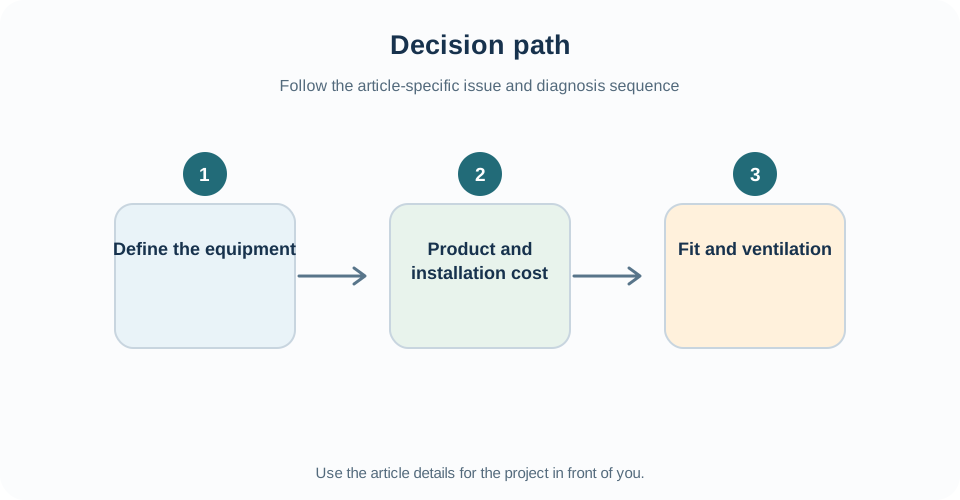
Confirm the model, capacity, number of zones, door swing, hinge side, and installation type before comparing prices. A product that fits the width may not fit the depth, ventilation space, cabinet face, or electrical location. Do not assume that “undercounter” means every model can be enclosed in the same way.
Product and installation cost
Product prices vary significantly by capacity, compressor system, controls, finish, glass, zones, and premium features. Installation can include removal, opening preparation, leveling, securing, trim, panel work, and commissioning. A retailer may provide a basic placement package while a cabinet installer handles the opening.
Ask for separate equipment, delivery, installation, cabinetry, electrical, removal, and disposal amounts. A built-in replacement may require a filler, a new panel, a modified toe-kick, or a change to adjacent cabinetry. Those are kitchen-cabinetry dependencies, not hidden appliance labor.
Fit and ventilation
Use the chosen manufacturer’s installation manual. Verify opening width, height, depth, rear and side clearance, front ventilation, door swing, leveling, and service access. A unit that cannot be serviced without removing cabinets may cost more over its life even if its initial installation is straightforward.
Check the delivery path and finished surfaces. Glass doors, custom panels, and narrow openings create handling risk. Include floor protection and a plan for the existing unit. If the opening has moisture damage, resolve that before the replacement is enclosed.
Electrical and moisture considerations
The product manual controls the model’s electrical connection and placement requirements. A suitable existing connection may make installation simple. A missing or damaged outlet, concealed wiring change, or service correction is separate electrical work. Do not use a generic product listing to establish a universal circuit or cord requirement.
Refrigeration equipment can produce heat, condensation, or drainage needs depending on the design. Check how the model handles these conditions and whether the location is appropriate. Do not treat a wine or beverage unit as a decorative cabinet insert without considering ventilation and service.
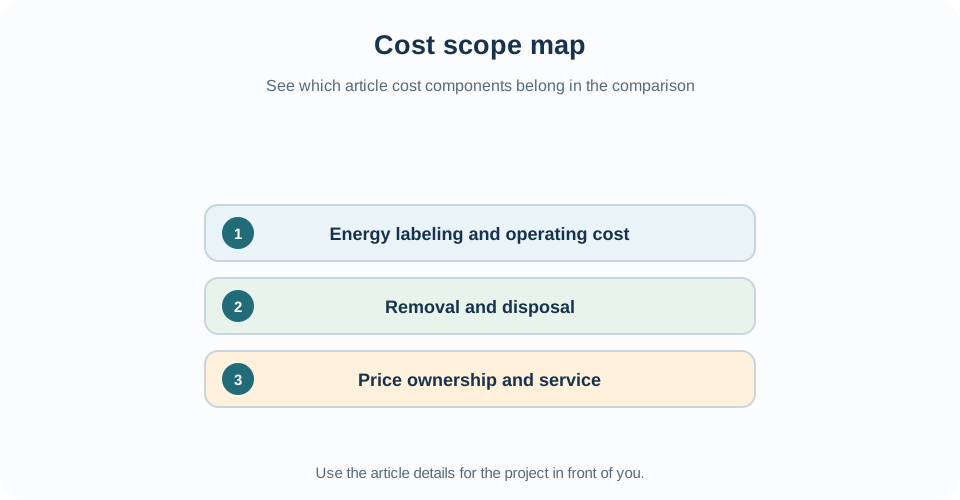
Energy labeling and operating cost
The Canadian EnerGuide label, where applicable, provides annual energy use and a comparison within a product class. The U.S. EnergyGuide framework may present different information. Label treatment for miscellaneous refrigeration can be product- and date-sensitive. Verify the exact model and market rather than assuming that every unit carries the same label.
Estimate operating cost with annual kWh and your local electricity rate, then add filter or maintenance costs where relevant. A premium unit with low consumption may still have a long payback if the purchase premium is high or use is limited. A unit used continuously in a high-rate area deserves more careful lifecycle modeling.
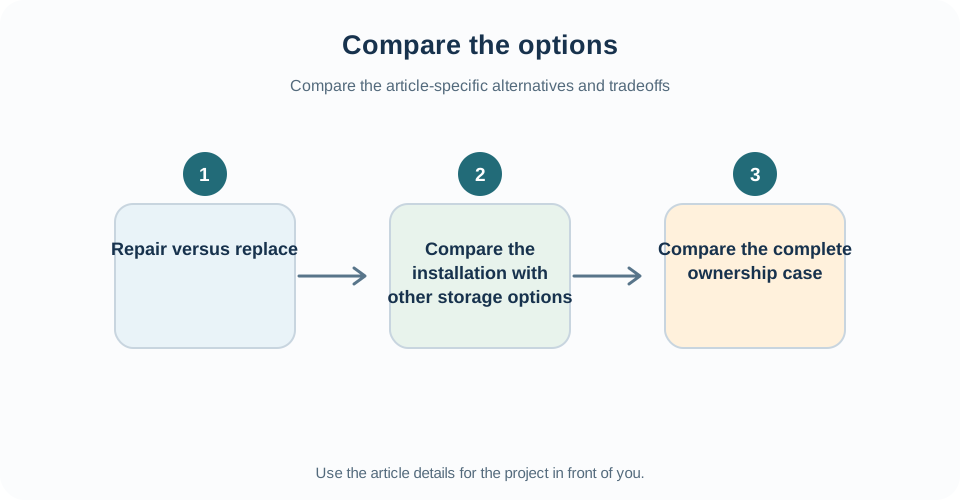
Repair versus replace
Repair may make sense when the cabinet, door, control, and sealed system are sound and a qualified provider supports the model. Replacement is more attractive when the unit is obsolete, parts are unavailable, temperatures are unreliable, or repair scope is uncertain. Built-in fit and cabinetry can make repair valuable, but they can also make a discontinued product difficult to support.
Ask for the diagnosis, part availability, service warranty, and replacement fit before authorizing a major sealed-system repair. Refrigerant handling and disposal require qualified channels. Do not open the circuit yourself.
Removal and disposal
Ask whether the old unit is included in the delivery or installation quote. Built-in appliances may need panels or trim removed before a hauler can reach them. Some refrigeration products can contain refrigerants; in the United States, EPA safe-disposal requirements apply to relevant equipment entering the waste stream. Canadian disposal must be verified through the local program or provider.
U.S. and Canadian uncertainty
Product availability, label applicability, taxes, installer experience, parts networks, and cabinetry labor vary across both countries. No reliable Canadian price should be created by converting a U.S. market observation. Obtain a local quote for the exact model and opening.
Match the unit to the storage job
Start with what the household wants to store, the number and size of bottles or cans, serving temperature, access frequency, noise tolerance, and expected ownership. A beverage cooler, wine refrigerator, and general refrigerator are not interchangeable just because their widths are similar. Keep capacity, temperature zones, shelving, humidity, and light exposure as product-specific assumptions.
Separate freestanding and built-in projects
A freestanding unit may need only a verified electrical connection, clearance, delivery route, leveling, and removal. A built-in unit may require front ventilation, a measured opening, panel or trim work, cabinet protection, and a service path. The exact manual controls clearance and ventilation; do not push a freestanding model into cabinetry without verifying that use.
Price ownership and service
Add electricity, filters or cleaning, noise, warranty, parts, local service, delivery, removal, disposal, and the cost of a discontinued model or unavailable replacement. A sealed cooling system may require qualified service and an appropriate disposal channel. Canadian stock and service must be confirmed locally; a U.S. listing or converted price is not a Canadian estimate.
Compare the installation with other storage options
If the opening is part of a kitchen or bar, compare the unit with cabinetry, a standard refrigerator compartment, or leaving the space open. The alternative may change the electrical, ventilation, finish, and service scope. Use the household’s actual storage need and expected use rather than paying for capacity that will remain empty.
Plan the delivery and commissioning sequence
Verify the exact packed dimensions, route, floor, opening, door swing, ventilation, leveling, electrical connection, panel or trim, and removal path. Ask who checks temperature operation, who protects the surrounding finish, and who returns if the unit is noisy, cannot cool, or is not serviceable in the installed position. Built-in work should preserve future removal access.
Compare the complete ownership case
Use a low-, typical-, and high-use scenario for electricity, filter or cleaning, service, and storage. A premium unit may be justified by temperature control, noise, capacity, or the value of the stored contents, but those benefits are household-specific. Include the risk of an unavailable replacement, discontinued parts, or a difficult built-in service event.
Keep the handoff market-specific
U.S. and Canadian product availability, taxes, electrical practice, installer packages, disposal, and service networks differ. Use the current market’s model, quote, warranty, and retailer support. Do not create a Canadian estimate by converting a U.S. listing or assume a category-level label proves local stock.
Keep the storage and service assumptions visible
The exact model should be matched to the opening, purpose, temperature zones, ventilation, noise, electrical path, and access. Ask what happens if the unit is discontinued, cannot hold temperature, or must be pulled from finished cabinetry. Add a temporary storage plan for the contents and a local service contact for the cooling system.
Decide what happens if the unit fails
Keep a temporary storage plan for the contents and identify the local service route before committing to a built-in installation. Ask whether the cooling system, controls, shelves, door seal, and panel can be serviced or replaced locally. The value of a specialized refrigerator depends on its useful operation over the ownership period, not only on the day-one appearance.
Use a final decision check
Before purchase, confirm the exact purpose, opening, ventilation, electrical path, local stock, service route, contents plan, delivery, removal, disposal, warranty, and ownership cost. If any of those remains unknown, keep a freestanding or non-appliance alternative available until the installer verifies the project.
Questions before ordering
Ask what the unit is designed to store, whether it is freestanding or built-in, where it vents, what opening it requires, how it is serviced, what connection it uses, whether a panel is reusable, what delivery includes, who handles cabinetry, and how the old unit will be disposed of. The right budget accounts for the equipment’s purpose and the opening it must occupy, not merely its advertised width.