
Dishwasher repair cost depends on the failed component, access beneath the counter, the source of any leak, parts availability, and the appliance’s age and service history. U.S. specialist sources place dishwasher repair roughly around $100 to $300, but a local quote can differ and Canadian pricing is unresolved without local evidence. A leak or drainage symptom may originate in the dishwasher or in the connected household plumbing.
 One Greater Toronto Area provider’s page, checked October 7, 2026, lists dishwasher repairs at $150–$400, including the service call, diagnosis, parts, and labor. It separately lists an $89–$129 diagnostic fee, waived with repair. The source does not state an ISO currency code or define its fault mix, so this is a provider-specific local observation rather than a Canadian price range. Compare its stated inclusions with the local written estimate.
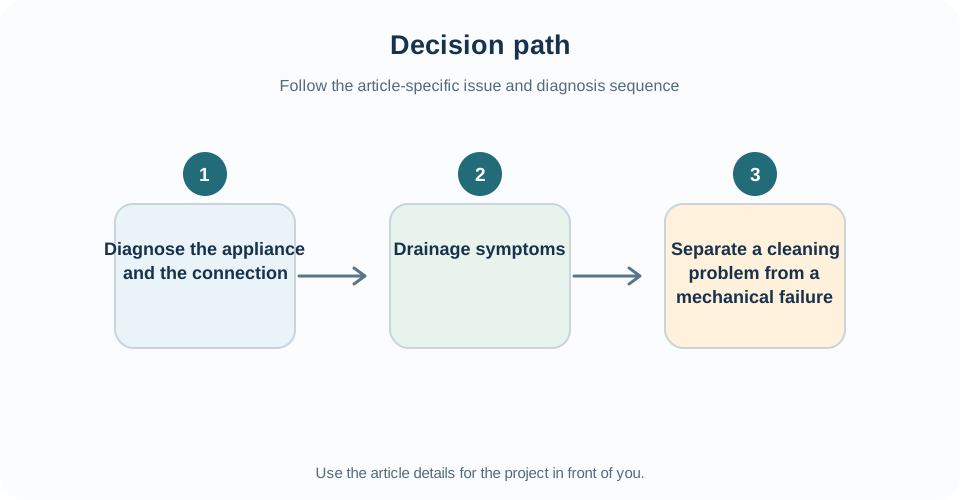
Diagnose the appliance and the connection
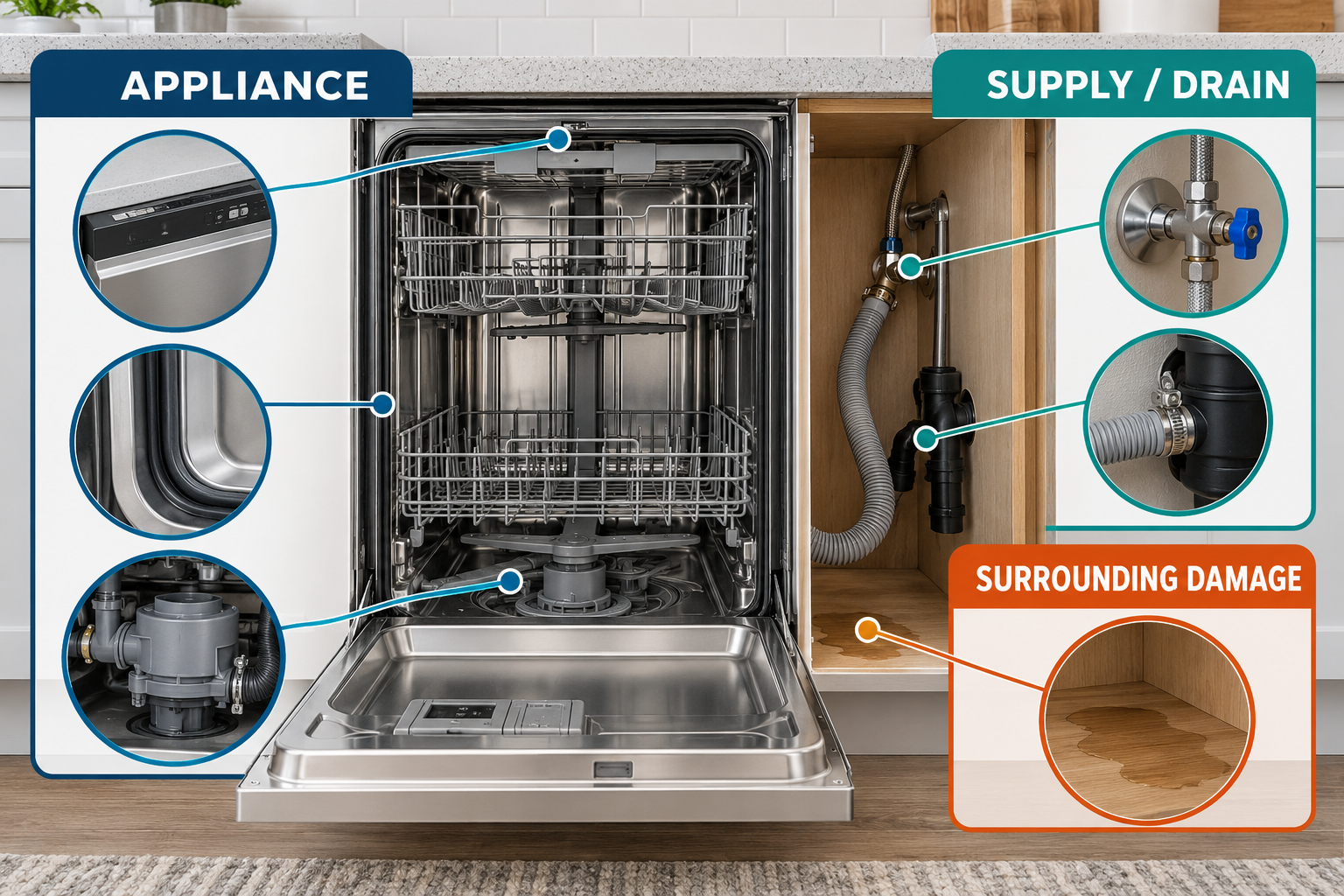
A dishwasher complaint can involve no power, poor cleaning, no heating, standing water, unusual noise, a door that will not latch, a leak, or a failure to fill or drain. Pumps, motors, controls, heating components, seals, racks, hinges, valves, and hoses can be involved. A supply valve, drain connection, air gap, garbage-disposal connection, or building drain can create a similar symptom.
Before the visit, record the model, age, error display, cycle, timing, and location of any water. Do not pull apart electrical or plumbing connections just to test a guess. Ask the technician which tests distinguish appliance failure from a building-side problem.
Common repair groups
Pumps and motors can affect circulation, drainage, noise, and cleaning. Controls or sensors can produce intermittent cycles or error messages. Heating components can affect drying and sanitation performance. Door seals, latches, hinges, and hoses can create leaks. Racks and trim are often more cosmetic, but damaged parts can affect loading or door closure.
The repair estimate should state the part, labor, diagnosis, access, and warranty. An appliance under a counter may require removing kick plates, insulation, or surrounding trim. A special-order part can add a second visit, shipping, and delay. Ask whether the diagnostic fee is credited and what happens if the first diagnosis changes.
Leaks deserve a separate decision
Water under the dishwasher can come from the door seal, pump, hose, valve, tub, drain connection, supply connection, or an overflow condition. The location of water after a cycle is a clue, not proof. Continued operation can damage flooring, cabinets, and subflooring.
If water reaches electrical equipment or concealed materials, use qualified help. A dishwasher repair provider may identify the appliance source but may not own cabinet, flooring, mold, or restoration work. If the leak is at the household valve or drain, plumbing work belongs in that scope. Water damage after a failure may require restoration rather than a simple appliance repair.
Drainage symptoms
Standing water can reflect a pump, filter, control, hose, air gap, disposal connection, or building drain issue. Do not assume that every slow-drain symptom requires a new pump. Ask what was observed at the appliance and at the connection, and whether the proposed repair addresses the cause.
The exact installation and connection requirements are model-specific. Check the current installation manual for the chosen model before relying on a connection detail or planning a repair. A search result is not a substitute for the manual.
Repair versus replacement
Repair is often easier to justify when the problem is localized, the dishwasher has a sound tub and door, parts are available, and the replacement opening or floor would create complications. Replacement deserves comparison when the tub leaks, repairs repeat, the control or motor is obsolete, the repair warranty is weak, or the total approaches the installed price of a suitable new unit.
Do not use a universal age threshold. Compare diagnosis, part, labor, return visit, water-damage risk, replacement appliance, delivery, installation, connection materials, removal, disposal, and water and energy use. A cheaper new dishwasher can still be expensive if it needs floor-height correction or plumbing and electrical work.
Warranty and parts
Check included warranty coverage for the tub, racks, controls, motor, labor, and service area. A paid plan may exclude cosmetic items, maintenance, filters, hoses, or conditions it considers installation-related. Keep the model and service records.
Ask whether a replacement part is new, approved, and available, and whether the provider guarantees the repair. A low-cost part that requires a second visit can be less attractive than an all-in repair price.
U.S. and Canadian market context
The specialist ranges in this article are U.S.-weighted. Canadian labor, taxes, appliance availability, service networks, and installation packages can differ. Do not convert U.S. dollars to Canadian dollars. A local Canadian quote should identify the same scope before comparison.
Questions for the technician
Ask what failed, how it was tested, whether the leak or drain issue is appliance-side, which parts and labor are included, whether the diagnostic fee is credited, how a return visit is priced, what warranty applies, and what replacement would cost after installation and removal. If the provider recommends a new unit, measure the opening and inspect the floor before ordering.
The useful result of a dishwasher service call is not a part name alone. It is a defensible view of the failure, the repair’s remaining risk, the connected building work, and whether replacement creates more value.
Separate a cleaning problem from a mechanical failure
Poor cleaning, standing water, unusual noise, a failed cycle, a leak, or a fault display can have several causes. The possible scope may include a filter or spray path, pump, motor, heater, latch, seal, control, inlet valve, drain hose, household water supply, or building drain. A visible symptom does not identify the failed part. Ask what was tested and whether the technician checked the appliance and its connections separately.
The dishwasher’s location makes the diagnosis more consequential. A small leak beneath a counter can damage flooring, cabinet bases, or adjacent finishes before it is noticed. If water has escaped, stop treating the issue as an ordinary repair-price question and ask for an appropriate assessment of the building materials. Appliance repair and restoration are separate scopes.
Compare contained and expanded repair paths
A contained repair may involve an accessible latch, seal, filter, or control with parts support. An expanded path may require moving the dishwasher, correcting the drain or water connection, repairing a leak, or returning after a special-order part arrives. A repair estimate should state access, disconnection, reinstallation, testing, and the warranty—not only the replacement part.
If a provider recommends replacement, compare the installed alternative with the confirmed repair. Include the opening, countertop and floor condition, water and drain connections, electrical readiness, delivery, removal, haul-away, disposal, and temporary dishwashing disruption. A dishwasher with a sound tub and cabinet may justify repair even when a generic age rule says otherwise; a leaking tub or obsolete control may make replacement stronger.
Use model-specific installation information
Before any replacement or connection change, use the exact current model manual and applicable local requirements. Dishwasher configurations differ, so do not treat a general diagram as plumbing or electrical instructions. Use a qualified installer for work that requires one under local rules or the manufacturer’s instructions.
Canadian repair prices and service availability need Canadian quotes. U.S. specialist ranges are comparison context only. The best decision states who owns the appliance repair, who owns connected plumbing or electrical work, what happens to the damaged area, and what the complete replacement path would cost.
Compare a contained repair with a water-damage path
First separate a cleaning or loading problem from a leak, drain, fill, pump, control, door-seal, or circulation problem. Ask what was tested and whether the technician checked the appliance connection, hose, shutoff, drain, and building-side plumbing. If water reached cabinetry, flooring, or an adjacent wall, restoration and drying are separate scopes. A part replacement is not a complete water-damage response.
Repair is more attractive when the diagnosis is clear, parts are available, access is straightforward, and the tub, door, racks, and cabinet are sound. Replacement deserves comparison when failures repeat, the model is unsupported, the unit is difficult to remove, or the opening and connections need work anyway. Add delivery, installation, removal, disposal, floor and cabinet protection, and the cost of being without a dishwasher.
Decide when to stop repairing
Set the decision point before authorizing a series of parts: repeated leaks, an unsupported model, a damaged tub or cabinet, difficult access, or a repair total that approaches a model-specific installed alternative. This is not a universal percentage rule. It is a comparison of remaining service risk, household disruption, opening condition, and local support.
Ask whether the diagnostic fee is credited, what the repair warranty covers, whether a return visit includes labor, and what happens if the first part does not resolve the symptom. Use the exact current model manual for connections and clearances. Do not allow a search description or another dishwasher’s diagram to become a universal installation instruction.