
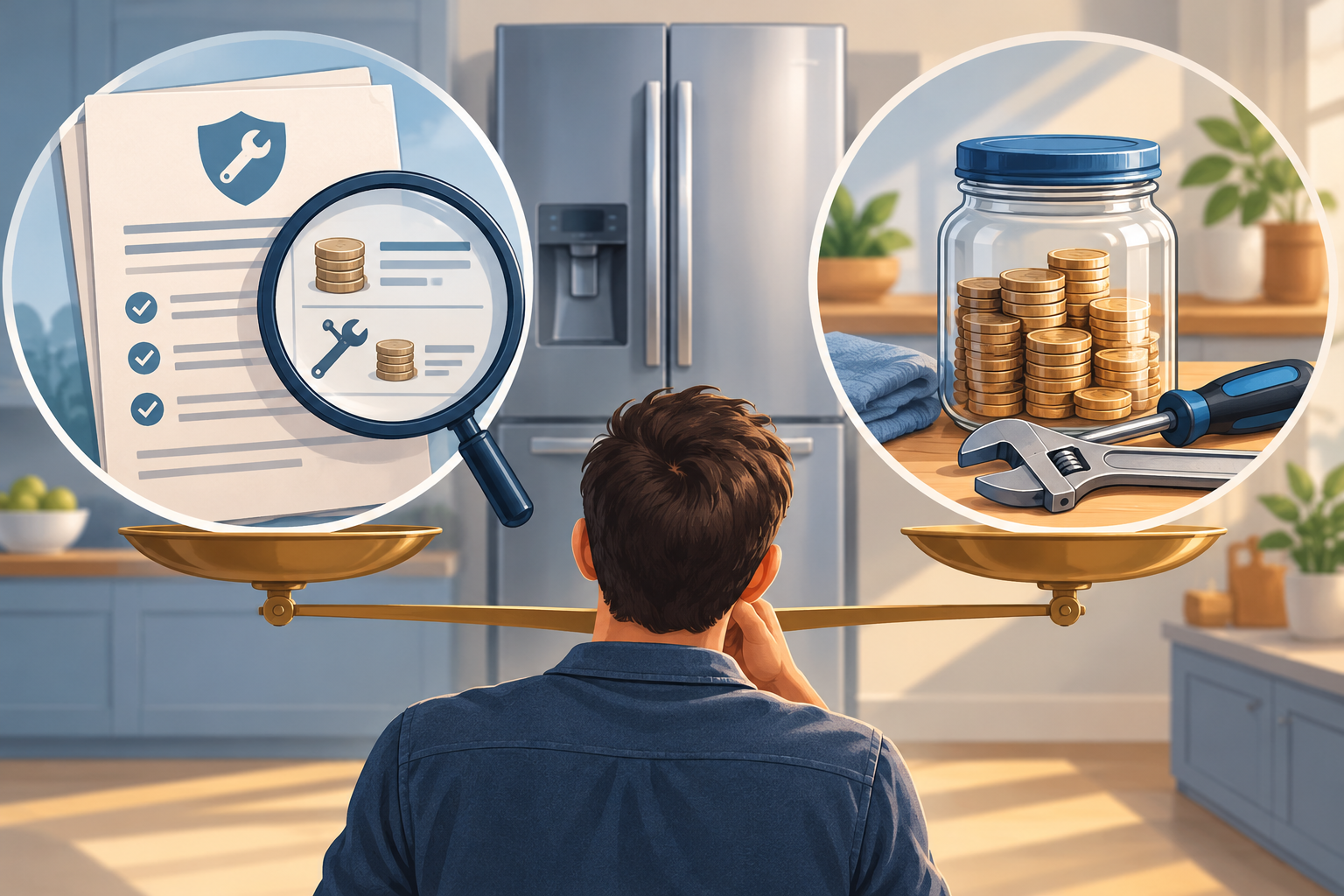
An appliance extended warranty or service contract is worth considering only when its extra coverage is clear, usable, and valuable for the appliance you actually own. It is not automatically a good deal because the appliance has electronics or because the seller presents the plan at checkout. Compare the contract price with likely repair exposure, deductibles, service fees, exclusions, claim limits, and the alternative of keeping a repair fund.
Warranty and service contract are different
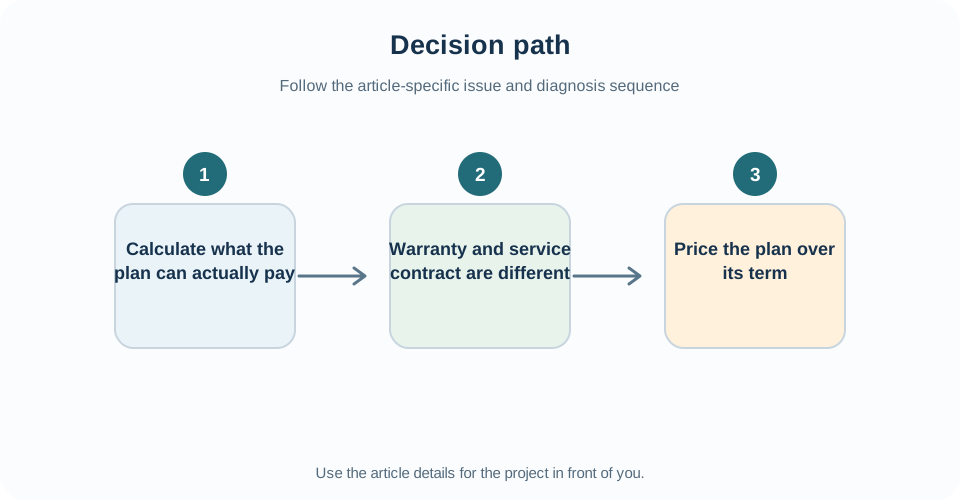
A manufacturer warranty may come with the appliance at no separate charge. An extended warranty or service contract costs extra and may be sold by the manufacturer, retailer, or another provider. The paid contract may begin after the included warranty, overlap it, or cover different parts and failures.
The Federal Trade Commission advises reading the exact coverage and checking whether the plan offers something beyond the included warranty. A plan that starts while the original warranty is active may provide less immediate value than its sales pitch suggests. Confirm the start date, end date, provider, appliance identity, and claim method.
Price the plan over its term
Record the purchase price, term, monthly or annual equivalent, deductible, service fee, shipping charge, inspection fee, and any limit on reimbursement. A plan that costs $240 for three years is $80 per year before a claim fee. That calculation does not mean the plan will pay $240 in repairs; it simply makes the commitment visible.
Ask whether the contract pays the technician directly or reimburses you. Check whether a service visit consumes a claim allowance, whether the provider can replace the appliance instead of repairing it, and how the replacement value is calculated. A “no-cost repair” can still involve a deductible, a trip fee, a limit, or a restricted provider.
Read exclusions carefully
Look for exclusions involving cosmetic damage, accidental damage, misuse, pre-existing conditions, wear, consumables, filters, racks, seals, hoses, glass, batteries, software, maintenance, corrosion, pests, water damage, and unauthorized modifications. The word “comprehensive” does not tell you whether the failed part is covered.
Check maintenance conditions. A contract can require proof that the appliance was maintained according to the manual. Keep receipts, service records, model information, and photographs. Do not assume that a service plan transfers when a home or used appliance changes owners; transferability is contract-specific.
Evaluate the provider and claims process
The value of coverage depends on the company that must arrange or pay for the repair. Identify the legal provider, not only the retailer’s brand. Ask who chooses the technician, whether the provider serves your area, how long approval takes, and what happens if the first repair does not solve the problem.
Check contact methods and complaint history using appropriate consumer-protection resources. Be cautious about unsolicited calls or messages saying that an appliance warranty is expiring. The FTC warns that high-pressure offers may come from companies unrelated to the manufacturer or retailer and may request personal or financial information before showing the contract.
Match coverage to the appliance
A service contract may be more relevant for a built-in refrigerator, premium wall oven, induction range, or complex laundry pair than for an inexpensive countertop product. It may also be less useful when the appliance has a long included warranty, inexpensive common repairs, strong local service, or a known replacement path.
For refrigerated appliances, check whether the contract covers compressor, sealed-system, refrigerant-related, and labor costs separately. For washers, dryers, and dishwashers, check tubs, bearings, pumps, controls, leaks, and labor. For ranges and cooktops, check glass, heating elements, ignition, electronics, and safety hardware. Do not infer coverage from an appliance category name.
Use repair probability carefully
Online specialist sources report broad U.S. repair ranges, but those figures do not establish how often your model will fail or how much a Canadian repair will cost. There is no reliable universal expected-value calculation without assumptions about failure probability, covered scope, repair prices, and the contract’s behavior.
Make a simple scenario table instead:
- no covered repair during the term;
- one ordinary covered repair;
- one major covered repair;
- a failure excluded or capped by the contract;
- a replacement required after repeated repair attempts.
Subtract the contract’s payment from the cost the plan would actually cover, then include premiums, fees, exclusions, and the value of your time. The result is a model, not a prediction.
Consider self-insuring
The FTC identifies setting aside money for future repairs as an alternative. A repair fund keeps the money available if the appliance never fails, but you carry the risk of a large repair early in the term. A service contract transfers some risk but may cost more than the repairs it covers and may restrict the provider or outcome.
Self-funding works better when you can absorb a repair, the appliance is common and serviceable, and the contract has narrow coverage. Paid coverage may feel more valuable when a failure would cause serious disruption, the appliance is difficult to replace, or a known expensive component is genuinely covered without a low reimbursement cap. “Feel” is not enough; verify the terms.
U.S. and Canadian legal limits
The FTC guidance is U.S. consumer information. It does not establish Canadian provincial consumer law, cancellation rights, transferability, implied warranties, or remedies. In Canada, the manufacturer warranty is generally included with the appliance while a paid extended agreement costs extra; warranty coverage and duration vary. Coverage may begin at purchase or delivery, and improper installation, misuse, or unauthorized repair can affect coverage. Read the exact warranty and service-contract terms and check the relevant provincial or territorial consumer-affairs resource. A credit card may also extend some purchase protections, so check its terms before buying duplicate coverage.
The same provider can offer different terms by market, retailer, product, or date. Keep the contract that applies to your purchase, including amendments and claim instructions.
Check for coverage that already applies before paying for an additional plan. Québec’s good-working-order warranty covers listed new appliances bought or leased from a merchant on or after October 5, 2026, for five years from delivery for washers, dryers, and dishwashers and six years for ranges, refrigerators, freezers, air conditioners, and heat pumps; the regulator says it transfers on resale, subject to product and legal conditions. In North Carolina, a covered home-appliance service-agreement company must disclose in writing before sale that its agreement is not required to purchase or finance the appliance; statutory exceptions apply. The FTC’s July 2024 release describes staff warning letters to eight companies, including concerns about parts or provider restrictions. Those letters are warnings, not final adjudications, and do not decide the terms of an individual warranty. Compare the exact invoice, included warranty, applicable statutory coverage, paid contract, and any remaining gap before buying.
Warning signs
Slow down when the salesperson will not provide the full terms, the plan is described as “everything covered” without exclusions, the provider is unclear, the price is hidden in financing, the contract starts before the included warranty ends, cancellation is not explained, or the offer arrives through an unsolicited urgent call.
A plan that requires routine maintenance is not necessarily bad, but the requirement should be realistic and documented. A plan that excludes the parts most likely to fail may not protect the decision you are trying to protect.
A decision checklist
Before buying, compare the included warranty, paid-plan term, total premium, fees, deductible, exclusions, covered parts, repair limits, provider, claim process, transfer and cancellation rules, and expected replacement cost. Ask what would happen if the appliance were unrepairable. Compare those terms with a dedicated repair fund and the appliance’s age, condition, use, and replacement difficulty.
An extended warranty is not a guarantee of lower ownership cost. It is a risk-transfer product. Buy it only when the specific coverage solves a specific financial or disruption risk that you understand and are willing to pay to transfer.
Calculate what the plan can actually pay
Start with the total amount paid over the contract term: purchase price, deductibles, service fees, shipping, diagnostic charges, and any required maintenance. Then list the covered failures and the limits on each claim. A plan can look inexpensive until a service fee is charged on every visit, a part is capped, or the provider chooses repair when the household expected replacement.
An expected-value calculation can organize the questions, but it cannot predict a particular appliance’s failure. For a rough scenario, compare the plan’s total cost with the repair and replacement costs the household could realistically face during the term. Run a low-use case with no claim, a middle case with one covered repair, and a high-cost case with a denied, capped, or replacement-level failure. Keep the result qualified because the probability, coverage decision, and future price are uncertain.
The plan is more relevant when a repair would create a serious cash-flow problem, local service is available, the appliance is costly to replace, and the contract covers the failure modes that matter. It is less compelling when the appliance is inexpensive, the plan duplicates the included warranty or a credit-card benefit, the provider is difficult to reach, or the exclusions remove the likely repair.
Read the transfer, cancellation, and claims terms
Find the exact rules for moving, selling, canceling, renewing, and filing a claim. Ask whether the plan follows the appliance or the original purchaser, whether a cancellation refund changes over time, and whether the provider can require an authorized technician. Check whether cosmetic damage, misuse, consumables, filters, installation problems, power events, water damage, and maintenance conditions are excluded.
Save the receipt, model number, warranty, service records, and any denial explanation. Those records may be needed to compare a second repair quote or challenge an incorrect assumption.
Match the plan to the replacement path
Compare the plan with a repair fund and with the cost of replacing the appliance if the covered failure occurs. A plan on a refrigerator may be more consequential than a plan on a low-cost countertop appliance because the replacement project can involve food loss, delivery, water connections, fit, and disposal. A plan on a built-in unit may protect against a larger project but can still be poor value if the provider cannot service the exact model.
Do not buy coverage merely because the salesperson names a likely failure. Ask what the contract pays, who decides the remedy, what the household pays at each visit, and how the claim affects future coverage. The useful comparison is the contract’s actual protection against the household’s actual exposure.