
When a home needs more work than the available budget can cover, rank the decisions by consequence and dependency. A cosmetic project may be visible, but an active leak, unsafe electrical condition, structural movement, or failing essential service can create a larger loss if it waits.
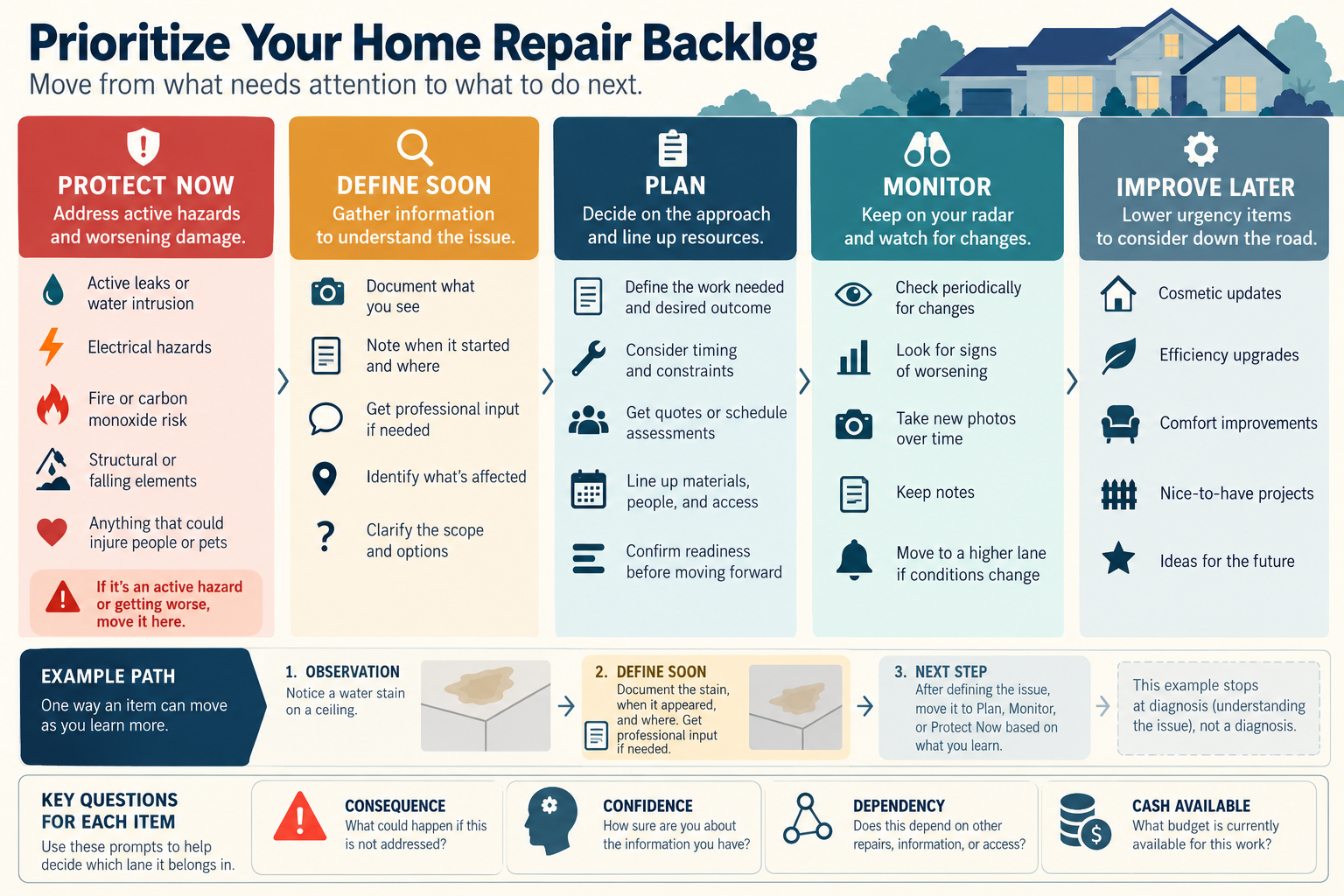
The name of a defect is not enough to determine its priority. A qualified assessment may be needed before you know whether a condition is urgent, repairable, or part of a larger system problem.
Use a consequence-first order
Begin with the following questions:
- Could someone be injured or exposed to a serious health or fire hazard?
- Is water, sewage, weather, or another source actively damaging the property?
- Is an essential service or safe occupancy at risk?
- Is there evidence of structural movement or failure that needs prompt professional evaluation?
- Will delay make an expensive assembly, finish, or neighboring system harder to repair?
- Does a verified insurance, financing, occupancy, or transaction condition change the timing?
- Is the work preventive, comfort-related, efficiency-related, or cosmetic?
This sequence is a triage framework, not a diagnosis. Do not classify a particular crack, smell, leak, or noise as safe or unsafe from a general article.
Build a backlog that can be acted on
For every item, record the observed condition, affected area, source of the information, urgency question, likely specialist, dependencies, planning cost, and consequence of delay. Give it a next action such as “protect,” “diagnose,” “obtain scope,” “price,” “monitor,” or “phase.”
Separate an observation from a repair assumption. “Water staining at the ceiling” is not yet a complete roofing, plumbing, or restoration scope. “Aging furnace” is not proof that replacement is immediately required. The next useful step may be a focused inspection rather than a broad construction quote.
Consider compounding damage
Preventive work can deserve priority when it protects a more expensive assembly or avoids repeated access. Roof drainage, water entry, drainage failures, untreated moisture, and deteriorating exterior protection are examples where the cost of delay may grow. The actual mechanism and condition determine the risk.
Freddie Mac connects regular upkeep with preventing costlier problems and recommends planning for known major purchases. That does not mean every maintenance task has a guaranteed financial return. Compare the cost of the work, the likelihood and consequence of failure, and the evidence that the intervention will address the cause.
Stage work around dependencies
Sequence work so that one project does not damage or strand another. Diagnosis may come before demolition. Structural or moisture correction may come before finishes. A permit, design, or engineering decision may come before construction. Temporary protection may be needed while funds are accumulated.
Ask whether an inexpensive repair would be wasted if a larger replacement is likely soon. Conversely, do not reject a safe, useful repair solely because replacement might eventually be considered. The remaining life, reliability, access, and household timeline matter.
Make a budget under constraint
Split the backlog into:
- Now: active danger, active damage, essential service, or conditions whose delay has a credible high consequence.
- Next: work that protects an assembly, supports a planned project, or has a known planning window.
- Later: maintenance that can be scheduled safely, efficiency or comfort improvements, and cosmetic work.
Use local quotes for defined work and ranges for uncertain work. Keep emergency liquidity separate from a replacement reserve. If cash is limited, document what is being deferred and the trigger that would move it into the next stage.
Do not let the backlog encourage unsafe DIY work or postponement of gas, electrical, structural, fire, health, sewage, active-water, or habitability hazards. Seek appropriate professional help and local authority guidance where required.
For work that can safely be planned, checking assistance may be useful, but record the program’s current intake, approval status, eligible scope, required contribution, timing, and property obligations. Do not move an active hazard or worsening condition to a later stage because an application or waiting list might fund it. The assistance guide covers verification; the funding comparison covers alternatives for a defined repair.
Revisit the list after each inspection, repair, major weather event, insurance change, or household change. A shorter list is not automatically a better plan; a defensible sequence that protects people and property is the useful result.
Give every backlog item a status
Use a small table rather than one undifferentiated list:
| Status | Meaning | Next action |
|---|---|---|
| Protect now | Active hazard or damage is occurring | Follow the appropriate emergency or qualified response |
| Define soon | The consequence may be material but the cause or scope is uncertain | Obtain diagnosis, inspection, or specialist opinion |
| Plan | Work is known but can be scheduled | Obtain a scope, quote, and timing plan |
| Monitor | No current evidence requires immediate work | Set a review date and condition that would escalate it |
| Improve later | Discretionary or cosmetic work | Fund only after higher-consequence needs are covered |
The labels do not diagnose a system. They make the information gap visible. A cracked finish may be cosmetic, a symptom of movement, or the result of a completed repair. A stain may be old or active. A name alone cannot safely determine priority.
Consider consequence, not just cost
The cheapest item is not always the best first item. Consider whether delay could affect life safety, essential services, active water or weather entry, structural stability, habitability, expensive adjacent materials, insurance, financing, or a time-sensitive ownership event. Then consider the confidence that the condition is present and the cost of getting a better diagnosis.
An expensive replacement may rank below a small source-correction repair if the repair prevents larger damage. A visible cosmetic defect may rank below a hidden condition that can worsen. A routine maintenance task may rank higher than a discretionary upgrade when the task protects an expensive assembly.
Sequence dependencies
Some work must happen before other work can be priced or completed. A source of moisture may need correction before damaged finishes are restored. Structural assessment may precede a finish repair. Testing may precede hazardous-material disturbance. Design or permits may precede construction. Note the dependency and avoid spending on downstream finishes that will have to be removed again.
For each priority, record the prerequisite, responsible professional, expected scope, and evidence needed to close the item. If the work depends on a lender, insurer, association, utility, or local authority, verify the responsibility instead of treating an informal recommendation as a binding rule.
Score the backlog without pretending to diagnose it
For each item, make four separate judgments: consequence if it worsens, confidence that the condition is present, cost of a better diagnosis, and cost or disruption of the likely intervention. Use words such as high, medium, and low rather than inventing precise risk scores. An expensive item with low confidence may need an inspection before it outranks a smaller, confirmed source-correction repair.
A useful backlog entry might read: “Ceiling stain, source not confirmed; protect area, obtain roofing or plumbing diagnosis, review after next rain.” That is more actionable than “repair ceiling.” Once the source is defined, split the entry into source correction, damaged-material restoration, testing, and any follow-on work.
Recheck the list when a new report, quote, weather event, occupancy change, insurance request, or failed temporary measure changes the facts. The priority order should follow the home’s actual exposure and the cost of delay, not the visual prominence of the defect or the order in which contractors happen to call back.
When cash is limited, document what is being deferred, why, what protective action is still needed, the next review date, and what would change the decision. This helps a homeowner discuss the tradeoff with a qualified professional and prevents a forgotten backlog item from becoming an emergency by default.
The resulting plan may include work in stages: stabilize, diagnose, correct the source, restore, and then improve. It should not encourage a homeowner to delay gas, electrical, structural, fire, health, sewage, active-water, or habitability hazards. Prioritization is a way to allocate attention and money responsibly, not a substitute for an appropriate safety response.
Add a review trigger to every deferral
“Revisit later” is too vague for a backlog. Give each deferred item a date or event that will reopen it: the next heavy rain, a seasonal change, an inspection, a warranty deadline, a change in occupancy, or the completion of a prerequisite. Record the protective step that remains in place and the signal that means the condition can no longer wait.
Separate a deferral caused by low confidence from one caused by insufficient cash. The first may need diagnosis; the second may need staging, a lower-risk temporary measure, or a change in the ownership plan. Neither should be represented as solved. If new evidence raises the consequence or confirms active deterioration, move the item up even when the original budget has not changed.
At each review, close items that were corrected, split items whose scope is now clearer, and remove duplicate entries. A clean backlog makes the next professional conversation more efficient and reduces the chance of paying for a downstream finish before the source or dependency has been addressed.
Keep a short explanation for the order: consequence, confidence, dependency, and available cash. When someone asks why a visible repair is waiting, the record should show whether it is being monitored, needs a diagnosis, or lost a budget decision to a higher-consequence condition.