
Routine maintenance is expected. An emergency repair is uncertain, urgent, or both. A major-system replacement is foreseeable but expensive. Treating all three as one savings target makes it difficult to know what money is available when a failure occurs.
The right structure depends on your income, property, insurance, debt, and risk. It does not require a single universal reserve amount.
Give each fund a job
| Fund | Intended use | Typical timing |
|---|---|---|
| Routine maintenance | Scheduled service, cleaning, supplies, and small upkeep | Known or recurring |
| Home repair reserve | Unexpected but property-specific repairs | Uncertain; often urgent |
| Replacement reserve | Known future roof, HVAC, water-heating, or other major work | Planned over a multi-year window |
| General emergency fund | Job loss, medical costs, transportation, and other household shocks | Unrelated to one property |
| Insurance deductible reserve | The amount you may need to pay before a covered claim responds | Event-dependent and policy-specific |
An insurance policy is not a replacement for repair savings. Coverage depends on the cause, policy wording, exclusions, deductible, limits, and claims process. Predictable maintenance-related deterioration may be treated differently from sudden covered damage.
Do not combine unrelated guidelines
Fannie Mae suggests a U.S. maintenance-budget rule of thumb that includes repairs and replacements and separately encourages an emergency fund. CMHC’s homeowner guidance identifies five percent of take-home pay as an illustrative guideline for emergencies in general. Those figures measure different things. Neither is a universal home-repair reserve formula, and they should not be added together or treated as competing requirements.
Use any published figure as a starting question: What costs does it include? What property, market, household, and time period does it assume? Then replace the assumption with your own spending history and known exposures.
Build the reserve around actual risk
List the property conditions most likely to create a cash shock:
- a system with unknown age or repeated failures;
- active water, drainage, or moisture concerns;
- a home that cannot remain safely occupied during a repair;
- difficult access or a remote location;
- severe climate exposure or seasonal freeze risk;
- a large insurance deductible or coverage limitation;
- several major systems approaching the same planning window.
For each item, write the earliest reasonable response, a low and high planning scenario, and how much cash would be needed before work could begin. Do not use a generic reserve number to imply that an undiagnosed structural, electrical, gas, fire, health, or habitability issue is financially safe to defer.
Use a staged plan when funds are limited
If you cannot fund every ideal bucket, prioritize in this order:
- Protect people and stop active damage.
- Keep essential services and safe occupancy in view.
- Fund recurring maintenance that prevents a larger likely loss.
- Build a replacement reserve for the most expensive or consequential known systems.
- Replenish emergency cash after an unexpected repair.
- Delay discretionary improvements until the basic exposure is understood.
This is a planning sequence, not a diagnosis of any named defect. A qualified professional should assess high-consequence conditions.
Replenish after use
After using the home repair reserve, record what happened, whether insurance or warranty applied, what the permanent scope became, and whether the event reveals a larger replacement need. Replenish the reserve gradually rather than pretending the next repair is unlikely because one has just occurred.
Keep a separate record for a major replacement. If you use replacement savings to fund an emergency, restore that future obligation in the revised plan. Avoid double-counting the same dollars as both available emergency cash and committed replacement money.
Make the fund practical
Automated savings can help, but the amount should remain compatible with essential household expenses and expensive debt. A small regular contribution, a documented priority list, and an early diagnostic can be more useful than an impossible target that causes every repair to be deferred.
Review the fund after a purchase, major renovation, insurance change, new occupant, or system replacement. A home repair reserve is a decision tool: it should make the next safe action possible without pretending that every future cost can be predicted.
Size the buckets without double-counting
Write down which dollars are genuinely available today and which are already committed. Money reserved for a known roof replacement is not fully available for a surprise appliance failure. A general emergency fund may be needed for a job loss or medical event at the same time as a home repair. An insurance deductible is available only if the event is covered and the policy responds.
Use separate labels even when saving in one account. For each bucket, state:
- the event it is intended to cover;
- the earliest date it may be needed;
- whether it must be liquid;
- whether insurance, warranty, or another party might contribute;
- what happens to the plan if the money is used elsewhere.
This prevents a homeowner from treating a large but restricted replacement reserve as protection against every short-term shock.
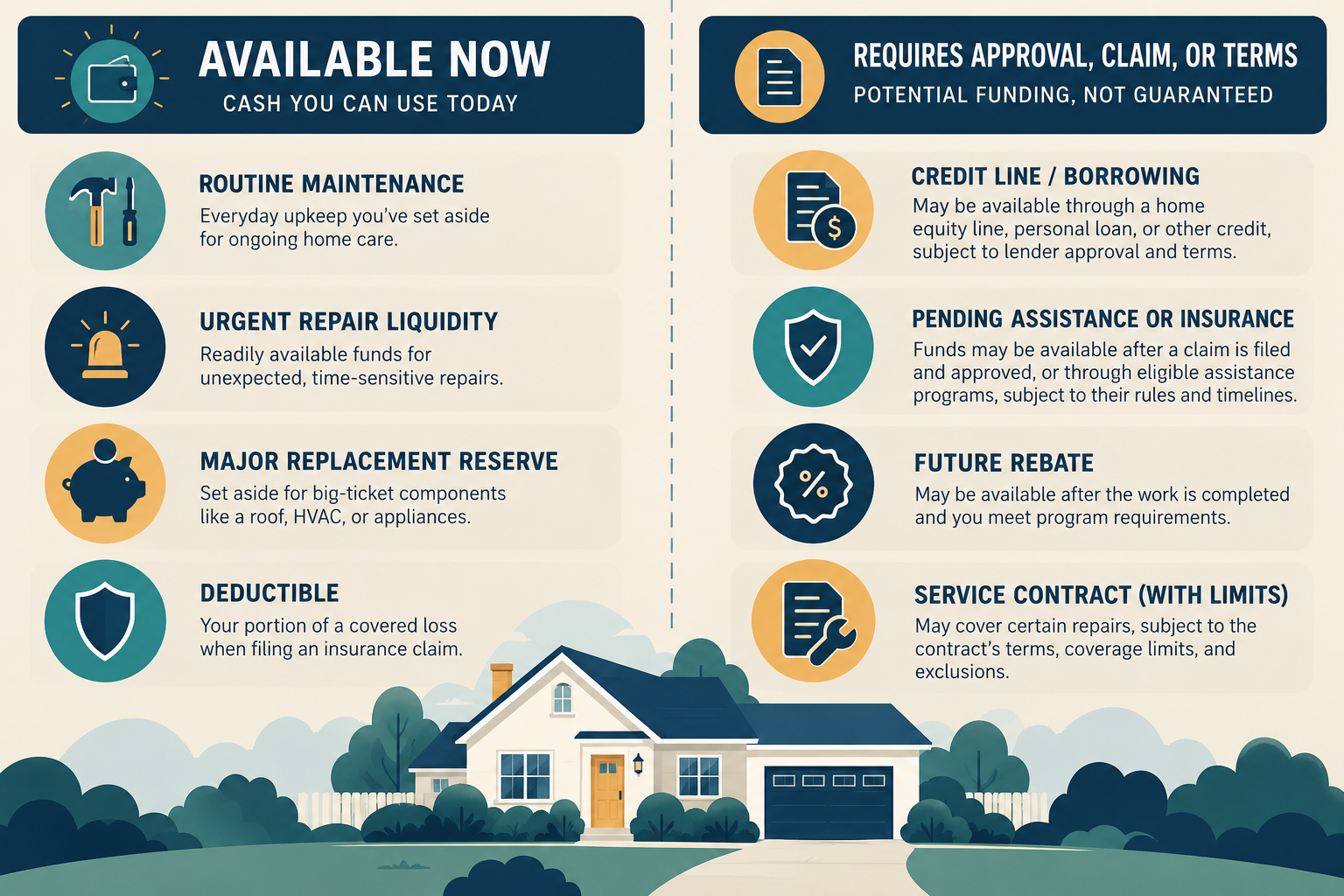
Also separate cash you can use today from resources that require another step. An unused credit line is borrowing capacity, not savings. A grant application, insurance claim, or rebate is not available cash until the responsible organization confirms the amount and timing. A paid service contract may reduce some covered costs, but its fees, exclusions, service charges, and limits leave exposure that still needs a plan. Use the repair-funding comparison for a defined job, the assistance checklist for a possible award, and the service-contract comparison before treating coverage as part of the reserve plan.
Build a low, likely, and high view
For routine maintenance, estimate the recurring amount from records and service schedules. For emergency repairs, list the most consequential plausible events and the first safe response, not a fictional average. For replacement reserves, estimate a planning range from current local quotes and the scope that is actually known. For each, record what would make the amount larger: difficult access, hidden damage, related upgrades, taxes, permits, temporary accommodation, or a second trade.
The high view is not a prediction. It shows whether the home is exposed to a cost that cannot be handled from current cash. That may lead to an inspection, phased work, insurance clarification, or a change in the ownership plan. It should not lead to unsafe delay or a promise that a reserve amount makes an unknown condition harmless.
Rebuild after a draw
When the fund is used, divide the event into immediate response, permanent repair, and future prevention. Record the cause, what was covered, what the homeowner paid, and whether the repair changes the replacement calendar. If the repair did not resolve the source, do not close the event merely because the first invoice was paid.
Replenishment can be staged. Fund the next critical exposure first, then restore routine maintenance and longer-term replacement savings. If the household cannot replenish everything at once, make the tradeoff explicit and seek qualified advice for high-consequence conditions. Avoid borrowing or relying on a claim payment until the terms, cost, and timing are actually known.
Choose the next dollar when the reserve is small
When funds cannot fill every bucket, protect the most consequential exposure first. Keep enough accessible cash for an urgent repair or temporary protection, continue any essential routine maintenance that prevents active damage, and record known replacement needs separately even if the contribution is small. Do not call a planned replacement a surprise simply because it was not funded.
Ask what can be reduced without making the home unsafe: a discretionary upgrade, cosmetic work, an optional service, or a project whose scope is not yet defined. Do not postpone an active leak, gas or electrical concern, structural instability, fire or health hazard, loss of essential service, or another worsening condition merely to preserve a savings target.
After a draw, note the cause, what it prevented, and whether the event changes the maintenance or replacement plan. Replenishment is easier when the fund has a defined job and the homeowner knows whether the next expense belongs to routine upkeep, emergency liquidity, a deductible, or a capital replacement.
Recalculate the buckets after buying or inheriting a home, a major renovation, an insurance-policy change, a new occupant, a climate event, or a change in household income. The first-year plan may need more liquidity because the home’s history is incomplete. A recently completed replacement may reduce one exposure but create warranty and maintenance responsibilities.
There is no universal amount that makes a homeowner financially safe. The useful result is a clear separation between predictable upkeep, unexpected repair liquidity, major replacement planning, household emergencies, and policy deductibles, with a practical sequence for the money available now.
Make the reserve easy to use under pressure
Write the withdrawal rule before an emergency happens. Define which events qualify, who can approve a transfer, what documentation to keep, and when the reserve will be reviewed afterward. The rule can be simple: protect people and stop active damage first, obtain qualified advice where needed, and separate temporary stabilization from the permanent repair decision.
Keep the accessible portion of the fund in a form that can be used when a bank transfer, deductible, temporary accommodation, or urgent service call is required. Do not count restricted investments, expected insurance proceeds, a contractor’s promise to bill later, or a future tax refund as cash already available. If another account is intended to cover one of those items, label it separately.
After a draw, record the amount that remains and the exposure it no longer covers. That makes replenishment specific: restore emergency liquidity, rebuild a known replacement reserve, or fund the next diagnostic step. A reserve is more useful when its limits are visible than when one large number suggests protection against every possible home cost.