
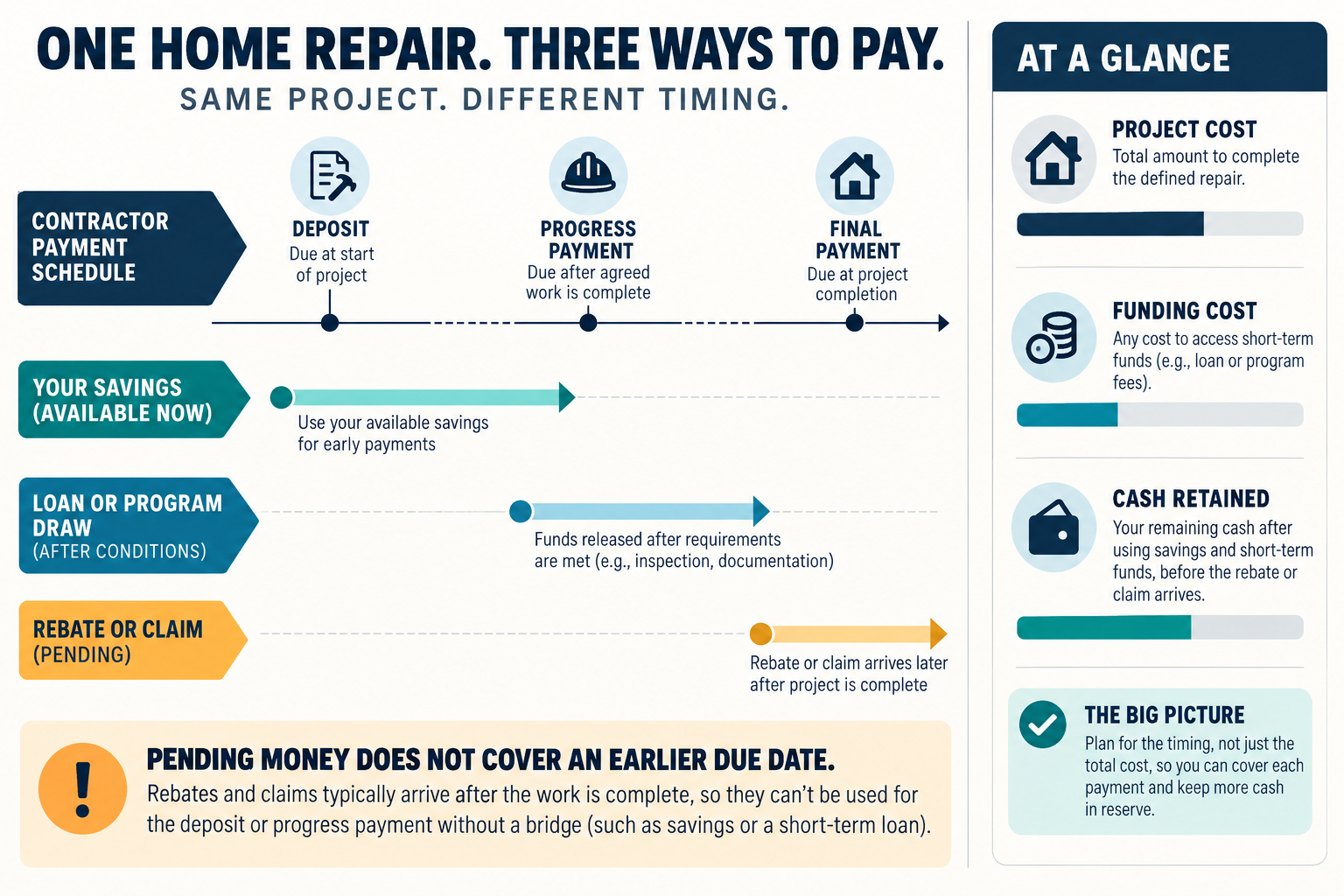
Once the needed work and a realistic budget are defined, decide how the money will be available when invoices are due. A repair can be affordable on paper and still be difficult to fund if a deposit is due before a loan draw, program approval, or rebate. Compare the project’s full cost, the cost and timing of funding, and the cash you need to keep for other household and property risks.
This is a comparison method, not a recommendation to borrow or a ranking of products. Rates, fees, eligibility, tax treatment, and repayment depend on your actual offer and location.
Define the repair and its payment dates first
Start with a signed or clearly scoped proposal. Include the contractor’s price, taxes, diagnosis, permits, access, disposal, restoration, owner-arranged work, and a reasonable allowance for unresolved scope. Then copy the proposed deposit, material payments, progress milestones, and final payment into a calendar.
Mark each amount as one of these:
| Status | What it means for the budget |
|---|---|
| Cash available now | Money you can use without another approval or repayment, after protecting essential household expenses and other known repair needs |
| Approved and accessible | A lender or program has confirmed the amount and the release conditions can be met on the required dates |
| Conditional or pending | An application, credit limit, program inquiry, rebate, claim, or tax benefit that still needs approval, documentation, or time |
| Not available | An option that does not fit your eligibility, contract, property, timing, or repayment capacity |
Do not treat a possible award or an unused credit limit as the same thing as money already available for a contractor’s deposit. If a benefit is paid later, budget for the invoice before subtracting it.
Compare the main paths
| Path | What it can do | Questions to answer before relying on it |
|---|---|---|
| Use savings | Avoids a new loan payment and may make invoices simpler | How much liquid cash remains for living costs, deductibles, and another repair? Is any savings already reserved for a known replacement? |
| Use an approved assistance program | May reduce the owner’s share or provide a specific loan or approved service | Who administers it, what work qualifies, when may work start, who receives the money, and what contribution or property obligation remains? |
| Unsecured borrowing | Provides funds without using the home itself as collateral | What are the actual fees, rate, payment, term, total repayment, and early-payment rules? Does the disbursement arrive before the contractor’s due date? |
| Secured borrowing | May make a larger amount available against home equity | What is the collateral, total borrowing cost, payment variability, fees, draw timing, and consequence if you cannot repay? Could the home be at risk? |
| Reduce or stage the scope | May spread cash needs across time | Does a qualified professional say the smaller phase is safe, functional, and complete enough? Will repeated mobilization, temporary protection, or remobilization add cost? |
Each path can include more than one product. The contract and lender documents control. A monthly payment alone does not show what the repair will cost to finance over the full term.
Separate loan structures and their risks
A home-equity loan generally provides a lump sum; a home-equity line of credit (HELOC) generally permits repeated draws up to a limit. A HELOC often has a variable rate, so its payment and total interest can change. These are functional descriptions from U.S. consumer guidance; the Canadian Financial Consumer Agency also explains that products, fees, repayment, and security vary. Review the actual offer and local rules before comparing them.
For any borrowing offer, write down:
- net funds you will receive after fees;
- fixed or variable rate and when it can change;
- required payment, term, and total scheduled repayment;
- appraisal, legal, setup, annual, or early-exit charges;
- collateral and any effect on the property title;
- restrictions on draws, invoices, contractor, or eligible work;
- what happens if the project ends early or costs more than expected.
For a simple comparison, use the lender’s disclosed total repayment and add any fees not already included. Compare that with the net proceeds actually available for the project. Do not infer a rate from a program maximum or assume that a lower monthly payment means a lower total cost.
Some arrangements marketed as home-equity investments or contracts are not ordinary loans. The homeowner may receive money now in exchange for a future amount linked to the home’s value or another settlement formula. The CFPB has described risks including complex costs and possible effects on the property or a future sale. Read the actual contract and get qualified advice before treating a no-monthly-payment offer as cost-free or equivalent to a HELOC.
Protect the cash you still need
Using savings has no scheduled loan repayment, but it reduces the money available for another repair, a deductible, essential expenses, or a period of reduced income. Before transferring funds, decide the minimum liquid amount you will retain and which other dollars are already committed to a major-system replacement or household emergency.
Borrowing can preserve cash initially while adding a payment and total financing cost. Assistance can help when approved, but an award may be limited to a defined scope, provider, or payment sequence. A staged project can reduce the first invoice but may add repeat setup, temporary protection, or price risk. Compare all of those effects over the time you expect to own the home.
Keep three totals separate:
- Project cost: the complete work and owner-side costs.
- Funding cost: fees, interest, repayment, or property obligations required to obtain money.
- Cash retained: money left for household needs and other property risks after the project is paid for.
An eventual incentive or reimbursement belongs in a separate scenario until eligibility and timing are confirmed. See rebates and tax credits for the cash-flow calculation and repair assistance for verifying a program.
Match funding to contractor milestones
Put each funding draw beside the contractor milestone it is expected to cover. A lender may require an invoice, inspection, or other evidence before releasing money. A program may require approval before work begins. A later reimbursement cannot pay a deposit that is due today unless you have another confirmed source for that cash.
Ask the contractor to show which payment is due for materials, completed work, testing, or closeout. If the funding conditions do not line up, ask whether the schedule can be adjusted, whether a different approved route is available, or whether a professionally appropriate smaller phase can proceed. Do not sign a schedule that depends on money that has not been approved and released.
Use a one-page decision worksheet
For the repair you are considering, record:
| Item | Your figure or answer |
|---|---|
| Full project budget and uncertainty | Quote, taxes, owner costs, and what remains unknown |
| Cash needed by each date | Deposit, progress milestones, closeout, and any bridge period |
| Savings used | Amount spent and cash retained afterward |
| Assistance or incentive | Administrator, written status, eligible work, conditions, and expected date |
| Borrowing offer | Net proceeds, fees, rate, term, total repayment, security, and payment schedule |
| Staged option | Defined phase, safety/functional assessment, added mobilization, and future obligation |
| Decision trigger | What would make you change the funding or scope plan? |
If the numbers are not yet comparable, the next step may be to define the project, request a written funding offer, confirm program rules, or ask a qualified professional whether staging is appropriate. No national comparison establishes a universally cheapest route for every U.S. or Canadian homeowner.