
Repair-versus-replace is not decided by one ratio that works for every roof, appliance, pipe, heating system, or structural assembly. A repair may be sensible when it restores a sound system at a manageable cost. Replacement may deserve study when failures recur, parts or compatibility are uncertain, remaining service is limited, or the repair would create a larger follow-on project.
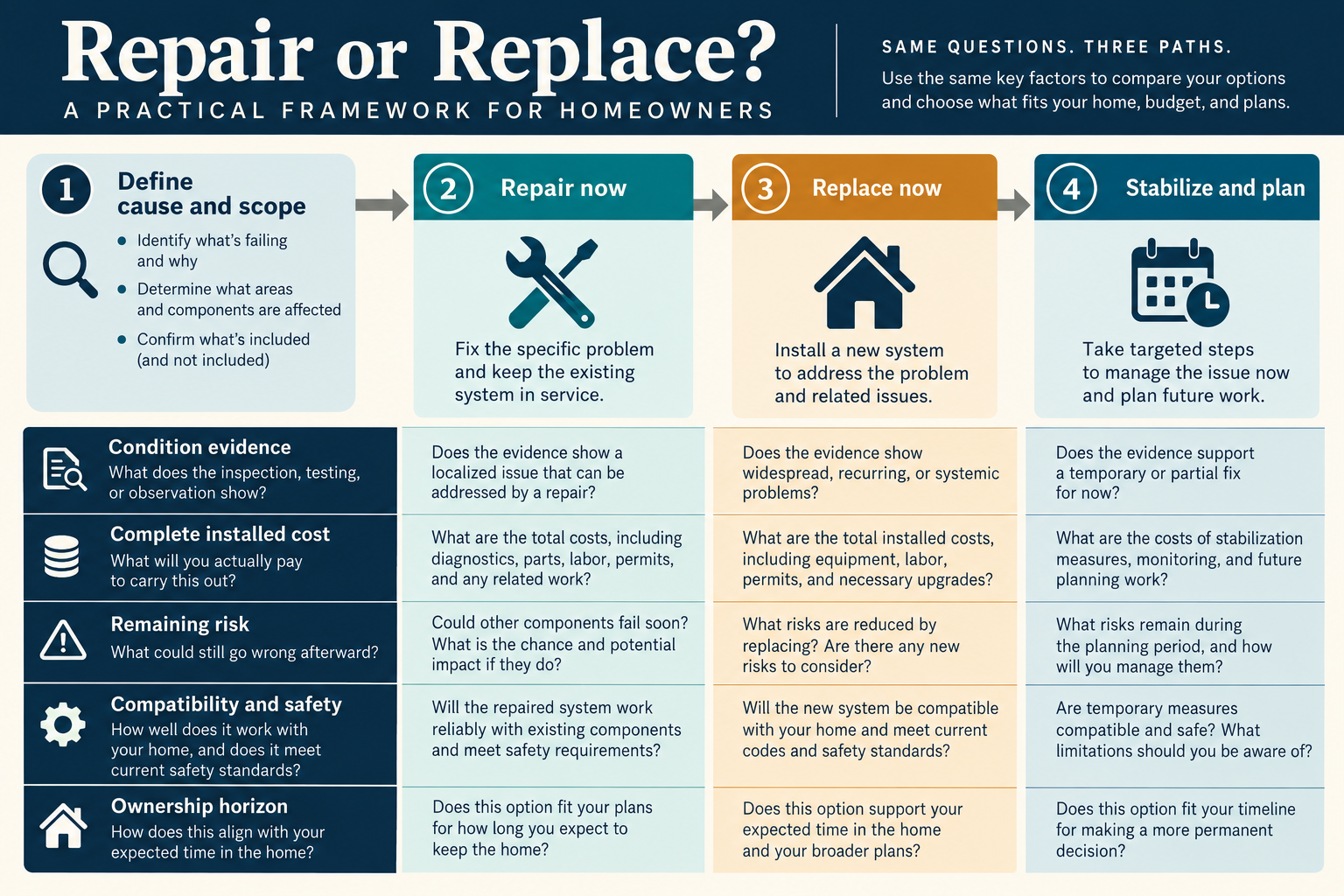
Start with a qualified diagnosis and a complete installed replacement scope. Then compare options over the time you expect to own the property.
Put the decision on one page
| Question | Repair | Replace |
|---|---|---|
| What is known? | Is the cause and scope defined? | Is the complete replacement scope defined? |
| Condition | Will the remaining assembly support the repair? | Does the existing condition make replacement more reliable? |
| History | Is this an isolated failure? | Are failures recurring or spreading? |
| Future use | Does the repair fit your ownership horizon? | Does the new system fit future plans and property capacity? |
| Total scope | Are access, testing, restoration, and related work included? | Are removal, permits, connections, commissioning, and closeout included? |
| Risk | What could remain unresolved? | What new compatibility or construction risk is introduced? |
The table does not replace a system-specific assessment. It prevents the visible repair price from being compared with an incomplete replacement number.
Count more than today’s invoice
For the repair option, consider the repair price, diagnosis, temporary protection, repeat service, remaining life, likely future failures, and damage if the repair does not hold. For replacement, include removal, disposal, access, associated infrastructure, design or permits, testing, finish restoration, operating changes, and warranty terms.
Compare the likely total over the ownership horizon, not just the first payment. A lower-cost repair can be rational when the system is otherwise sound and the homeowner expects to move soon. A higher-cost replacement can be rational when reliability, availability, or a planned renovation makes the broader work timely. Neither conclusion is universal.
Treat age as context, not a verdict
Chronological age can indicate that a system deserves inspection or reserve planning, but it does not prove failure or establish a replacement deadline. Maintenance, installation quality, climate, use, previous alterations, and condition can matter more.
Repeated repairs may be evidence of a pattern, but the pattern still needs interpretation. A series of unrelated low-consequence repairs is different from one recurring failure that leaves the home exposed to damage or unsafe operation.
Check safety and compatibility first
Safety, code, manufacturer requirements, and technical compatibility can override a purely financial comparison. A replacement may require a service upgrade, structural support, ventilation, drainage, controls, or other related work. A repair may be unsafe or ineffective if it leaves a hazardous underlying condition.
Use the relevant specialist for electrical, gas, structural, fire, environmental-health, water, or other high-consequence questions. Do not publish or rely on a general repair-versus-replace rule as permission to bypass those assessments.
Check existing coverage before choosing the work
If a system has a manufacturer, builder, workmanship, or separately purchased service contract, read its actual terms before comparing repair and replacement as if all costs were yours or all costs were covered. Check what failure is covered, whether a condition or maintenance exclusion applies, any service fee or payout cap, who selects the repair provider, the authorization process, response expectations, and how the contract treats repair versus replacement. Confirm approval before scheduling work when the agreement requires it. Keep cash for the deductible, excluded work, capped amounts, and work outside the contract. This does not establish that a contract is worthwhile; the contract-versus-reserve guide addresses that separate decision.
Compare scenarios instead of using a “50% rule”
Make at least three scenarios:
- Repair now: known cost, likely remaining service, and the next review point.
- Replace now: complete installed cost, disruption, warranty, and related work.
- Stabilize and plan: safe temporary work, diagnostic cost, reserve building, and a later replacement decision.
For each scenario, record the best-case and adverse-but-plausible outcome. Include financing cost, loss of use, energy or water use where supported, and the cost of an unsuccessful repair. A model-specific or system-specific savings claim needs evidence; do not assume a newer product pays for itself.
Use the homeowner’s horizon
The right option depends partly on how long you expect to own the home, whether a sale or renovation is near, how much disruption you can tolerate, and whether a future project will expose the same assembly. A buyer, long-term owner, landlord, and seller may rationally choose different options after reviewing the same condition.
The decision is ready when the cause, scope, full cost, remaining exposure, and safety boundaries are visible. If they are not, spend the next dollar on better definition rather than pretending an unsupported percentage can decide for you.
Build comparable repair and replacement cases
Do not compare a repair invoice with an equipment-only replacement price. For each option, include:
- diagnosis and design;
- removal, disposal, access, and protection;
- installation, connections, permits, testing, and commissioning;
- finish restoration and work by other trades;
- maintenance, warranty, and likely follow-up;
- disruption, temporary service, and carrying costs;
- remaining risk after the work is complete.
The repair option may preserve the existing system but leave a recurring failure, compatibility issue, or short planning horizon. The replacement option may solve the immediate problem but trigger capacity, code, structural, finish, or coordination work. Write both scopes at the same level of completeness before judging the totals.
Ask what evidence favors each path
Repair tends to deserve closer consideration when the cause is defined, the surrounding assembly is sound, the part is available, the system has useful remaining performance, and the repair does not create a new compatibility or safety problem. Replacement deserves closer consideration when failures are recurring, the condition is broadly deteriorated, essential parts or support are unavailable, the repair leaves a short or uncertain planning window, or a replacement materially changes the ownership economics.
These are decision factors, not universal rules. A single failure does not prove that a system should be replaced. A cheap repair does not prove that it should be made. Ask the qualified professional to distinguish the observed condition, the repair’s expected purpose, and what remains unknown.
Include the owner’s horizon
A long-term owner may value reliability, operating cost, warranty, and reduced disruption later. A seller may prioritize a safe, credible, documented solution without funding a broad upgrade. A buyer may need to understand lender, insurance, or transaction effects. A landlord or shared-property owner may face responsibility boundaries. The same repair-versus-replace facts can lead to different choices because the time horizon and authority differ.
Do not treat resale value, efficiency, or a warranty as guaranteed financial return. Use them as scenario inputs and ask what evidence supports the expected benefit. If a replacement is likely to be followed by a renovation or capacity upgrade, coordinate the decisions rather than paying twice for access or finish work.
Use a comparable-options worksheet
Write the repair and replacement options in parallel. For each, record the immediate price, diagnosis, access, removal or preparation, related work, permits or testing, warranty, disruption, expected remaining exposure, and the next likely decision. Then add the owner’s horizon and any reason the property may change before the option’s expected life is used.
| Decision question | Evidence to request |
|---|---|
| Is the cause known? | Observations, tests, and limitations of the diagnosis |
| What will the repair restore? | Defined outcome, parts, labor, and remaining weak points |
| What does replacement require? | Complete installed scope, compatibility, connections, and closeout |
| What happens if the option fails? | Response time, secondary damage, warranty, and temporary plan |
| What could change the choice? | Inspection result, quote, future project, ownership horizon, or safety finding |
If the repair option is inexpensive but likely to require the same access again, include that cost. If replacement brings a new capacity or compatibility question, include the professional assessment before comparing totals. The right answer may be a safe repair followed by reserve planning rather than an immediate all-or-nothing choice.
If the cause is not established, pay for an appropriate diagnostic before choosing between broad repair and replacement. If a repair requires opening a concealed assembly, define the stop point, unit price, or authorization rule. If the replacement scope depends on site conditions, request a proposal that states the assumptions and exclusions.
Keep a short record of the decision: condition, alternatives, complete cost range, expected remaining exposure, time horizon, safety or code questions, and the event that would trigger reassessment. A multi-factor framework is more reliable than a rule that replaces a system when a repair reaches a fixed percentage of a new installation.
Put a stop point around hidden conditions
When work may uncover concealed damage, define what the contractor may do without another approval and what requires a new scope. Ask for the unit price or pricing method for investigation, the evidence that would support expansion, and the temporary protection available if the work pauses. This applies to both repair and replacement; a new system can still require unexpected access, disposal, or related correction.
Do not compare a repair invoice with a replacement headline price. Include diagnosis, preparation, removal, connections, permits or inspections where applicable, testing, restoration, cleanup, taxes, warranty, and the likely next service event. If an item is not included, label it as an assumption or range. The comparison becomes more useful when each option reaches the same defined endpoint.
Once the stop point is reached, update the worksheet with the new evidence and decide again. A staged repair can be a sound choice when it controls the immediate risk and buys information; it should not become an open-ended series of invoices without a reassessment date.