
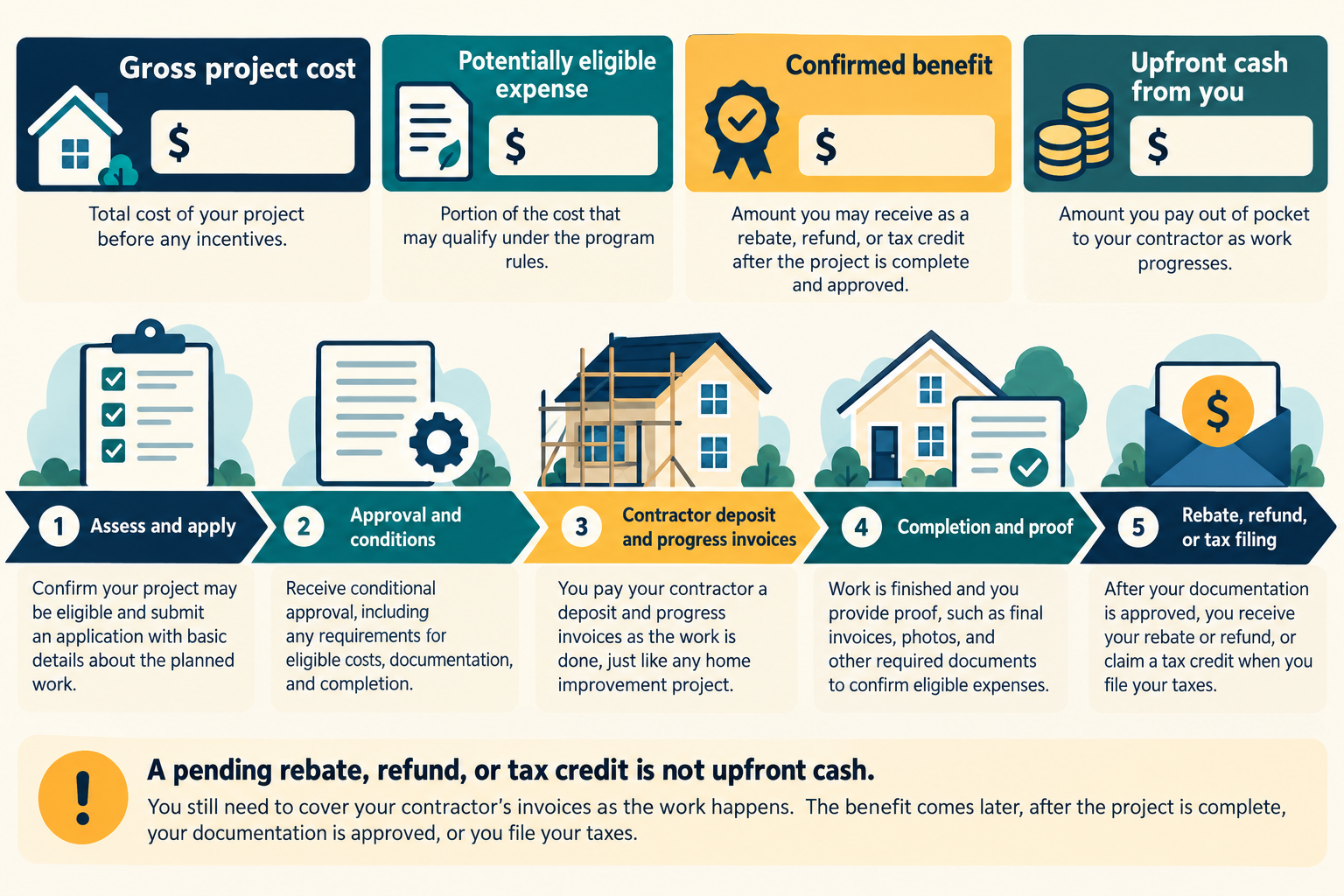
An advertised rebate or tax credit can make a project appear cheaper than the amount you must pay to get the work done. Before approving a contractor’s schedule, separate the gross project price from the expense that might qualify, the benefit that has been confirmed, the cash due up front, and the date any money could arrive.
Program rules and tax treatment change. This is a project cash-flow framework, not tax-return advice or a catalogue of current incentives. Verify current terms with the program administrator or tax authority for the year and work involved.
Separate five amounts
| Amount | What to include |
|---|---|
| Gross project cost | Contractor scope, taxes, assessment, permits, enabling work, owner-arranged costs, and unresolved items |
| Eligible expense | The specific measure, product, labour, or other calculation base accepted by the program |
| Potential benefit | The amount produced by the actual formula, subject to approval and household eligibility |
| Upfront cash need | Deposit, progress payments, final invoice, application costs, and any amount due before review |
| Eventual net outlay | Gross cost less the benefit actually received, plus financing costs and non-eligible work |
Do not subtract a headline maximum from the quote. A benefit may apply only to part of a project, require an assessment or approved provider, have a cap, or depend on a tax return and household circumstances.
Identify what kind of benefit is offered
The word “rebate” is used for different payment paths. Identify the mechanism before entering a number in your budget:
| Mechanism | When it may affect cash | What to verify |
|---|---|---|
| Point-of-sale discount | Reduces a specified invoice if the seller applies it | Eligible product, seller participation, limits, and whether it is already in the quote |
| Rebate or reimbursement | Often follows purchase, installation, inspection, or proof of payment | Application deadline, required documents, inspection, eligible amount, and expected processing |
| Loan or financed incentive | May provide funds now but requires repayment | Net proceeds, fees, rate, term, security, payment, and eligible scope |
| Tax credit or deduction | Usually determined through the applicable tax process | Tax year, eligibility, calculation base, refundability, filing requirements, and household tax position |
| Insurance-premium refund | Uses an insurance premium or policy calculation rather than the contractor’s price | Eligible insured borrower, qualifying work, application deadline, and paid invoices |
A refundable tax credit and a non-refundable credit can have different effects. A refundable credit may produce a payment under the applicable rules; a non-refundable credit generally reduces tax otherwise payable and may not provide the maximum value to every household. Verify the current rule for your situation rather than assuming the advertised maximum becomes cash.
Put the conditions in writing before work starts
Ask the program administrator or tax authority:
- what property, homeowner, contractor, product, and project conditions apply;
- whether an assessment or application must be approved before work begins;
- whether the eligible amount uses the full project price or only selected expenses;
- whether materials, labour, taxes, permits, or related work are included;
- whether the benefit is capped, refundable, transferable, or subject to household limits;
- what proof of payment, model information, photos, inspection, or completion record is required;
- how incentives interact, and whether the same expense may be claimed more than once;
- the filing or application deadline and when funds can realistically arrive.
Keep a written response or the exact current program terms with the quote. A contractor’s estimate of your tax benefit is not an eligibility decision. If rules are unclear, have a qualified tax professional or program administrator review the facts before you rely on the amount.
Build the timeline around the invoice
List each date the project may require money:
- assessment, design, or application cost;
- approval or program reservation, if required;
- contract deposit and special-order materials;
- progress payments and required inspections;
- completion, commissioning, and final invoice;
- submission of receipts and other proof;
- expected rebate, refund, or tax filing date.
Then mark what happens if the benefit is delayed, reduced, or denied. Can you make the contractor payments from confirmed cash or an approved loan? Will the project still fit the household budget without the expected reimbursement? If not, resolve that gap before signing, ask whether the scope can be phased appropriately, or wait for a written funding decision if it is safe to do so.
| Scenario | Budget treatment |
|---|---|
| Confirmed and paid at purchase | Reduce only the invoice amount actually discounted |
| Approved, paid after completion | Keep the full payment schedule in the upfront cash plan; show the approved payment separately |
| Application pending | Budget the project without the benefit until a decision is made |
| Reduced or denied | Show how the remaining gross cost will be paid and whether the project is still feasible |
For borrowing or retained-cash choices, use the funding comparison. For an assistance program that may provide approved repair funds, see how to verify grants and loans.
Examples of different calculation bases
Current programs illustrate why the exact calculation matters. The CMHC Eco Improvement page describes a conditional refund of part of the mortgage insurance premium for qualifying CMHC-insured borrowers and work. That is not a percentage rebate on the renovation price. Confirm the current eligibility, qualifying expenses, deadline, and documentation before including it.
Tax-year boundaries matter too. The IRS Energy Efficient Home Improvement Credit page currently limits the credit to qualifying improvements made through December 31, 2025; do not budget it for work placed in service in 2026 based on an older promotion. The consulted Canada Revenue Agency home accessibility expense page is for the 2025 tax year. It does not establish eligibility for expenses in a later year. Check the rule for the year your expense is incurred.
Regional energy programs also have their own prerequisites. Ontario’s Home Renovation Savings Program lists selected rebate routes and conditions; the current administrator’s terms, assessment sequence, and eligible work control. A displayed maximum is not a quote reduction or a promise that the homeowner will receive that amount.
Keep the records that support the actual claim
Save the original quote, itemized scope, assessment, approval, contractor and product details, invoices, proof of payment, permits, inspection results, photographs, and completion documents. Store the program’s written decision and payment confirmation with the repair record. If the work changes, ask whether the change affects eligibility before authorizing it.
At project closeout, record the gross cost, the eligible amount the administrator accepted, the benefit approved and received, any financing fees, and the remaining out-of-pocket amount. If the benefit does not arrive as expected, update the reserve rather than continuing to count it as available cash.