
Preventive maintenance pays for an inspection, service, adjustment, cleaning, or replacement before a failure. Run-to-failure means accepting that an item will be repaired or replaced when it stops working. Neither strategy is always cheaper. The choice depends on the likelihood of failure, how effective the maintenance is, the cost of the task, and what happens if the system fails at the wrong time.
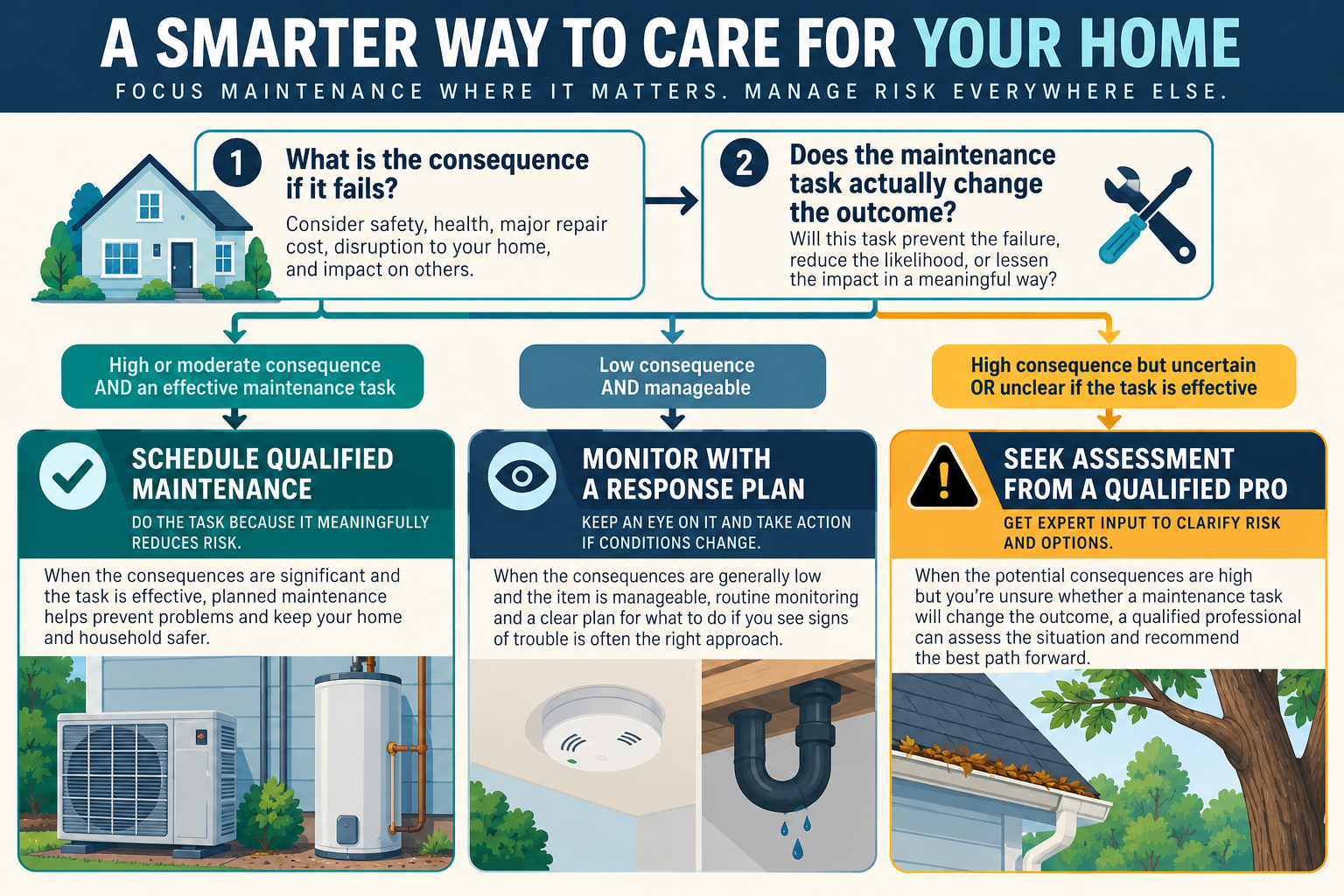
Start with the consequence of failure
Preventive attention deserves more weight when failure could:
- threaten life safety, fire safety, health, or secure occupancy;
- cause active water, sewage, freeze, or weather damage;
- interrupt heating, cooling, water, power, or another essential service;
- damage an expensive connected assembly;
- require emergency access, temporary accommodation, or a second mobilization;
- be difficult to repair because parts, labor, or weather windows are limited.
These are consequence questions, not diagnoses. A generic maintenance article cannot establish that a particular system is safe to ignore or that a named task will prevent a specific failure.
When run-to-failure can be reasonable
Accepting failure may be rational for a low-cost, noncritical, accessible item when the repair is straightforward, replacement parts are available, and the failure will not cause secondary damage. The homeowner should still understand the inconvenience and keep a small response plan.
Run-to-failure is a poor fit when a component is hidden, failure is sudden, the home cannot remain safely occupied, or the consequence grows while a contractor is being found. “It has not failed yet” is not evidence that failure will be inexpensive.
Check the maintenance itself
Ask:
- What does the manufacturer or qualified professional actually require?
- Does the task diagnose a developing condition, preserve a component, or merely improve appearance?
- What is the cost of the service and any related access or shutdown?
- What evidence shows that the task changes failure risk or life?
- Could an incorrect service action create damage or invalidate a warranty?
- What is the safe alternative if the task cannot be completed on schedule?
Use manufacturer instructions and qualified providers for safety-sensitive equipment. Do not invent service intervals or assume that a generic checklist applies to every model, climate, or installation.
Compare the expected cost without false precision
For preventive maintenance, include the service, access, parts, testing, downtime, and any follow-on repair it identifies. For run-to-failure, include the likely repair or replacement, emergency response, consequential damage, temporary protection, and inconvenience.
The probability of failure is rarely known precisely. Use a low, expected, and high scenario instead of claiming that maintenance guarantees a saving. A maintenance task can be valuable because it preserves safety or reduces uncertainty even when its financial return cannot be calculated.
Make a risk-based list
Divide household items into:
- Protect now: safety, active damage, essential service, or high-consequence conditions.
- Schedule: recurring work that preserves a system or reduces a credible failure exposure.
- Monitor: low-consequence items where observation and a response plan are sufficient.
- Replace or redesign: items whose maintenance cost, failure pattern, or compatibility problem points to a broader decision.
Keep records of service, symptoms, parts, warranties, and recommendations. The record can show whether repeated maintenance is solving the problem or simply postponing replacement.
Do not delay an active hazard or worsening water, gas, electrical, structural, fire, health, or habitability condition to wait for a cheaper appointment. Cost management starts with safe containment and an appropriately qualified assessment.
Preventive maintenance is most defensible when it addresses a defined risk and fits the manufacturer’s or professional guidance. Run-to-failure is most defensible when the consequence is limited and the response is genuinely manageable. Revisit the choice as the home’s condition, occupants, climate, and budget change.
Evaluate the consequence of failure
For each system or task, ask what failure would affect:
- life safety or exposure to gas, electricity, fire, structural instability, or hazardous conditions;
- water entry, freeze damage, sewage, or damage to adjacent assemblies;
- heating, cooling, water, sanitation, access, or another essential service;
- the availability of parts, a qualified technician, or an acceptable temporary option;
- the household’s ability to absorb an emergency visit, disruption, or replacement.
The same maintenance cost can be reasonable for one property and poor value for another. A low-consequence item with easy replacement may be allowed to run to failure. A neglected task that protects an expensive or safety-critical assembly may deserve earlier attention even when the immediate financial return is difficult to measure.
Ask whether maintenance changes the outcome
Not every paid service prevents a failure. Confirm what the task is intended to inspect, clean, adjust, test, or document, and what condition would cause a follow-up repair. Manufacturer instructions, qualified trade guidance, climate, use, and system design control technical recommendations. Do not turn a general maintenance schedule into a universal requirement for every model.
When possible, compare the maintenance cost with the cost and consequence of the failure it is meant to reduce. Include the chance that the task will reveal a separate repair, the cost of access, and whether the service is effective for this condition. A maintenance visit that finds a developing problem may still be valuable even if it does not prevent every failure, but do not claim a guaranteed payback without evidence.
Make run-to-failure a managed choice
Run-to-failure should not mean “ignore it.” For a low-consequence item, keep a replacement part or budget, know who can respond, and recognize the signs that make the choice unsafe. Record the expected disruption and whether a failure could affect another system. If the item is in a difficult location or replacement requires a long lead time, the apparent low cost may be misleading.
Similarly, preventive maintenance should not mean servicing a component indefinitely after repeated failures or obsolescence. A pattern of repairs may move the decision toward diagnosis, replacement planning, or a different system. The choice should be reviewed when the repair history, property use, occupants, weather exposure, or available budget changes.
Test the assumption and review the result
For a preventive task, state what change you expect: a condition found earlier, a failure avoided, a component kept within its required operating condition, or simply a record that supports a warranty or insurance conversation. After the task, record what was actually found and whether the recommendation changed. This prevents a recurring service from continuing automatically after it stops adding useful information.
For a run-to-failure choice, write the response plan before failure occurs. Identify the replacement or repair path, likely lead time, temporary measure, and signal that makes the item no longer low consequence. If a spare part is difficult to obtain or the system requires a narrow seasonal window, the cost of waiting may be higher than the invoice suggests.
Review both choices after a failure, major repair, change in occupants, severe weather, or change in household cash flow. The goal is a managed risk decision that can be revisited, not a permanent label attached to a system.
Create three groups: tasks required by a manufacturer or qualified professional; tasks that protect against a meaningful, property-specific consequence; and optional tasks whose benefit is uncertain. Schedule the first group as appropriate, investigate the second, and price the third against other ownership priorities. Keep records of dates, findings, invoices, warranties, and recommendations so the next decision is based on the home’s history rather than memory.
Never use a maintenance-versus-failure calculation to delay an active gas, electrical, structural, fire, health, sewage, water, or habitability hazard. Safe containment and qualified assessment come first. The economic framework is for choosing how to manage defined risk, not for granting permission to wait on an undiagnosed dangerous condition.
Make the choice visible to the next owner or provider
Record the system, model or location if known, current condition, last service, recommendation, expected consequence of failure, and response plan. Note whether the choice depends on a warranty, a seasonal operating window, a spare part, a specialist, or access that is currently available. A clear record reduces the chance that a future homeowner or contractor repeats an unnecessary service or misses a known exposure.
Review the choice when the system’s role changes. A low-consequence appliance may become important if it supports a vulnerable occupant or a critical room. A previously difficult repair may become easier when another project opens the same area. Conversely, a maintenance task may be less valuable after a planned replacement is scheduled. Reassess the facts rather than defending the original label.
The goal is not to maximize maintenance or minimize invoices. It is to keep the consequence, evidence, response time, and remaining uncertainty visible enough that the next decision is deliberate.
Review the response plan before the season changes
For a system that may fail during a demanding season, check the provider’s availability, parts or replacement path, temporary measure, and household impact before choosing to wait. A run-to-failure decision is less attractive when a failure would occur at a time of limited response capacity or when a replacement requires conditions that are available only briefly.
Keep the plan proportionate. A low-consequence item may need only a note and a budget line; a critical system may need earlier diagnosis or replacement planning. The distinction should come from the property’s actual consequence and evidence, not from a blanket rule about maintenance frequency.