
Repair assistance can take the form of a grant, a repayable loan, a deferred or potentially forgivable loan, reimbursement after work, or a project delivered by an approved provider. The name of a program does not tell you which form applies to your household or whether it can pay a contractor on time. Confirm the current terms with the organization that administers the application before you rely on it.
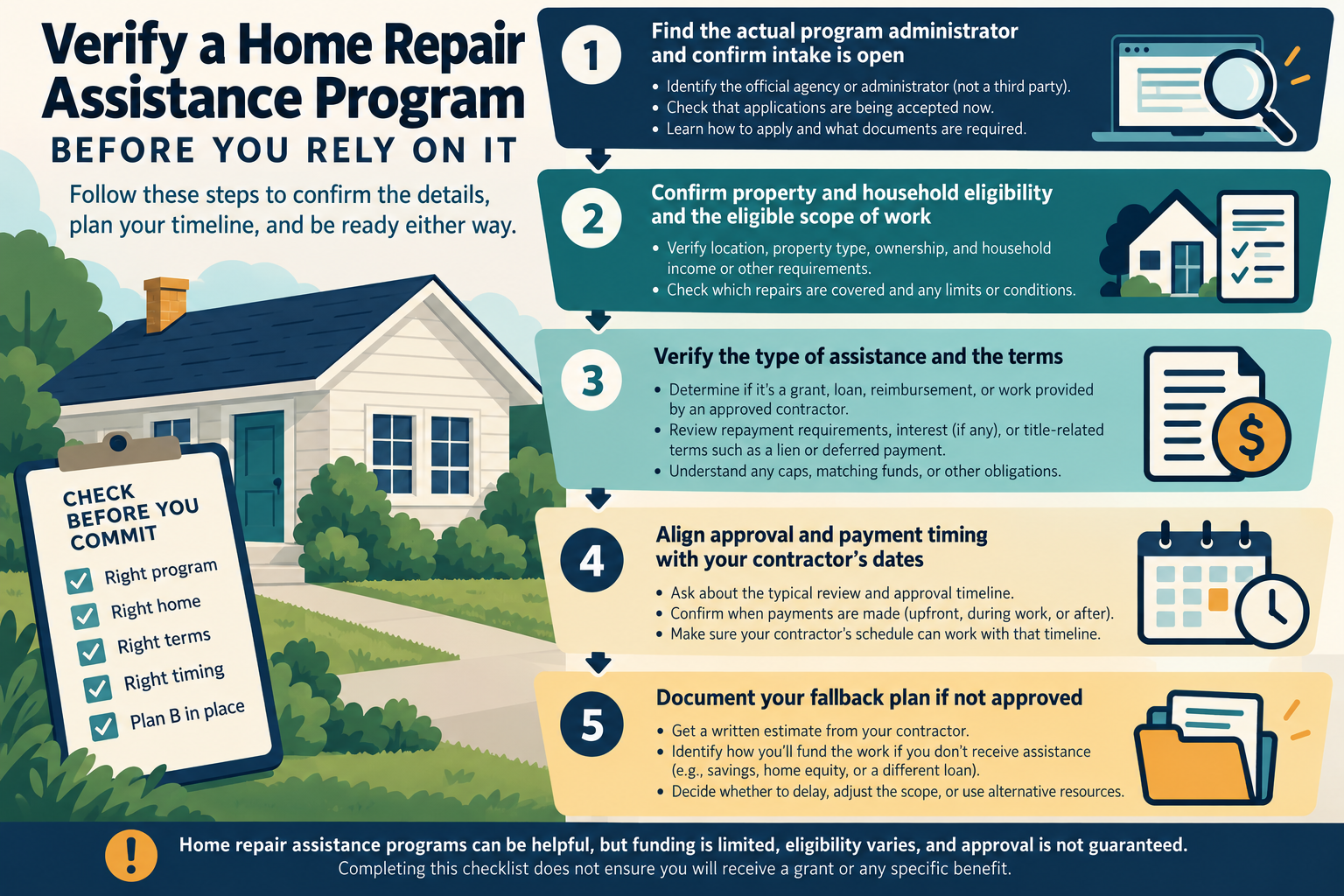
This article is a verification method, not a list of every U.S. or Canadian program and not a promise that an applicant will qualify. A public listing is a lead to investigate, not an award.
Define the need before searching
Write down the property’s location, ownership and occupancy status, the repair or adaptation, the current condition, the estimated cost, and when the work is needed. Include whether the issue is an active safety concern, active damage, or a planned project. This helps distinguish a repair program from disaster recovery, weatherization, accessibility, energy-upgrade, or mortgage-renovation funding that may have different rules and purposes.
For urgent hazards or worsening damage, arrange appropriate protection and qualified assessment without waiting for an uncertain application. Ask whether a temporary measure is safe and permitted; assistance timing does not establish that a condition can wait.
Find the administrator and current intake
Begin with a government or recognized housing-agency page, then follow it to the actual administrator and application channel. Check that the page applies to the property’s location and that applications are currently accepted. A federal overview may help identify state, provincial, municipal, tribal, Indigenous, or local programs, but the office that makes the decision has the controlling current terms.
For example, USAGov’s home-repair assistance guide directs readers to programs with different locations and eligibility. It also cautions that the federal government does not give individuals “free money” for home repairs. That overview helps with discovery; it does not determine an individual’s eligibility or show whether a local program has funds.
Use the administrator’s published phone number or secure application portal. Be cautious if an intermediary promises a guaranteed award, requests an unusual upfront fee, or asks you to send sensitive documents through an unverified channel. Confirm any contractor or application fee with the program itself.
Identify what the assistance actually is
Ask the administrator to identify the form of help in writing:
| Assistance form | Budget questions |
|---|---|
| Grant | Is it paid to you, the contractor, or another party? Is any contribution or condition attached? |
| Repayable loan | What is the rate, term, payment, fees, security, and total repayment? |
| Deferred or potentially forgivable loan | What events trigger payment, forgiveness, or repayment? Does sale, transfer, occupancy change, or refinance matter? |
| Reimbursement | Must you pay first? Which invoices, approvals, inspections, and proof of payment are required? |
| Approved work or provider service | Who selects the contractor, defines the scope, handles changes, and pays excluded work? |
These forms affect the cash you need, the timing, and obligations tied to the property. A “grant” label on a search result does not establish that all funds are a grant or that no repayment or document condition applies.
Check every eligibility and work condition
Ask the program to confirm the items that matter to your application:
- who may apply and who must own or occupy the home;
- income, age, disability, veteran, rural, property-value, or household requirements, if any;
- whether the repair, assessment, materials, and contractor qualify;
- whether a program inspection or professional diagnosis must happen first;
- whether work may start before written approval;
- whether a specific contractor or procurement process is required;
- what contribution, taxes, permits, or related work you must pay;
- what happens if the work uncovers a condition outside the approved scope.
Do not infer eligibility from a program name, a neighbor’s award, a published maximum, or a contractor’s assurance. Ask for a written decision or an exact list of the documents still needed.
Look for repayment and property obligations
Read the application agreement and any loan, lien, title notice, covenant, or repayment document before signing. Check the interest and fees, when repayment begins, whether payments are deferred, what triggers repayment, and how sale, transfer, refinancing, or a change in occupancy affects the obligation. If a term could affect title or a future sale, ask the administrator to explain it and obtain independent legal or financial advice where needed.
Program examples show why the form must be checked. The USDA Section 504 page for Nevada describes separate loan and grant conditions for eligible rural homeowners; its income, age, property, purpose, and funding limits do not establish a general entitlement elsewhere. Alberta’s SHARP program is a local example with distinct assistance forms, including a loan secured against the property for eligible applicants. Neither example represents every U.S. or Canadian program, and neither page establishes that a particular household qualifies.
Put approval dates beside contractor dates
An award can be useful but still arrive too late for the proposed payment schedule. Record each application, assessment, approval, contractor start date, deposit, progress payment, inspection, reimbursement request, and expected disbursement. Ask whether the program pays the homeowner or contractor and whether it pays before or after completion.
| Status | How to budget it |
|---|---|
| Searching or contacted | No money is committed; keep the full repair cost visible |
| Application submitted | Track the application, but do not count the amount as available cash |
| Approved with conditions | Record the exact scope, required documents, contribution, and release dates |
| Funds received or provider work authorized | Apply the confirmed amount only to the eligible work and date |
| Claim or reimbursement submitted | Keep the expense in the budget until payment is received |
If you need to bridge a deposit or pay for work outside the approved scope, compare the actual alternative and its cost in the repair-funding guide. Do not borrow on the assumption that a pending application will be approved.
Keep the decision record
Save the administrator’s current program page, application, written eligibility response, approved scope, contractor rules, agreement, payment instructions, receipts, inspection results, and completion documents. Record the staff contact and date for any verbal explanation and request written confirmation for a term that affects cost, timing, repayment, or title.
If the program is closed, the repair is excluded, or the timeline does not fit, note that clearly and choose another feasible path. The responsible decision is the one that shows what is approved, what remains conditional, what you must pay, and how urgent work will be handled safely.