
The first year after buying a home is a period of discovery as well as maintenance. The inspection, seller disclosures, service records, warranties, and your first seasons in the property can reveal different kinds of work. There is no universal first-year percentage because the result depends on condition, age, what the purchase price already accounted for, and whether major systems were recently replaced.
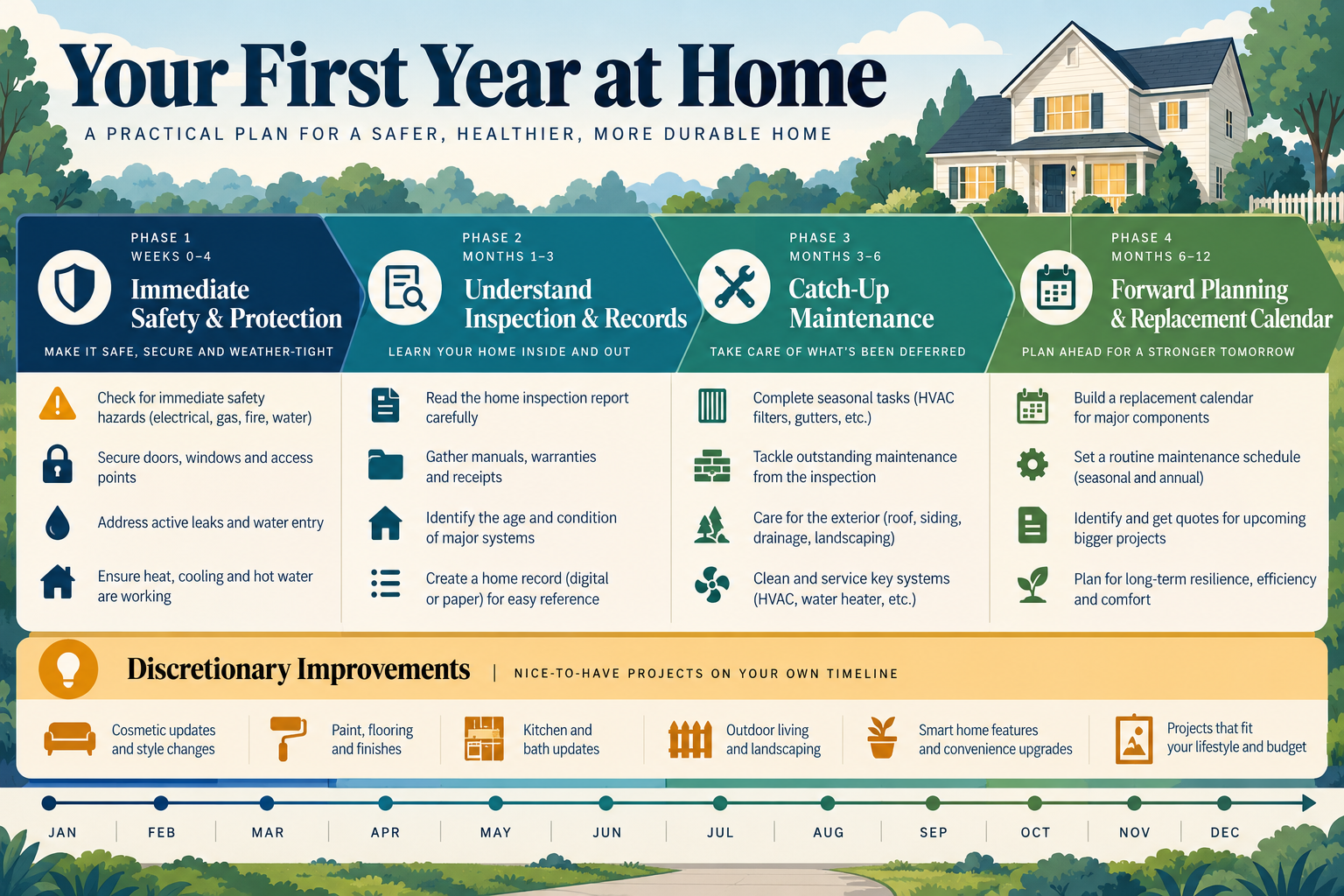
Build the budget in stages so urgent work does not compete invisibly with routine upkeep or a planned remodel.
Start with the inspection, but do not treat it as a quote
Sort the inspection report into:
- active safety, water, structural, health, or habitability concerns;
- essential systems needing prompt repair or specialist assessment;
- catch-up maintenance and conditions to monitor;
- aging components that belong on a replacement map;
- cosmetic improvements and owner preferences.
A general inspection identifies conditions within its scope; it does not establish every repair method or contractor price. Obtain a specialist assessment and comparable quotes for material items. The inspection-budget guide explains that translation step.
Fund the first actions
Set aside money for work that protects people and property, preserves essential service, or prevents active damage from spreading. Depending on the home, that may involve weather protection, water control, a qualified safety assessment, an urgent repair, or a temporary measure.
Do not use a move-in checklist as permission to disturb gas, electrical, structural, environmental-health, fire, or active-water conditions. Use qualified professionals and local requirements where the work demands them.
Create four first-year lines
| Line | Includes |
|---|---|
| Immediate stabilization | Urgent repair, safe temporary work, specialist diagnosis, or active-damage control |
| Routine ownership | Seasonal service, cleaning, filters, small repairs, and recurring maintenance |
| Replacement preparation | Assessments, current quotes, and savings for systems approaching a major decision |
| Discretionary work | Paint, finishes, layout changes, upgrades, and other improvements |
Keep a separate general emergency fund for job loss, medical costs, transportation, and other household shocks. A home repair reserve and an insurance deductible are not interchangeable with that general fund.
Check what the purchase did not reveal
Review the age and condition of the roof, heating and cooling, water heating, electrical service, plumbing, windows, drainage, exterior protection, appliances, and site systems. Record model information, warranties, prior repairs, maintenance instructions, and any access or permit constraint.
Locate the records behind those entries where possible: paid invoices, repair scope, permits or inspection results, maintenance notes, warranty terms, and any open service or repair commitment. Confirm what a warranty actually covers and whether its terms continue after a sale before treating a newly discovered cost as covered. A past invoice or missing record does not establish the system’s present condition. For a repair funding shortfall, see savings, borrowing, or a staged project; for an optional contract, see home warranty or repair reserve.
Your first winter, summer, heavy rain, or heating season may expose performance issues that were not obvious on inspection. That does not prove that the inspection was deficient; it may reflect limited inspection scope, a condition that was not active, or a system that needs a trade-specific assessment.
Avoid a universal first-year number
Fannie Mae offers a U.S. maintenance, repair, and replacement rule of thumb based on home value, while CMHC describes ongoing maintenance and operating costs for Canadian homeowners. These are planning context, not a first-year forecast and not a conversion method between markets.
Use local quotes and your property’s inventory. A newer home with recent replacements may have low near-term repair exposure but still need routine costs. An older or newly acquired home may require catch-up work and more diagnosis. The purchase inspection and actual records matter more than a generic target.
Build the replacement calendar
For each known future project, note the planning window, current condition, likely installed scope, amount already reserved, and consequence of delay. Save gradually for major systems rather than letting every known replacement become an emergency. Update the calendar after the first service visit or significant repair.
Do not start discretionary remodeling with every dollar that remains after closing. First learn the home’s systems, stabilize urgent conditions, and keep enough flexibility for a repair that could not reasonably be predicted.
Divide the first year into phases
The first months after closing are not all the same. A useful plan has at least four phases:
- Immediate safety and protection: address active hazards, loss of essential service, water entry, security, weather exposure, and conditions that can worsen.
- Understanding: review the inspection, confirm system ages, locate shutoffs and equipment records, and obtain specialist diagnosis for material findings.
- Catch-up maintenance: complete recurring work that was deferred or not documented, while separating it from discretionary improvements.
- Forward planning: set a maintenance budget, emergency reserve, and replacement map based on what the first months revealed.
The phases may overlap. A serious issue should not wait for the end-of-year review, and cosmetic work can wait until the condition is understood.
Make an inspection-to-budget map
For each inspection finding or new observation, record the condition, urgency, confidence, next professional, likely cost class, and time horizon. Separate a general recommendation from a verified defect. An inspector may identify a concern that needs a plumber, electrician, roofer, engineer, or other specialist before a useful quote exists.
Use ranges and scenarios for poorly defined work. Include diagnosis, access, permits, restoration, taxes, temporary protection, and related trades where they may matter. Do not add every line of an inspection report as an immediate repair. The value of a report is to help sequence decisions, not to turn maintenance observations into a single inflated total.
Do not confuse first-year cash with first-year cost
Some work may be needed during the first year because the property condition requires it. Some spending is simply a choice to renovate soon after purchase. Keep owner-selected upgrades separate from repair, maintenance, and stabilization. A new kitchen, landscaping project, or finish change can consume liquidity needed for a system with a known planning risk.
Also budget the costs around the repair: temporary lodging, storage, moving, utility changes, inspections, diagnostic fees, and time away from work. A project that looks affordable on a contractor quote may not fit the household’s first-year cash flow once disruption is included.
Turn the first year into a learning loop
At the start of each quarter, compare planned work with what the property actually revealed. Record the condition found, the scope completed, the cost paid, the time required, and any related work that became visible. Update the inspection-to-budget map instead of keeping the inspection report as a static list. A repaired leak may change the finish budget, the insurance record, and the maintenance calendar at the same time.
Use the first year to improve estimates, not to force every project into a deadline. If a system performs normally but its age or records are uncertain, inventory it and price the next information step. If an active or high-consequence condition appears, move it ahead of cosmetic work. If cash is constrained, show which work is funded, which is staged, and which remains exposed.
At year-end, compare actual costs with the provisional plan, move unresolved items into a dated sequence, and carry forward the updated inventory, warranties, local quotes, and replacement windows. This should make the second-year plan more grounded without implying that one year of ownership eliminates uncertainty.