U.S. cost guides place a professionally installed wood stove around USD $3,000–$8,000 for common projects that include installation and some chimney work. A freestanding pellet-stove guide gives USD $1,600–$4,100 installed, but other U.S. guides report different ranges and categories. These figures are planning observations, not matched bids. In Canada, one Ottawa-area guide estimates CAD $6,000–$10,000 for a pellet stove or insert with appliance, venting, and hearth pad. It does not establish a comparable installed wood-stove range. The right choice depends on the existing vent path, local fuel, upkeep, and how much heat the stove is expected to provide.
Compare two different heating routines
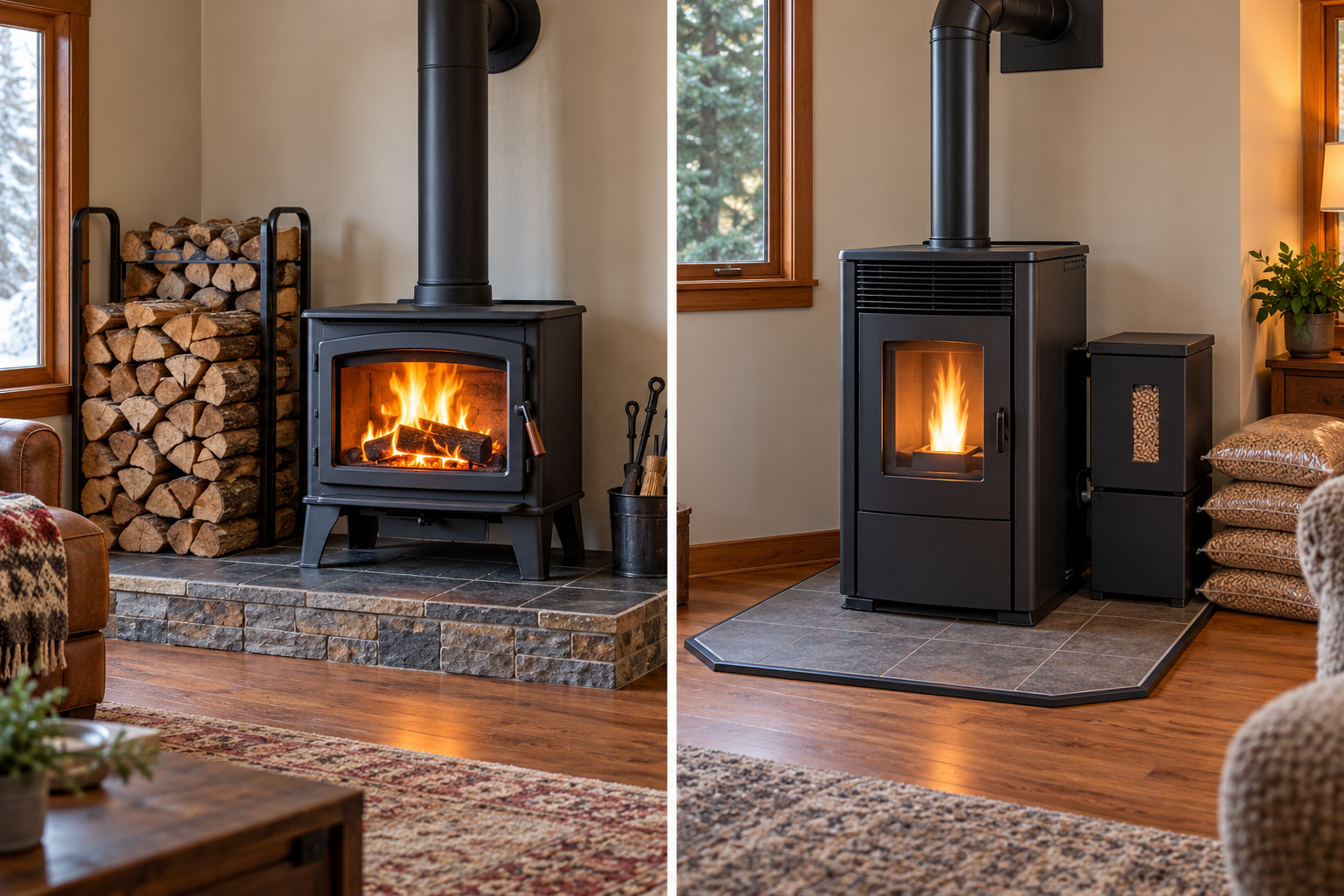
A wood stove burns split firewood loaded by the homeowner. A pellet stove burns manufactured pellets from a hopper, using a feed system and, depending on the model, powered components such as an auger or fan. Both need a suitable appliance, safe venting, a compatible hearth or floor-protection arrangement, and qualified installation. Neither is automatically a low-cost replacement for a whole-house furnace or heat pump.
Start by deciding whether the stove is supplemental heat, a frequent-use room heater, or part of a broader heating plan. A small stove serving a living area is not comparable with a system sized to heat every room. Consider the rooms, distribution, operating schedule, fuel storage, cleaning, service availability, and the central system that remains. Keep chimney reconstruction, major masonry work, and emergency-heating planning separate when those are the main projects.
Wood can suit an owner who has a dependable source of properly prepared fuel and accepts regular loading, ash handling, and storage. Pellet-stove outage behavior depends on the design. Many models use powered components to feed fuel or move heat, but EPA notes that some less-common gravity-fed stoves can provide heat without electricity. US Stove’s GW1949 manual describes one natural-draft model that does not require electricity for normal operation; it lists both a propane torch and a 120-volt heat gun as ignition methods. Check the exact stove’s manual for its power requirements, outage behavior, backup support, and restart instructions.
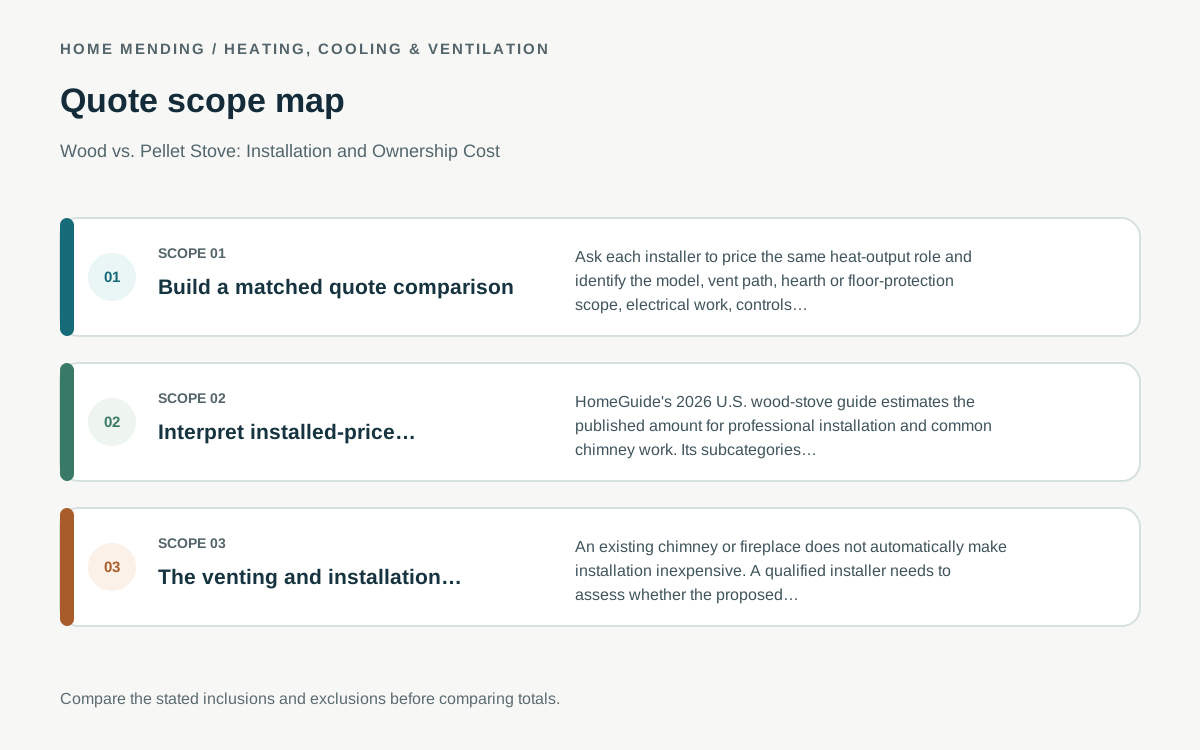
Interpret installed-price examples carefully
HomeGuide’s 2026 U.S. wood-stove guide estimates USD $3,000–$8,000 for professional installation and common chimney work. Its subcategories include about USD $3,000–$5,000 to replace a stove in an existing setup, USD $4,000–$8,000 for an installation using an existing masonry chimney, and USD $5,500–$9,000 or more when no chimney exists. Those categories reflect different project conditions; they are not extra charges to add together. A new chimney or major masonry work can exceed the guide’s common range and should be quoted separately.
For a freestanding pellet stove, HomeGuide reports USD $1,600–$4,100 installed. Fixr gives a separate U.S. range of USD $1,000–$4,500 with a USD $3,000 average, and Angi reports USD $1,009–$3,667. These guides do not use identical categories or documented transaction samples. Do not average them into a precise national figure or assume that a fireplace insert, new vent route, hearth work, and existing-stove replacement cost the same.
The Canadian pellet example is narrower: a specialist guide for Ottawa says CAD $6,000–$10,000 for a pellet stove or insert, naming the appliance, venting, and hearth pad as included. It describes an insert using an existing masonry fireplace and liner as tending toward the lower end, and a freestanding stove with a new through-wall vent as tending higher. It is one regional guide, not a Canadian survey or a guaranteed contractor quote.
Canadian retailers also display product-only offers, including an Osburn pellet model starting at CAD $4,799. Product price is not installed cost. A Toronto-area wood-stove guide displays $3,000–$8,000 as typical, but does not identify the currency and its listed component minima do not reconcile with the stated lower total. Treat that as an unresolved source observation, not a CAD range or an itemized budget. Ask for a local quote with appliance, vent, hearth, labor, permit, inspection, tax, and finish work separated.
The venting and installation boundary matters
An existing chimney or fireplace does not automatically make installation inexpensive. A qualified installer needs to assess whether the proposed appliance and venting are compatible with the existing conditions and the applicable requirements. The project may involve a liner or new vent, hearth or floor protection, clearances, combustion-air provisions, an electrical connection if the selected model requires one, removal, finish repair, and local inspection or approval.
Ask whether the proposal assumes an existing chimney that is usable, a new vent route, an insert in an existing fireplace, or major chimney work. Those are materially different scopes. A price for labor to connect a stove is not equivalent to a turnkey quote that includes the appliance, venting, hearth, inspection, and tax. Keep chimney rebuilds and structural repairs as separate line items so they do not disappear inside a stove price.
The U.S. EPA’s residential wood-heater rule covers specified newly manufactured wood and pellet heaters; it does not require replacement of every existing stove simply because federal standards apply to new products. The EPA’s certified-heater database can help identify model information, but product certification is not proof that a particular home’s vent, clearances, floor protection, or installation is safe or approved. In Canada, local and provincial requirements differ. Check the exact model instructions and ask the municipal authority and qualified installer which approvals apply.
Wood smoke has health and neighborhood implications. Health Canada recommends maintaining a wood stove, using dry seasoned wood, and following manufacturer guidance for chimney and flue cleaning. Local restrictions can also limit when or whether a stove may be used. Confirm the rules for the address before treating the appliance as available heat every day of the year.
Compare fuel and routine ownership cost
There is no single national firewood or pellet price that predicts a household’s annual cost. Firewood varies by species, moisture, cut length, delivery volume, storage, and local availability. Natural Resources Canada’s graded-firewood bulletin explains that product labels may identify origin, species, moisture, and dimensions. Ask a seller what quantity is delivered and how the fuel was measured; “a load” is not a standardized heat amount.
Pellets are sold by bag or bulk delivery, and price can vary with grade, season, distance, and storage. NRCan’s pellet-grade guidance describes fuel properties such as moisture and ash content, but a grade label does not establish that the product suits every stove. Follow the appliance manual’s fuel requirements. The seller’s displayed price and delivery terms matter as much as a per-bag comparison.
Compare fuels using the appliance’s documented consumption and the heat you expect to use. A practical ownership worksheet can include delivered fuel price, expected seasonal quantity, electricity for powered feed, controls, or fans where applicable, cleaning supplies, professional service, and likely replacement parts. Use local prices and your household’s intended runtime. Do not copy a guide’s monthly estimate as though it were a bill forecast.
The distinction is especially important when comparing pellet-stove electricity costs. Powered-feed models may use an auger, ignition components, controls, or fans; gravity-fed designs can avoid some or all of those electrical parts. Exact electrical draw, startup sequence, outage behavior, and backup requirements are model-specific. Ask what happens during a power interruption, whether the manufacturer supports a backup supply, and what the manual requires before restarting. Include any backup equipment separately; do not assume a battery will run a particular stove for a set duration without checking the model’s full load and manufacturer guidance.
Account for maintenance and labor
Both appliances need regular attention, but the tasks differ by model and fuel. Wood-stove ownership includes handling ash, checking door seals and visible components, arranging qualified inspection, and cleaning the chimney or flue as the manufacturer and local authority require. Health Canada’s annual professional-inspection advice is general health guidance, not a quoted service package or a universal legal schedule.
Pellet-stove upkeep can include emptying ash, cleaning the burn pot, inspecting venting, and servicing powered feed or fan components. The frequency depends on the exact appliance, pellet quality, runtime, and manufacturer instructions. Ask the installer to show which maintenance is routine owner care, which work requires service, what is covered by a warranty, and what local providers charge.
Maintenance time has value even when it does not appear on a contractor invoice. A homeowner who wants lower daily handling may prefer the pellet routine, while a homeowner with seasoned wood and a willingness to tend a fire may prefer wood. The apparent fuel-price advantage can be outweighed by delivery, storage, cleaning, outages, or paid service. Compare an ownership horizon that matches how long you expect to use the appliance.
Build a matched quote comparison
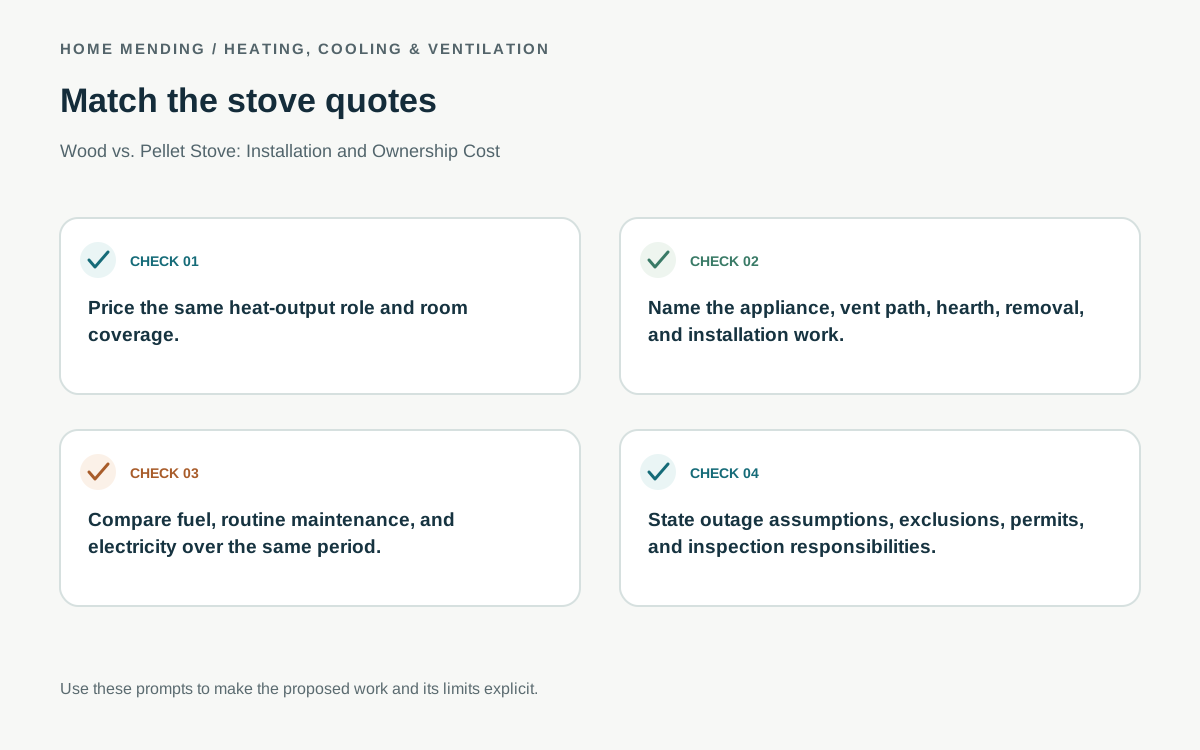
Ask each installer to price the same heat-output role and identify the model, vent path, hearth or floor-protection scope, electrical work, controls, removal, installation labor, commissioning, permit or inspection responsibility, tax, warranty, and exclusions. State whether the project uses an existing fireplace or chimney and what its condition is assumed to be. If the installer recommends a new chimney or major rebuild, separate that work from the appliance and standard connection.
Compare one wood option and one pellet option with the same room coverage, installation assumptions, fuel period, maintenance horizon, and power-outage plan. Do not compare a product-only pellet listing with an installed wood-stove guide. Do not deduct an incentive or tax credit until an official current program confirms the exact equipment and applicant eligibility.
Useful questions include:
- Is the quoted amount for the stove alone, standard installation, or a complete vent-and-hearth project?
- What condition is assumed for the chimney or fireplace, and what concealed work is excluded?
- Which local permits, inspections, burn restrictions, or insurer requirements apply?
- What fuel specification does the exact model require, and where can it be purchased locally?
- What are the model’s electrical needs, outage behavior, routine cleaning, and service availability?
- Which startup, operation, and maintenance instructions will the installer provide?
Which option is a better fit?
Wood may fit when the homeowner has space and a reliable supply for dry firewood, accepts hands-on operation, and values its familiar loading and tending routine. Pellet may fit when bagged or bulk fuel delivery is practical and a more controlled feed is useful. Powered-feed or fan models need dependable electricity or manufacturer-supported backup; some gravity-fed models may avoid that dependency, subject to their own operating and installation requirements. Neither choice is automatically cheaper or more dependable; climate, house layout, fuel market, installation work, local rules, and use pattern decide the result.
If the intended role is whole-home primary heat, compare the stove with a properly scoped furnace, boiler, or heat-pump project rather than assuming a room appliance covers the entire load. The best estimate is the one that makes installed work and recurring ownership visible before you select the appliance.