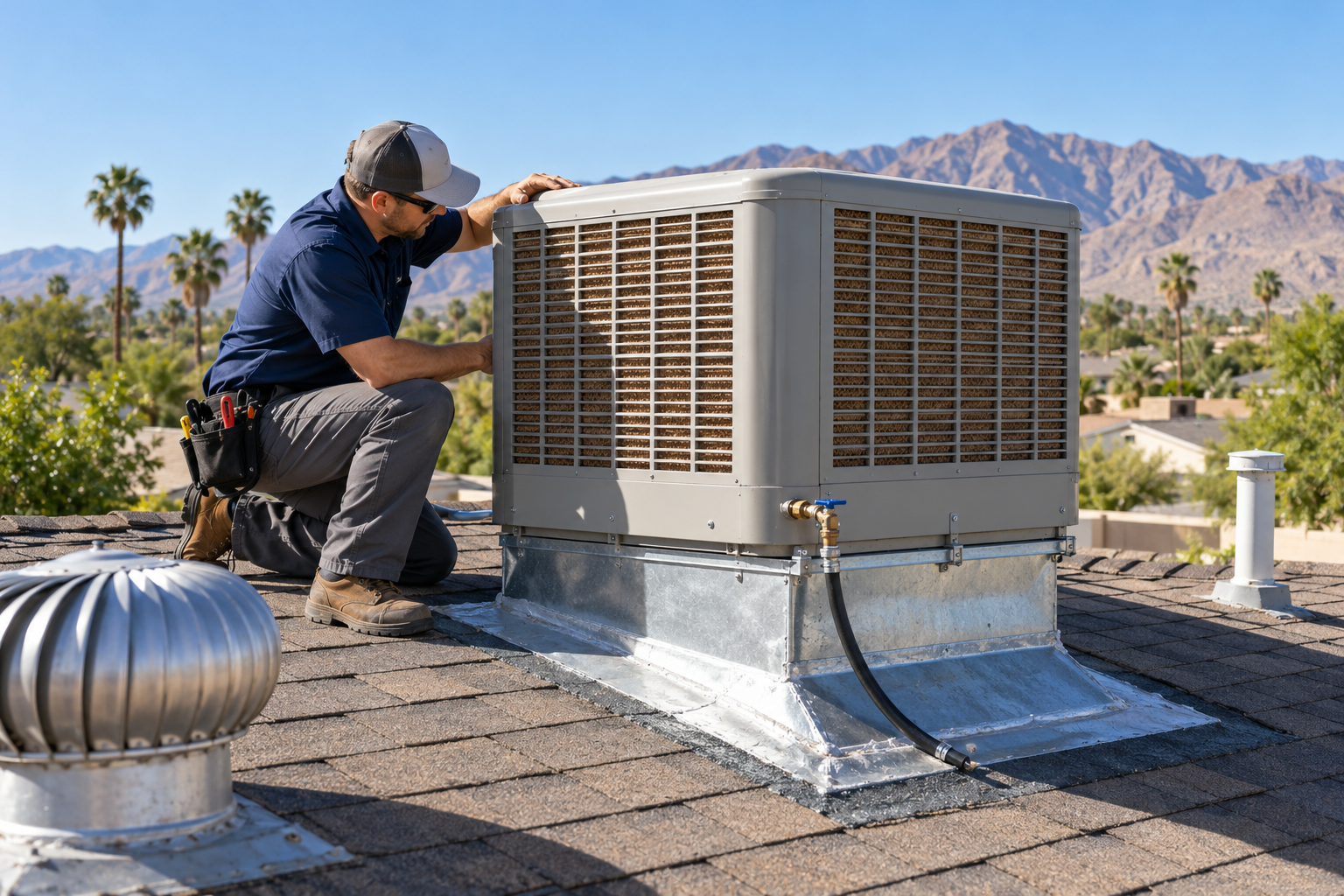
Angi’s 2026 U.S. guide reports an average of about USD $3,500 for a permanent whole-house or ducted evaporative cooler and about USD $2,500 for a roof-mounted installation. Those are source-specific guide averages, not local quotes or a Canadian price range. The guide’s separate USD $2,543 overall average and USD $1,544–$3,759 range combine portable, window, roof-mounted, and ducted systems; they should not be read as the installed price of a permanent whole-home system. Canadian installed pricing has not been established in comparable evidence.
The total depends on whether the home is a suitable dry-climate application and what the installer must add for equipment, mounting, duct distribution, an exhaust path, water, electrical service, controls, and seasonal upkeep. A cooler that is a poor fit for the climate or house can be an expensive way to get unreliable comfort.
What this guide covers
This page concerns a permanent mounted or ducted evaporative cooler serving a home. A portable unit, a window-mounted appliance, and a whole-home central air conditioner are different projects with different prices and coverage. The Angi guide reports separate product-type averages, which is why its overall figure should not be used as the budget for a ducted retrofit.
An evaporative cooler uses evaporation to lower the temperature of air. In a conventional direct system, outdoor air passes over wetted media and enters the home cooler but more humid. A designed path must let air leave the home as new air enters. Some indirect systems use a heat exchanger so the supply air is cooled without receiving the same added moisture, but their equipment and configuration are not interchangeable with a standard direct cooler. This cost guide does not treat research-stage or specialty designs as ordinary residential options.
The Department of Energy’s home-cooling overview distinguishes evaporative cooling from air conditioning and cautions that ventilation cooling is ineffective in hot, humid weather. The older DOE technical guide explains direct and indirect system operation and the need for an outlet path, but its historical price comparisons are not current market evidence. Use current equipment instructions and a site-specific design for a purchase decision.
Keep the price evidence in its lane
Angi reports that 539 verified Angi Pro projects informed its 2026 guide. The reported USD $3,500 whole-house/ducted figure is more relevant to a permanent system than the mixed USD $2,543 overall average, but the page does not provide transaction records or a matched scope for a particular home. Its USD $2,500 roof-mounted category is a separate source classification; do not add it to the ducted average or assume every roof installation has the same distribution and finish work.
There is no current Canadian installed-price sample in the evidence for this type of cooler. Do not relabel a U.S. guide amount as CAD or use a portable-unit listing to fill the gap. Ask local contractors whether permanent evaporative equipment and service are available in your area and request a quote in local currency with the actual mounting, duct, water, drain, electrical, and exhaust work described.
The source’s mixed-system range illustrates why equipment classes need separation. A portable unit may need no roof penetration or permanent distribution. A roof-mounted whole-home unit may require support, weather protection, water connection, and connection to ducts. A ducted indoor installation has a different access and finish boundary. Compare only bids for the same system type and service area.
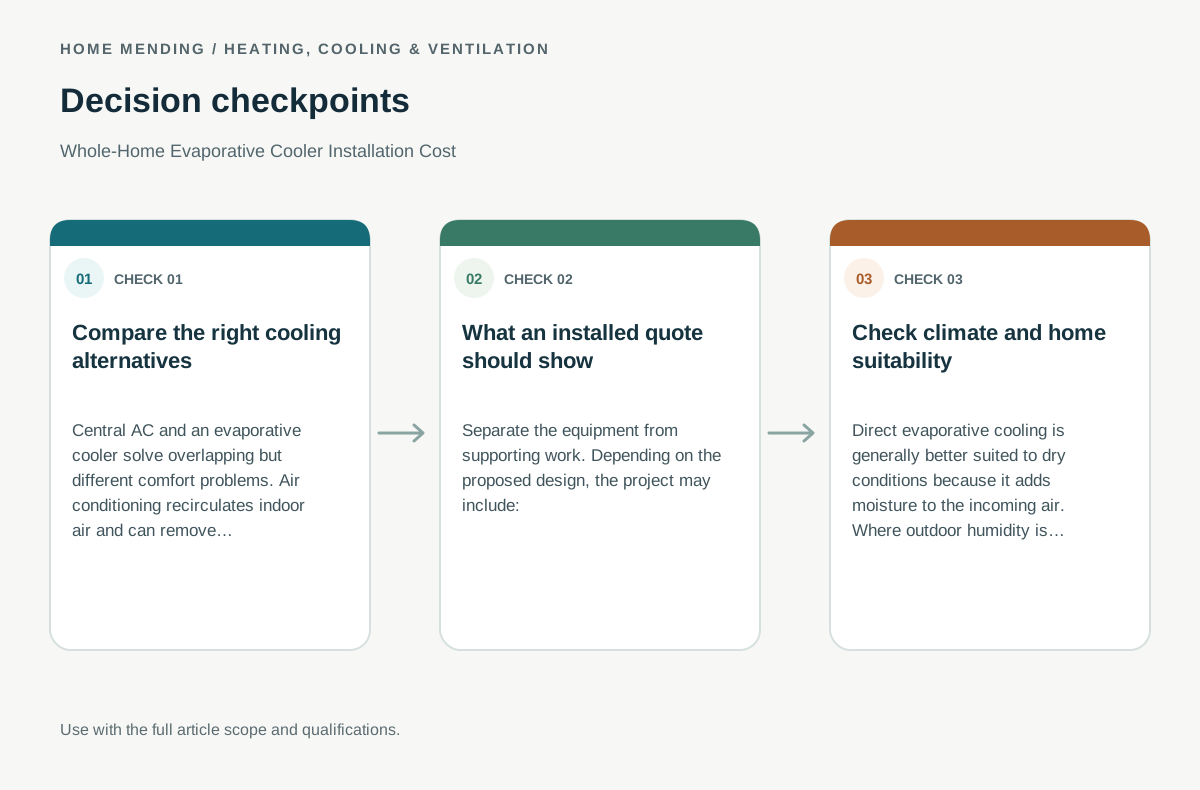
Check climate and home suitability
Direct evaporative cooling is generally better suited to dry conditions because it adds moisture to the incoming air. Where outdoor humidity is already high, the cooler has less useful evaporative potential and can make indoor humidity less comfortable. Climate maps can help narrow questions, but they do not establish comfort in a particular home; weather, building design, airflow, and humidity all matter.
Because a direct cooler introduces outdoor air, it needs an exit path such as an open window or designed vent. If that path is closed, the system cannot deliver its intended airflow. The installer should explain which rooms receive air, where it exits, how the system handles doors and pressure, and how the selected unit fits the home. A product capacity or square-foot label is not a substitute for design.
An evaporative cooler is a poor fit when you need closed-window cooling, reliable dehumidification, or cooling during high humidity. It may also be inappropriate when outdoor air is smoky or otherwise unhealthy. The EPA’s wildfire filtration guidance treats bringing outdoor air indoors differently from filtering recirculated air during smoke events. A cooler is not a smoke filter; check local air-quality guidance and the manufacturer’s operating instructions before use.
Consider water availability and local restrictions before selecting equipment. A permanent system needs a water supply, and some designs discharge water as part of operation or maintenance. Exact consumption depends on the model and operating conditions. Do not use a dated national water example or another home’s operating bill as a prediction; ask the contractor for current model-specific water and electrical information.
What an installed quote should show
Separate the equipment from supporting work. Depending on the proposed design, the project may include:
- cooler, controls, and specified cooling capacity;
- roof or wall support, curb, weatherproofing, and access equipment;
- duct connection, transitions, registers, or distribution changes;
- opening or exhaust provisions for outgoing indoor air;
- water supply, shutoff, drain, overflow, and seasonal service access;
- electrical circuit, disconnect, controller, and any needed wiring;
- removal or reuse of old equipment, cleanup, and finish repair;
- startup, airflow or operation checks, homeowner handoff, and warranty;
- permits, inspections, or trade approvals required in the local jurisdiction.
The list is a quote-normalization aid, not an installation procedure. Ask the contractor to identify any roof penetration and who is responsible for the roof warranty. Ask whether water and electrical connections are included or merely assumed to be nearby. If ducts or openings are being reused, ask what was inspected and what condition is assumed.
Site access, roof height, the location of ducts, finished ceilings, and existing electrical or plumbing routes may shift the total. So can whether the project replaces an existing unit or creates a new distribution path. A contractor should identify concealed-condition allowances and state what would trigger a change order rather than presenting an unqualified “installed” total.
Budget the ongoing inputs
The installed quote is only one part of ownership. Ask which pads, media, reservoir or water components, filters, pumps, and controls require service, and what the selected manufacturer says about inspection and cleaning. Maintenance depends on the system and water conditions; do not assume a single annual price or interval across all models.
For water cost, use the exact model’s current consumption specification, likely operating hours, local water and sewer rates, and any drain or bleed behavior. For electricity, use the selected motor and pump input, operating hours, and local electricity rate. These are calculations for your proposed system, not national annual-cost estimates. Ask the contractor to state assumptions and separate seasonal startup or shutdown service from ordinary repairs.
If the installer cannot provide current model-specific water and power inputs, keep those costs as unquantified questions rather than borrowing estimates from another product class. The evidence does not establish a representative annual water bill or universal savings versus central AC.
Compare the right cooling alternatives
Central AC and an evaporative cooler solve overlapping but different comfort problems. Air conditioning recirculates indoor air and can remove moisture while cooling. A direct evaporative system depends on outdoor-air conditions, adds moisture, and requires an air exit path. In dry climates, an evaporative system may be worth pricing; in humid climates or during poor outdoor-air conditions, central AC may offer a more dependable operating window.
Compare the complete projects and likely use. Include the cooler’s installation, water and electricity, maintenance, and any distribution changes. For AC, include matched equipment, controls, refrigerant lines, condensate, electrical work, removal, and commissioning. A claimed difference in energy use cannot be treated as a guaranteed bill reduction without local rates, operating hours, humidity, cooling demand, and equipment performance.
Portable and window evaporative units may work for a room-level need, but they are outside this permanent-installation estimate. If only one room needs occasional cooling, price that separate option. If the need is continuous ventilation rather than cooling, see the whole-house ventilation guide. If outdoor nighttime air is the main idea, the whole-house-fan guide covers that different equipment decision.
Questions to ask before accepting a quote
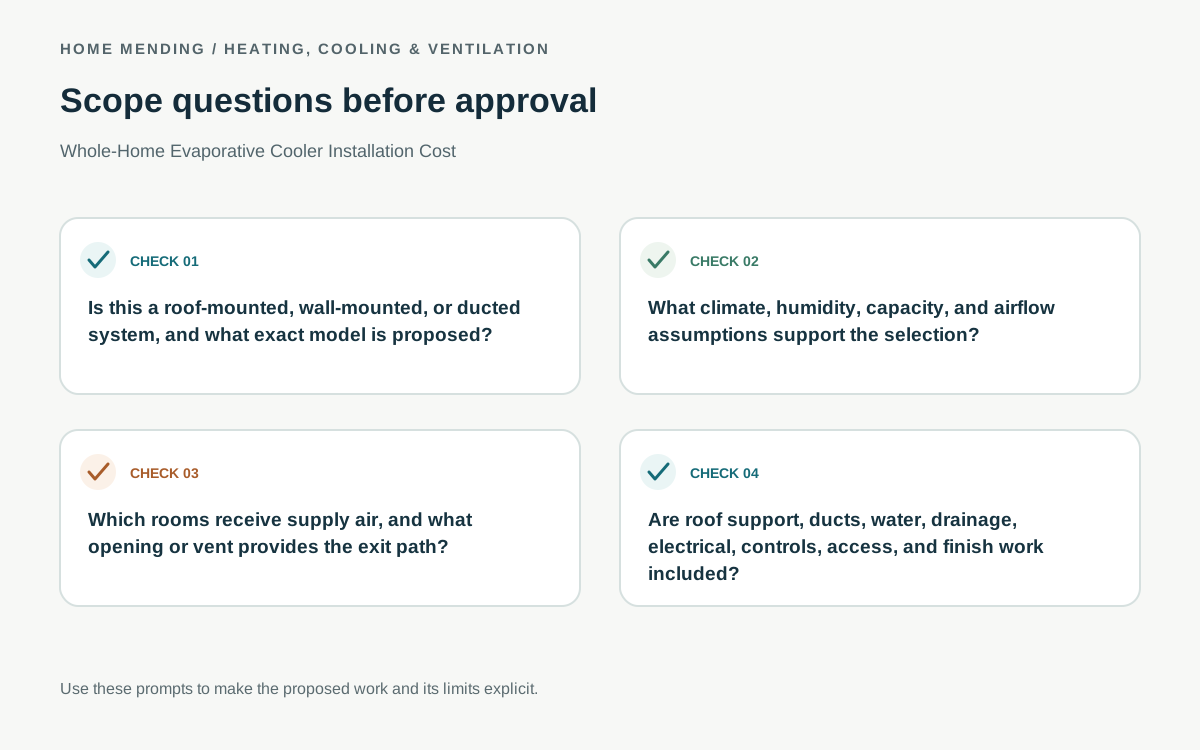
- Is this a roof-mounted, wall-mounted, or ducted system, and what exact model is proposed?
- What climate, humidity, capacity, and airflow assumptions support the selection?
- Which rooms receive supply air, and what opening or vent provides the exit path?
- Are roof support, ducts, water, drainage, electrical, controls, access, and finish work included?
- What are the model’s current water and electricity inputs under stated operating conditions?
- Which parts need seasonal cleaning or replacement, and what does that service cost locally?
- What permits or inspections apply, and who confirms them?
- What is excluded from the installed total, and how are concealed conditions priced?
A well-scoped proposal explains both the site work and the weather conditions where the system is useful. If the home needs cooling during humid weather, smoke events, or periods when windows cannot be opened, include another cooling approach in the comparison rather than relying on the most favorable evaporative-cooling scenario.