
The right comparison is not a repair invoice versus a replacement sticker price. It is the cost, performance, uncertainty, and disruption of keeping the existing system against the complete scope of a suitable replacement. ENERGY STAR identifies age, repeated repairs, rising bills, uneven comfort, humidity, dust, noise, and suspected duct or coil problems as reasons to evaluate the wider system. Those are signals, not an automatic replacement rule.

Illustrative planning scenario (U.S. dollars, September 2026)
This is a worked decision example, not a universal threshold: compare a $1,200 diagnosed repair today with a $9,000 replacement quote. If the repair leaves an aging system likely to need another $800 repair during the next year, the one-year repair exposure is $2,000; compare that with the replacement scope, financing, disruption, and expected ownership period.
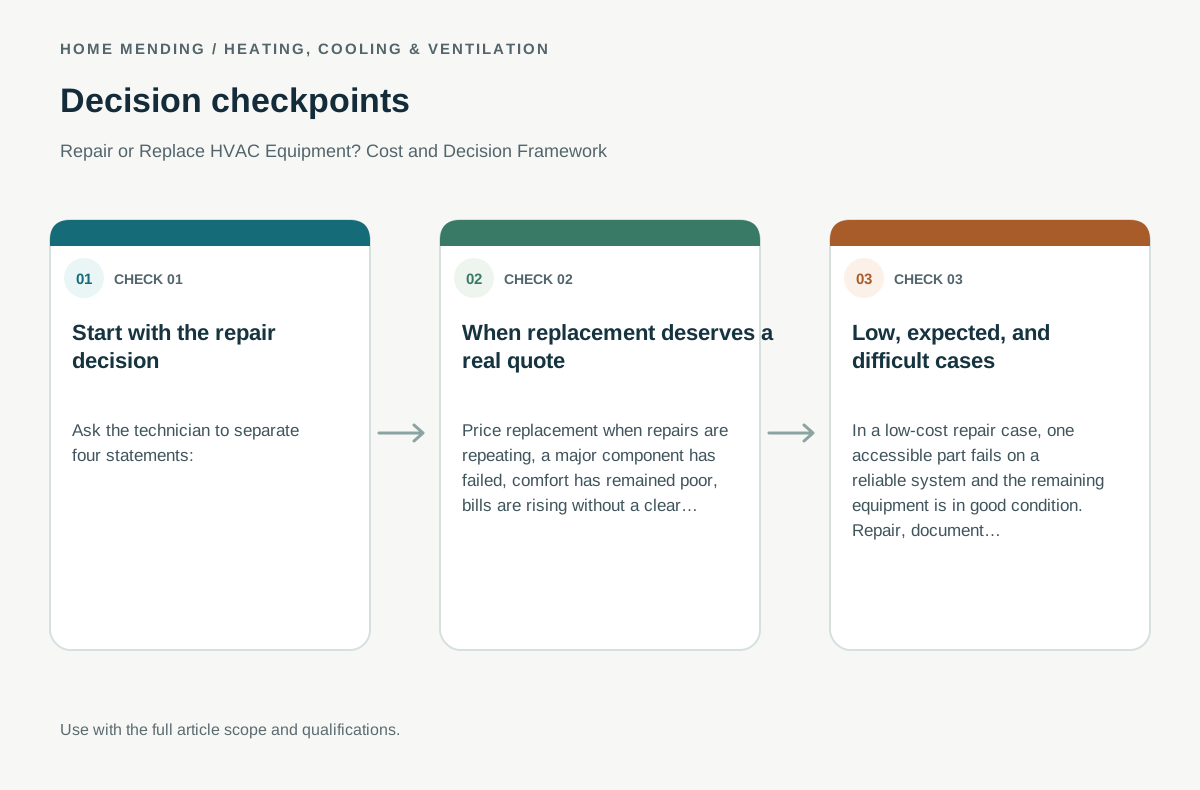
Start with the repair decision
Ask the technician to separate four statements:
- what has actually failed;
- what repair is required to restore operation;
- what condition will remain after the repair;
- what replacement would include if you chose it now.
A quote that says only “old unit—replace” does not show the repair alternative. A quote that names one part but ignores a recurring airflow or refrigerant problem does not show the remaining risk.
When repair is economically strong
Repair is often reasonable when the failure is clearly diagnosed, the equipment has been dependable, the surrounding ducts or hydronic distribution are sound, the part is available, and the repair buys a useful period of service. It is especially defensible when you need to defer a larger project until a planned renovation, seasonal budget date, or coordinated replacement.
Document the repair date, part, warranty, symptom, and any recommended follow-up. That record turns the next decision into evidence rather than memory. Include the likely cost of another service call if a related failure occurs.
When replacement deserves a real quote
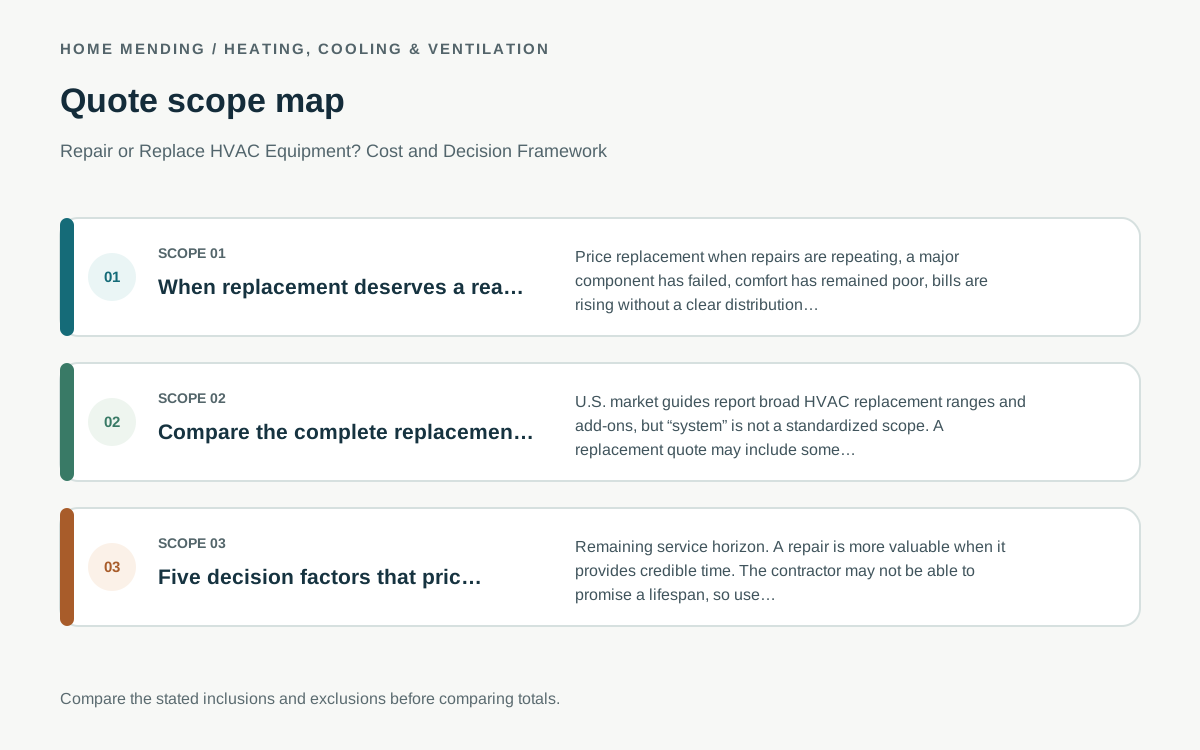
Price replacement when repairs are repeating, a major component has failed, comfort has remained poor, bills are rising without a clear distribution explanation, parts or refrigerant are uncertain, or the equipment no longer fits the home’s future plans. ENERGY STAR gives roughly 10 years as an evaluation point for AC and heat pumps and roughly 15 years for furnaces and boilers, but it does not make age alone a universal rule.
Replacement also becomes more attractive when the current system needs several independent interventions. One inexpensive repair may still be worthwhile; three separate mobilizations in one season can change the ownership economics.
Compare the complete replacement scope
U.S. market guides report broad HVAC replacement ranges and add-ons, but “system” is not a standardized scope. A replacement quote may include some or all of:
- equipment and capacity selection;
- matched indoor and outdoor components;
- ducts, returns, registers, pipes, or emitters;
- refrigerant lines and condensate;
- controls and thermostats;
- gas, oil, electrical, or venting work;
- removal, disposal, access, and protection;
- testing, balancing, commissioning, permits where applicable, and warranty documentation.
Canadian homeowners should request local CAD pricing. Do not convert a U.S. price into a Canadian target.
Five decision factors that price tags miss
Remaining service horizon. A repair is more valuable when it provides credible time. The contractor may not be able to promise a lifespan, so use condition, failure history, parts availability, and documented maintenance rather than a precise forecast.
Repeat-work economics. Add likely future diagnostics, emergency premiums, and duplicated access or removal. A repair that requires opening a finished ceiling twice may be less attractive than a coordinated project.
Performance and comfort. If the failure is actually duct leakage, poor return air, bad balancing, or an envelope issue, replacing equipment alone may not help. ENERGY STAR’s quality-installation guidance treats airflow and duct evaluation as part of the replacement decision.
Compatibility and obsolescence. A legacy refrigerant, matched coil, communicating control, venting arrangement, or hydronic distribution may limit the repair or replacement choices. EPA states that an existing R-22 system is not required to be replaced solely because it uses R-22 in the U.S.; the economic and technical decision remains property-specific.
Ownership horizon. A short-horizon owner may value a bounded repair and preserved cash. A long-horizon owner may value predictable service, efficient operation, parts availability, and one coordinated installation. Neither horizon makes a particular technology automatically best.
Low, expected, and difficult cases
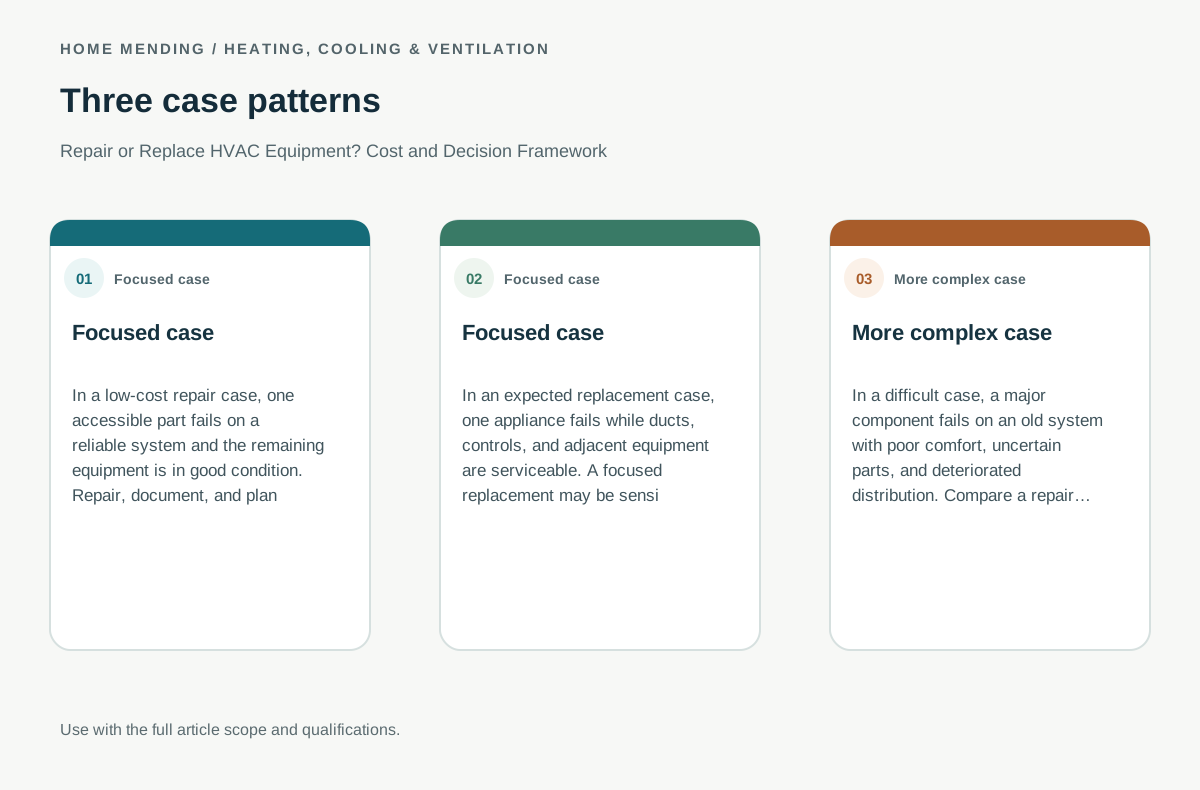
In a low-cost repair case, one accessible part fails on a reliable system and the remaining equipment is in good condition. Repair, document, and plan normal maintenance.
In an expected replacement case, one appliance fails while ducts, controls, and adjacent equipment are serviceable. A focused replacement may be sensible if compatibility is confirmed.
In a difficult case, a major component fails on an old system with poor comfort, uncertain parts, and deteriorated distribution. Compare a repair that may only restore one function with a replacement that addresses the whole assembly. Include duct, electrical, venting, and access allowances rather than comparing equipment-only numbers.
A practical quote worksheet
Record equipment age and model, service history, failed component, repair total, repair warranty, expected remaining condition, replacement capacity basis, matched components, distribution work, controls, fuel or electrical work, removal, testing, exclusions, and schedule. Ask each contractor to price the same assumptions.
Then evaluate three totals: the repair now; repair now plus plausible repeat work during your ownership horizon; and replacement with an expected allowance for hidden or supporting work. Keep optional efficiency upgrades separate from work required for safe, compatible operation.
The decision threshold is personal but not arbitrary
Do not use a universal “repair must be less than half of replacement” formula. A repair may be sensible above that ratio when it buys reliable service and avoids major disruption. A cheap repair may be poor value when it leaves a failing coil, obsolete controls, or a known distribution defect.
Choose repair when the failure is bounded and the remaining system earns your confidence. Choose replacement when the repair only postpones a broader, already-visible system decision. If the evidence is incomplete, pay for diagnosis or a scoped second opinion rather than pretending the uncertainty is zero.
Use a three-column comparison
For the existing system, record the immediate repair, known follow-up work, and condition left afterward. For replacement, record equipment, supporting work, removal, testing, and uncertainty allowance. For postponement, record the likely cost of another service call, emergency timing, and disruption if the failure occurs later. This keeps “do nothing for now” from being treated as cost-free.
Age becomes useful only when paired with failure history, parts availability, comfort, bills, and the condition of ducts, coils, controls, emitters, or venting. An older well-maintained unit with one isolated fault can be a better repair candidate than a newer system with repeated failures. A new replacement is not a solution to a duct or envelope problem.
Ask what would change the recommendation
The contractor should be able to name the decision-changing fact: a confirmed leak, a verified matched component, a failed heat exchanger, a duct restriction, an unavailable part, or a replacement capacity assessment. If the recommendation does not change when those facts change, it is probably a sales rule rather than an economic analysis.
For a long-horizon owner, predictable service and correct installation may justify replacement. For a short-horizon owner, a bounded repair may preserve cash if its residual risk is disclosed. Resale value is not a guaranteed recovery of replacement cost, so treat it as one consideration rather than a promised return.