
U.S. specialist repair guidance places a broad range for HVAC repairs around $130–$2,000. That band is useful as a reminder that “HVAC repair” is not one job, not a local quote, and not a component price list. A small control or adjustment can be very different from a compressor, heat exchanger, coil, blower, or concealed distribution repair.
Decide what the visit should leave you knowing
The diagnostic portion should identify the symptom, operating mode, likely failure family, tests performed, and remaining uncertainty. The repair portion should identify parts, labor, access, refrigerant or fuel work, testing, and warranty. This separation makes a small service call comparable with a larger repair or replacement decision.
Repair is stronger when the cause is bounded and the remaining system is credible. Compare broader work when symptoms repeat, multiple components are declining, access is difficult, or ducts, controls, or sizing are part of the complaint. Do not authorize every recommendation at once; approve the next supported scope and keep unresolved alternatives visible.
Most repair invoices combine some version of:
- dispatch or diagnostic labor;
- additional labor to access and install the part;
- the part, refrigerant, consumables, or replacement materials;
- testing, cleanup, and any return visit.
The same part can cost differently when it is in an attic, crawl space, tight cabinet, or integrated system. Emergency timing can change the labor cost even when the repair itself is straightforward. Ask whether the quoted total includes the diagnostic fee, tax, disposal, refrigerant recovery or recharge where applicable, and commissioning or testing.
Small, moderate, and major repair families
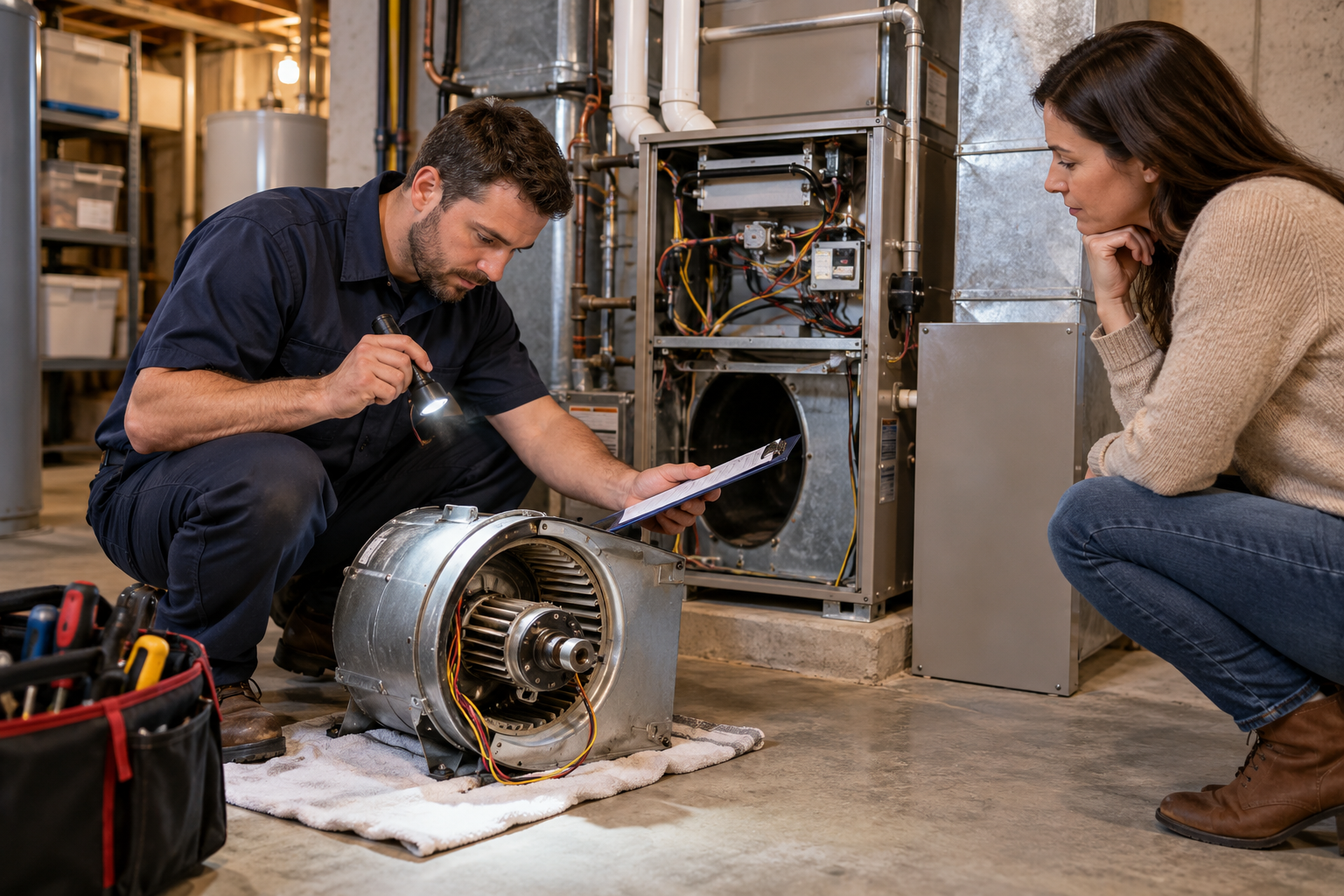
Small work may involve a control adjustment, accessible electrical or thermostat component, drain correction, filter-related airflow issue, or minor duct connection. It still requires diagnosis; a symptom such as no cooling does not prove that a particular small part failed.
Moderate work may involve a blower component, motor, control board, fan, valve, ignition component, circulator, or localized duct repair. The equipment family matters: a furnace-integrated blower, a separate air handler, a hydronic zone, and a mini-split indoor unit have different replacement scopes.
Major work includes compressors, coils, heat exchangers, buried or concealed distribution, repeated refrigerant leakage, ground loops, or a combination of failures. These repairs deserve a replacement comparison because the new repair may not remove age, compatibility, or future-service risk.
What makes the range widen
The failed component usually dominates, but the economic drivers interact:
- System type: gas, oil, electric, hydronic, split AC, heat pump, and ductless equipment require different parts and skills.
- Age and availability: an older unit may have difficult-to-source parts or a legacy refrigerant context, but age alone is not proof that replacement is correct.
- Access: opening a finished ceiling or moving equipment can cost more than the visible component.
- Cause versus symptom: a repaired blower will not solve an undersized return, a leaking duct, or an envelope problem.
- Timing: emergency, weekend, and peak-season work can carry a premium.
- Related scope: controls, line sets, condensate, venting, electrical supply, or duct repairs may be necessary for the main repair to perform.
ENERGY STAR identifies ducts, airflow, refrigerant charge, sizing, and installation quality as part of system performance. That is why an honest repair diagnosis may recommend distribution or control work instead of replacing the most expensive box.
Repair quote scenarios
In a simple case, a repeatable symptom leads to one accessible failed component, the part is available, and the system has a credible service horizon. Compare the all-in repair with the cost of another diagnostic call, not just the part.
In a typical case, the repair includes a component plus a related correction, such as a blower repair with airflow work or a boiler repair with a control or circulation issue. The quote should identify which item is essential and which is recommended.
In a difficult case, the cause is uncertain, access is poor, or multiple parts are deteriorated. A staged diagnostic scope may be sensible, but “replace parts until it works” is not a sound budget. Ask what evidence will justify the next step and what happens if the diagnosis changes.
When another trade enters the job
An HVAC contractor may identify a condition that belongs primarily to electrical service, building-envelope performance, water intrusion, chimney masonry, indoor environmental health, or major remodeling. The HVAC article can explain the interface without turning those adjacent projects into an HVAC repair line.
Examples include insufficient electrical capacity for a replacement heat pump, attic insulation causing temperature imbalance, a masonry flue problem affecting an appliance, or mold and water damage requiring remediation. Clarify whether the HVAC quote assumes that other work is already complete.
Repair versus replacement crossover
Compare repair when the failure is bounded, the equipment is otherwise reliable, parts are available, and the repair preserves useful performance. Compare replacement when repairs are repeated, the system has several age-related defects, comfort remains poor, the repair is a major portion of a replacement budget, or the proposed fix leaves a known incompatible or obsolete system in place.
There is no universal age cutoff or percentage rule. A lower-cost repair can be poor value if it is likely to be followed by another mobilization. A replacement can be poor value if the problem is a duct, control, or load issue that the new equipment will inherit.
Make quotes comparable
Request the diagnosis, failed part, labor, service fee, materials, testing, warranty, exclusions, and expected service horizon in writing. If replacement is a plausible alternative, obtain a replacement quote that states capacity basis, matched components, ducts, controls, removal, venting or electrical work, and commissioning.
The useful question is not “How much is HVAC repair?” It is “What failed, what does this repair change, what risk remains, and what would the next major decision cost if I postpone replacement?”
Read the estimate by failure family
For a control or thermostat repair, verify the proposed part matches the equipment and that setup and testing are included. For a blower or motor repair, ask whether airflow, return restrictions, and wheel condition were checked. For refrigerant or coil work, ask how the leak or charge problem was established and what recovery, repair, and testing are included. For a furnace or boiler, identify the fuel and whether the scope crosses into combustion, venting, pressure, or inspection work.
This prevents a long list of possible parts from becoming a budget. Several causes can remain possible during diagnosis; an authorized repair quote should become narrower once the evidence supports a specific intervention.
Define conditional work
Use a base repair total and a clearly described conditional amount for work that cannot be seen before access or disassembly. Examples include a concealed duct connection or a damaged fitting discovered after a cabinet is opened. Do not accept an unlimited “miscellaneous” allowance as a substitute for scope.
Before authorizing, state the outcome expected: heat or cooling restored, a leak stopped, airflow measured, or a control sequence corrected. Some repairs restore operation without correcting comfort or energy performance. That is not necessarily failure, but the quote should say what it does and does not promise.