
“Partial power” usually means some outlets, lights, or rooms work while others do not. That description does not identify the failed part. A single receptacle may need a device repair, while several dead locations may involve a protective device, breaker, connection, branch circuit, panel, service equipment, or utility condition.
A U.S. specialist source places a straightforward existing outlet replacement around $80–$200, with standard replacement examples around $80–$150. New outlet work is reported around $150–$350, and a Canadian specialist source reports CAD $80–$200 for representative replacement work. These are planning observations. Diagnosis, access, minimum charges, and wiring condition determine whether your total stays near those examples.
First define the pattern
The number and arrangement of dead locations matter more than the phrase “dead outlet.” One failed device, every outlet downstream from one location, one room, several rooms, and part of the home after a service event are different starting points. A report should identify the affected locations and whether lights or other circuits are also involved.
Possible cost paths include:
- a failed receptacle or switch;
- a tripped protective device or breaker that needs professional assessment;
- a loose or damaged connection in a box or accessible circuit section;
- a branch-circuit fault requiring tracing and repair;
- a damaged or incompatible panel component;
- a service or utility problem affecting part of the property;
- a larger legacy-wiring or distribution condition discovered during diagnosis.
Do not open an energized box or panel, bypass protection, or assume a three-slot face means a circuit is grounded. CPSC guidance treats home wiring and panel work as safety-sensitive and directs untrained people away from invasive inspection.
What the service call covers
The first invoice may contain dispatch, travel, a minimum or first-hour charge, diagnostic time, and a small replacement device. A specialist Canadian guide reports first-hour observations around CAD $100–$200; U.S. service-call guides report similar broad first-hour observations in USD. The effective cost depends on the contractor and location, not an exchange-rate comparison.
If the fault is not visible or cannot be safely isolated during the visit, the electrician may provide a repair quote rather than complete the job immediately. Ask whether testing, materials, shutdowns, return visits, wall repair, permits or notifications, and utility coordination are included.
Three repair scenarios
Contained device repair: One receptacle is damaged and the box and conductors are serviceable. The total may be a service-call minimum plus an ordinary device and labor. A scorched, loose, warm, or improperly supported box is not a cosmetic replacement.
Protective-device or circuit correction: The outlet is one symptom of a GFCI, AFCI, breaker, connection, or branch-circuit issue. The cost includes diagnosis and the correctly scoped protective or wiring work. The device price is a minor part of the decision.
Concealed or system-level fault: Several locations lose power, the fault is intermittent, or the panel/service/legacy wiring is implicated. Budget for staged diagnosis, access, possible finish restoration, and a separate project quote. A large number of dead outlets does not automatically mean the whole house needs rewiring.
Access and finish restoration
Nearby accessible wiring may allow a defined repair. A run behind finished walls, plaster, tile, insulation, or an occupied ceiling costs more to trace and restore. If a new cable or box is needed, ask whether cutting, patching, painting, and cleanup are included or excluded. Outdoor, basement, and detached-structure work can add weatherproofing, distance, trenching, or responsibility questions.
Multiple small repairs can often be grouped into one scheduled visit, but bundling is useful only when each finding is listed. Ask for a line-by-line scope so a low total is not hiding an unresolved circuit fault.
Utility versus homeowner responsibility
If part of the home loses power after a storm or service event, utility involvement may be appropriate. Service-entrance responsibility varies by utility and jurisdiction. Do not assume the utility owns every component near the meter or that the homeowner owns all of it. The quote should identify the handoff point, required disconnect/reconnect, and which party bears each charge.
How to compare quotes
Give each electrician the same location list and ask for:
- observed cause or remaining diagnostic uncertainty;
- device, breaker, protective, circuit, panel, or service scope;
- access and finish assumptions;
- materials and compatibility responsibility;
- permit, notification, inspection, or utility steps where applicable;
- testing and confirmation that power is restored safely;
- exclusions and the price of additional concealed work.
Ontario and British Columbia publish different electrical administration examples, including Ontario notification/inspection fees and B.C. homeowner permit classes. Those are not total project prices or universal rules. For Canadian work outside those examples, verify the local authority’s process.
The decision is economically clear when you know whether you are paying for a device, a protective-device correction, a branch-circuit repair, or a broader distribution investigation. Until that distinction is made, the most honest estimate is a diagnostic range rather than a single outlet price.
Turn “partial power” into a location map
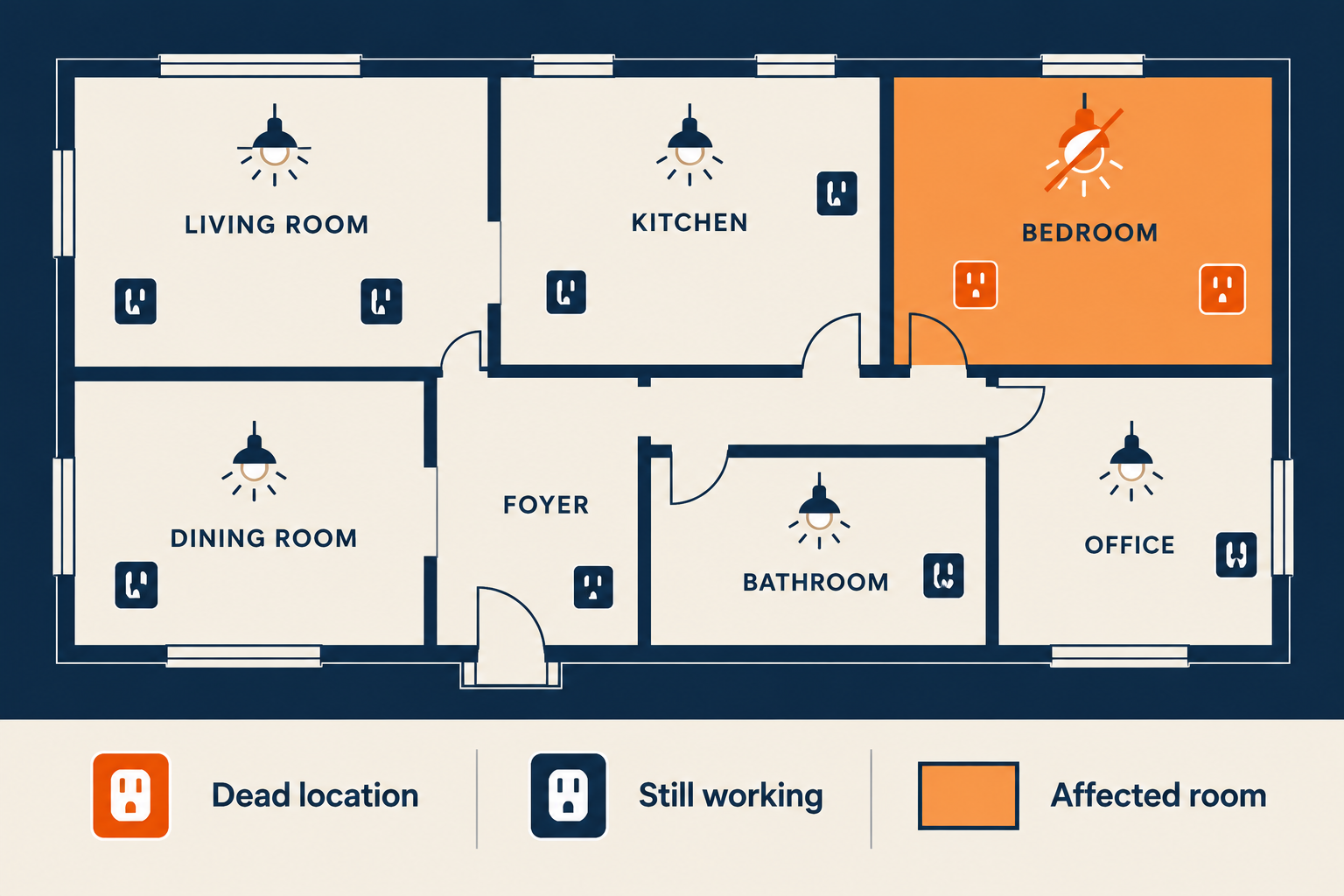
List every dead outlet, light, and room, along with any nearby locations that still work. Note when the loss began, whether it follows a storm or renovation, and whether a breaker or protective device has operated. This map is more useful than counting outlets because it shows whether the problem is localized, downstream, circuit-wide, or potentially service-related.
Do not use the map to justify invasive testing. A homeowner can report observations from safe positions, but the electrician should determine the fault and perform electrical testing. A three-slot receptacle is not proof of grounding, and a dead receptacle is not proof of a failed receptacle.
Decide when a map is worth paying for
If one receptacle is dead, the first cost question may be a service minimum and a device or connection correction. If several outlets, lights, or rooms are affected, a location map and circuit assessment can prevent the electrician from pricing isolated replacements that do not explain the pattern. Ask which locations were tested, which remain untested, and whether a protective device, breaker, connection, branch wiring, panel, or utility condition is the current working hypothesis.
The route to a finished repair may include access openings and restoration. Separate those from the electrical diagnosis so a low initial allowance does not become an unbounded wall-repair charge. If the symptom appeared after renovation, water exposure, a storm, or a new appliance, provide that timing; it can change the diagnostic path without proving a cause.
For a short-term decision, repair the defined fault and preserve the record. For long-term ownership, include labels, circuit documentation, and the cost of correcting retained legacy or grounding conditions while access is available. A dead outlet is resolved when the cause, affected boundary, and tested result are explicit.
Price the next decision
If the electrician can identify one damaged device and sound surrounding wiring, the service minimum and replacement may be the whole project. If the circuit must be traced, add diagnostic time and access. If several locations are affected, request a circuit schedule and ask whether a protection device, breaker, connection, panel, service, or utility issue explains the pattern.
The quote should establish a decision threshold before concealed work begins. Agree on an allowance or maximum diagnostic amount before returning with a larger repair proposal. This keeps a cheap-looking outlet repair from becoming an unapproved wall-opening project.
For a short ownership horizon, a contained, documented repair may be sufficient when the retained system is assessed. For a longer horizon, include future renovation access, repeated visits, and whether a partial rewire or panel correction would remove recurring uncertainty. The correct scope is the one that explains the pattern, not the one with the fewest replacement devices.