
Flicker is a symptom, not a repair specification. One lamp, one fixture, several lights on one circuit, or lights throughout the property can point to different work. Ontario’s Electrical Safety Authority identifies dim, surging, or flickering lights as a possible sign of a loose connection in a fixture, lighting circuit, or electrical service, and notes that shock or fire risk may result. That guidance supports professional assessment; it does not diagnose your home or establish a universal repair price.
For budgeting, begin with an electrician service call—often roughly $100–$200 in U.S. or Canadian first-hour/visit market observations, expressed in the applicable currency—then separate the possible repair paths. Emergency or concealed work can exceed that starting point.
Localized flicker versus a broader pattern
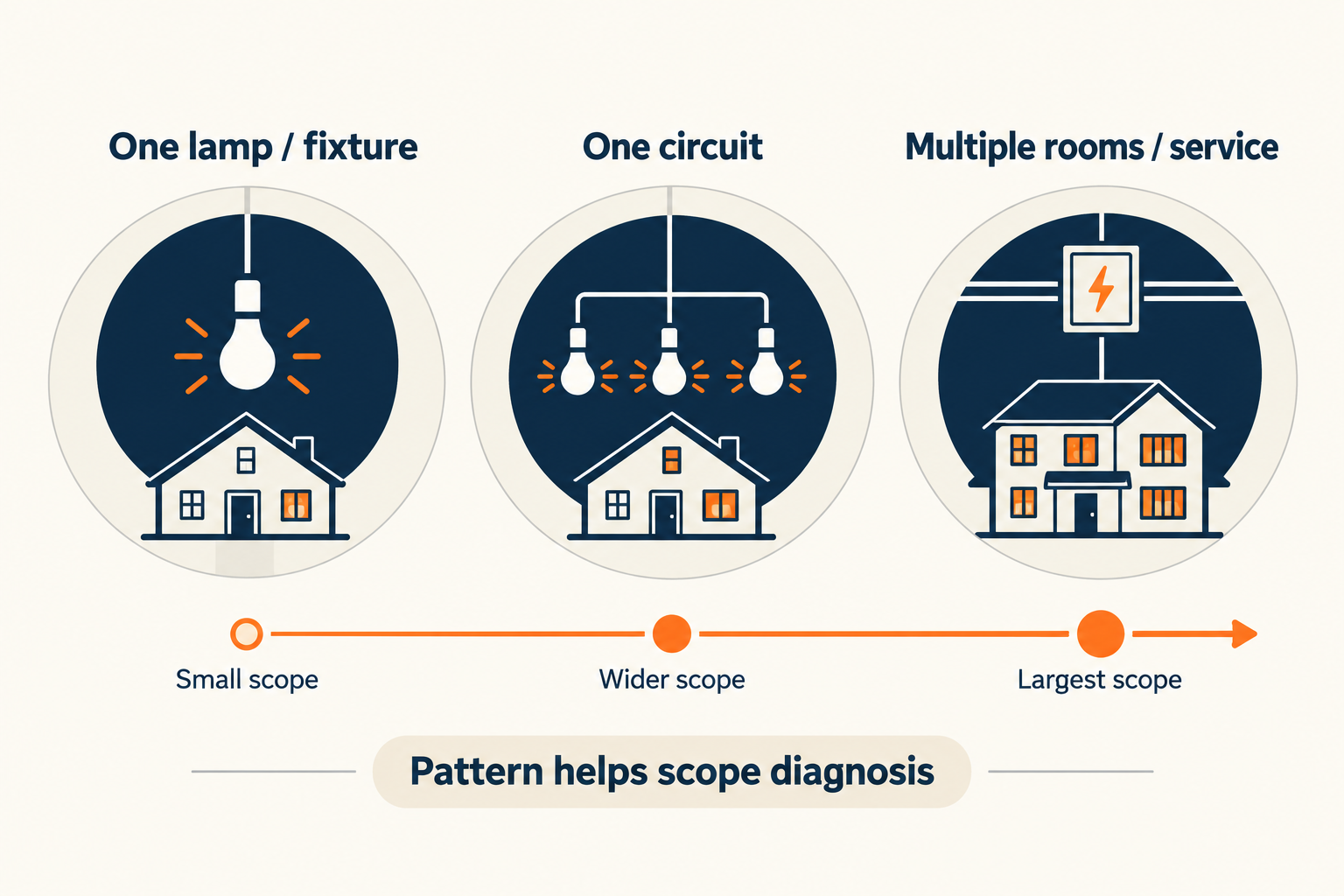
The first useful distinction is scope:
- One lamp or fixture: The bulb, driver, socket, dimmer, fixture, or local connection may be involved. The electrical system may be sound, but replacement compatibility still matters.
- Several fixtures on one circuit: A switch, connection, branch-circuit conductor, protection device, or load interaction may require investigation.
- Lights change when equipment starts: The observation may reflect a load interaction, voltage problem, loose connection, or service condition. Do not infer the cause from timing alone.
- Whole-home or multi-room flicker: The electrician may need to consider panel, service, utility interface, or multiple-circuit conditions. Utility responsibility varies by location.
Flicker that appears only with a smart control, dimmer, LED driver, or particular lamp can be a product/load compatibility issue. Flicker accompanied by heat, odor, buzzing, arcing, scorching, or smoke raises the urgency and should not be treated as a normal lamp replacement.
What the diagnostic visit may cost
The initial fee pays for time to define the pattern and inspect accessible components. Cost rises with the number of affected locations, intermittent timing, inaccessible boxes, high ceilings, panel or service access, and the need for specialized testing. A written repair quote may follow when the electrician needs parts, a shutdown, utility coordination, or wall access.
| Scenario | What may be priced |
|---|---|
| One failed lamp or fixture | Service call or fixture assessment, followed by a lamp/fixture decision if the electrical connection is sound. |
| Local switch, dimmer, or connection issue | Visit plus compatible device or connection repair; an older or aluminum-wired installation may change the method. |
| Circuit-level fault | Diagnosis, circuit repair, access, testing, and possible finish restoration. |
| Panel/service concern | Broader inspection, service equipment repair, utility coordination, or panel scope. |
| Utility-side possibility | Electrician or utility assessment may be needed before assigning customer-owned repair cost. |
Published cost guides for electricians and device replacement can provide planning context, but none can tell whether your flicker is a $100 device problem or a larger hidden-condition project.
Why access and uncertainty matter
An accessible junction or switch box can make a bounded repair relatively simple. A connection above a finished ceiling, behind tile, or within a crowded panel takes longer to reach and restore. Intermittent flicker can also require observation across operating conditions rather than one visual check. Ask what the initial visit includes and what the next diagnostic step costs if the fault is not reproduced.
Do not create a false saving by asking for a device swap before the cause is established. If an overheated connection is left behind, the new faceplate or fixture does not resolve the economic or safety problem. Conversely, do not accept a whole-panel recommendation merely because multiple lights flicker; ask for the evidence linking the symptom to the proposed scope.
Aluminum wiring and older systems
CPSC lists unexplained flickering, warm faceplates, and burning-plastic odor among warning signs associated with investigated aluminum-wire connection problems. Its guidance says people without thorough electrical training should not inspect or adjust wiring, and that qualified personnel should identify the wiring and examine connections. These are safety boundaries, not a current universal remediation method or a conclusion that every flickering light involves aluminum wiring.
Knob-and-tube, fuse equipment, altered circuits, and older terminations may add assessment time. Insurer treatment and accepted remediation vary by jurisdiction and policy. Budget a professional evaluation, not an automatic whole-house rewire.
When utility involvement may matter
If the pattern extends beyond the home or appears at the service interface, the electrician may recommend contacting the utility. Ownership and repair responsibility at the service entrance are not uniform across North America. A quote that includes meter, service conductors, or utility disconnect/reconnect should identify which party controls each step and what happens if the utility finds a different cause.
Information to give the electrician
Record which rooms and fixtures flicker, whether the effect is continuous or intermittent, what equipment was operating, and whether there is heat, odor, noise, smoke, or visible damage. Note recent lamp or dimmer changes, renovations, panel work, water entry, storms, or utility events. Do not remove covers or enter the panel to collect more information.
The right budget is a service-call allowance plus a scenario-based repair range. The right decision is reached when the electrician explains whether the problem is local, circuit-wide, service-related, utility-related, or unresolved—and prices the next step accordingly.
Check a lamp and dimmer as a product pair
When flicker is limited to a dimmed LED or CFL, the exact lamp and control combination can matter. Lutron’s application note says traditional incandescent or halogen watt ratings do not establish an LED/CFL load; compatibility and minimum/maximum load depend on the specific lamp model and dimmer. Incompatible combinations can flicker, but that source does not diagnose a home’s wiring or rule out a loose connection. Give the electrician the lamp and dimmer model numbers if available, and ask for the exact compatibility basis instead of relying on a generic wattage rule.
A single fixture with a confirmed product mismatch may lead to a contained device or lamp decision. A broader pattern, repeated unexplained flicker, or symptoms such as heat, odor, buzzing, arcing, or smoke still need professional assessment on their own terms.