
GFCI protection is intended to reduce the consequences of electric shock from a ground-fault condition. CPSC distinguishes that purpose from AFCI fire protection. U.S. specialist outlet observations place GFCI replacement around $90–$200, while a Canadian device or service visit may be quoted in CAD with a first-hour minimum. The final cost depends on whether a receptacle or breaker is used, what locations are protected, existing wiring, access, and local requirements.
Receptacle versus breaker
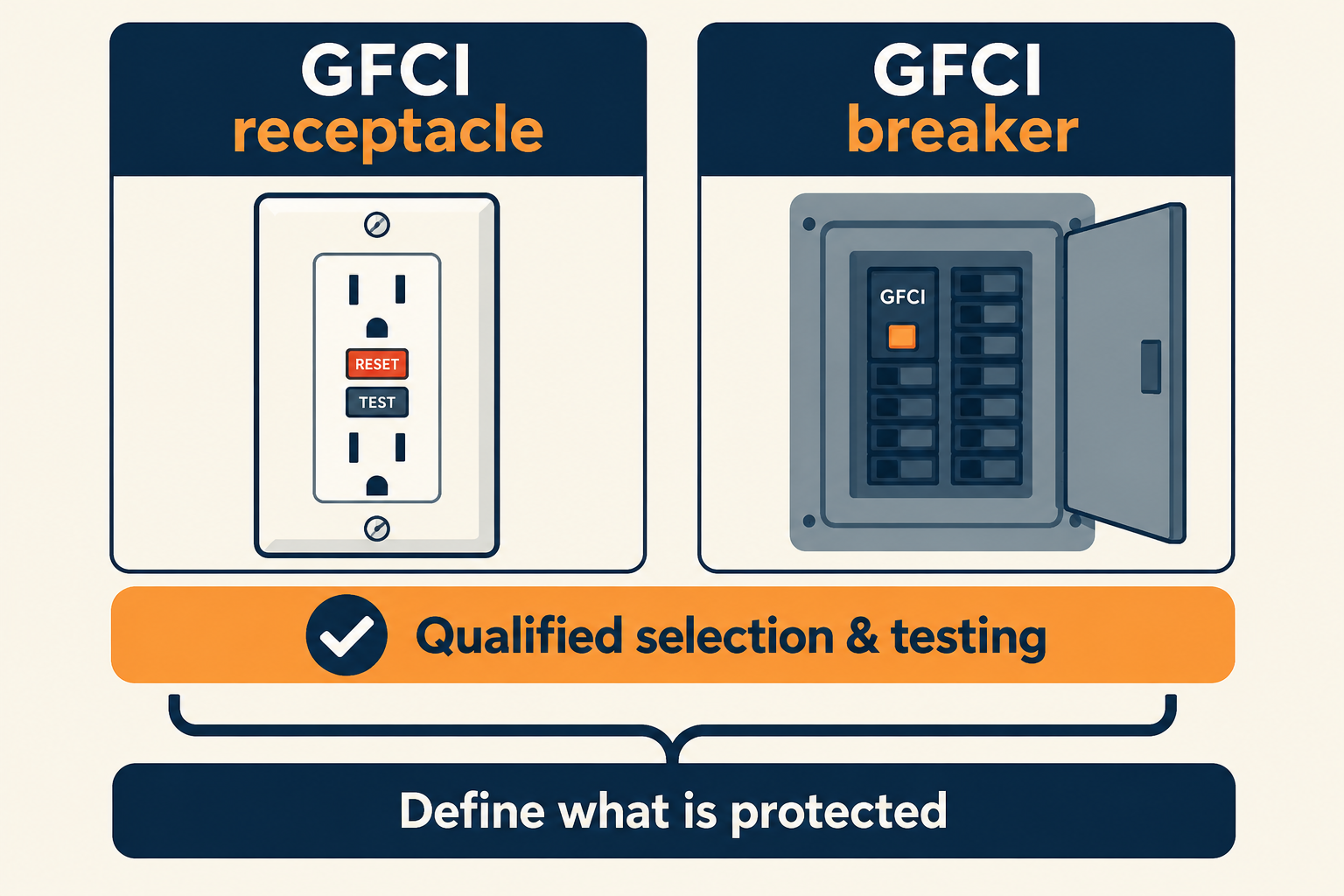
A GFCI receptacle is a device-level approach that may protect its location and downstream portions under the applicable installation. A GFCI breaker is installed at the panel and can change the scope, device cost, compatibility questions, and access. These are not interchangeable choices a homeowner should select from appearance alone.
Ask the electrician to explain which protection point is being added or corrected, what it protects, and what existing wiring or panel condition limits the choice. Do not bypass a device that trips.
What the price may include
- service-call and diagnostic labor;
- receptacle or breaker and compatible installation;
- box, conductor, panel, or connection correction;
- downstream protection or device mapping;
- outdoor or wet-location enclosure, cover, or penetration work;
- testing and labels;
- permit, notification, inspection, and finish restoration where applicable.
For a single device, the electrician’s minimum may dominate. For several locations, grouping work can improve economics if each outlet and circuit is listed.
Cost drivers and scenarios
Straight replacement: An existing GFCI device is diagnosed as defective and the box/wiring are suitable. The price is visit, device, labor, and testing.
Canada has a model-specific exception to ordinary replacement pricing: Health Canada recalled named Electrical Devices TST15 15-amp and TST20 20-amp GFCI packages because terminal screws may fail to tighten. The notice tells consumers to stop using those products and contact Unison Ridge for removal, return, and refund instructions. Check the current recall notice for affected packages and remedy details; this does not apply to other GFCIs or establish a general replacement need.
New protection: A standard receptacle or circuit needs GFCI protection under the applicable project scope. Adding protection may involve downstream devices, panel space, wiring condition, and a new box.
Wet or outdoor location: Exterior exposure, moisture, enclosure, routing, and local protection rules add cost uncertainty. Use the outdoor outlet guide for the broader exterior installation.
Reset or trip problem: A GFCI that will not reset or trips repeatedly may be detecting a fault, have a wiring/device issue, or be defective. Ontario ESA’s handbook describes a limited test-button observation and directs professional replacement if power stays on after the test; that Ontario guidance does not authorize opening or altering equipment.
Requirements are local
Ontario ESA describes GFCI as shock protection and gives examples concerning outlets near sinks and receptacles near tubs or showers; the applicable room, location, and current code affect project scope. CPSC material is U.S. consumer safety guidance and does not establish current requirements for every jurisdiction. Code edition, renovation versus replacement, and local authority adoption can change the answer.
Quote checklist
Ask what condition or requirement prompted the work, receptacle or breaker approach, protected locations, compatible device, existing wiring, panel interaction, access, testing, permit/inspection, labels, and exclusions. A quote that says “install GFCI” without saying what is protected is incomplete.
The economical choice is the one that provides the required protection for the actual installation and explains any remaining circuit fault. It is not necessarily the lowest device price.
Separate a device issue from a circuit fault
A GFCI that trips may be responding to a fault, moisture, a connected load, a downstream device, or a failed unit. Replacing a device does not price the investigation when the trip repeats. Leviton describes automatic self-test as a feature of some modern GFCIs that periodically checks internal sensing and tripping; the source gives no test interval or response for every model. The exact device instructions control how to interpret an indicator or trip. Do not assume every GFCI has this feature or treat it as permission to ignore instructions or a recurring fault.
Keep a device replacement, added protection, and circuit diagnosis as separate quote paths. For an older or ungrounded circuit, GFCI protection does not automatically create an equipment-grounding path. If an inspection recommends protection, ask the electrician to identify whether the finding is a device condition, a missing protection point, or a broader circuit issue.
Specify the protection result being priced
For each outlet or circuit, ask whether the quote replaces one device or adds protection, whether it uses a receptacle or breaker, which locations are protected downstream, and how the result will be tested and labeled. Include outdoor enclosure, moisture correction, access, and restoration when relevant. If the device is part of a renovation, compare the protected scope with the work planned while walls are open, but avoid speculative upgrades until the required result is clear.
The quote is complete when it states the protection boundary, compatible device, circuit condition, testing, and any remaining diagnosis. That gives the homeowner a usable cost comparison without implying that device installation alone resolves every trip or grounding concern.