
A breaker that trips once is an event. A breaker that trips repeatedly is a diagnosis problem. The cost might stay near a service-call minimum if a connected device is the cause, or it might grow into a breaker, branch-circuit, panel, or wiring repair. A U.S. specialist source reports roughly $100–$200 for breaker replacement as a market observation. Angi’s Cost Insights panel reports $570–$1,000 for a dedicated circuit, but the same page gives $250–$1,100 in its opening text and a $750–$1,520 calculator total. Angi does not reconcile those sections’ assumptions, so the ranges should not be blended; treat the Cost Insights figure as one U.S. planning observation, not a diagnosis or local quote.
Do not repeatedly reset a breaker to keep a failing circuit in service, bypass protective equipment, or open a panel. Arrange qualified electrical assessment, especially when the trip is accompanied by heat, odor, sparks, buzzing, smoke, or visible damage.
What the symptom can mean
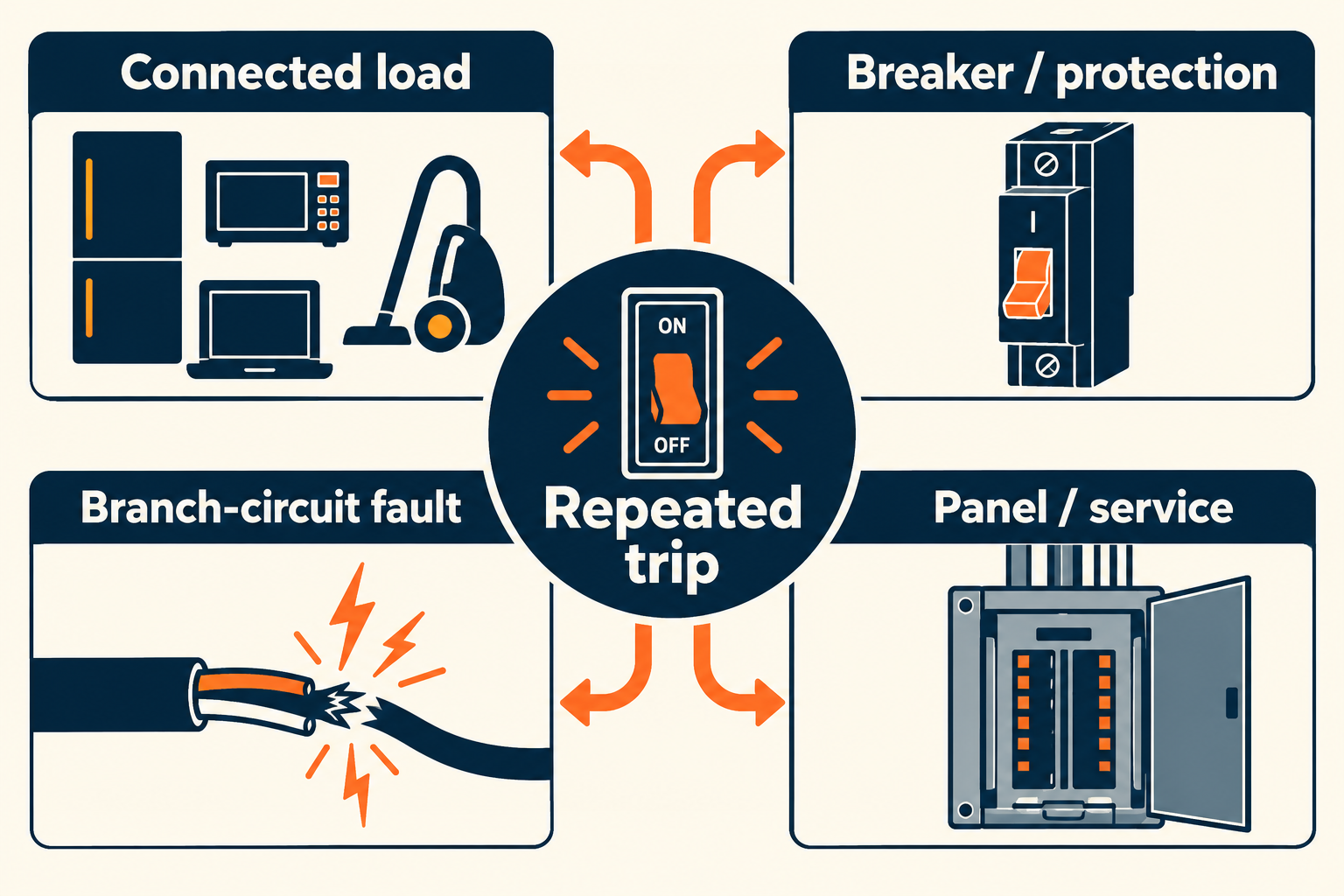
The same symptom can arise from different problem classes:
- Connected-load problem: Several appliances or a single failing device may draw more current than the branch circuit can safely carry.
- Breaker or protection-device problem: The breaker may be worn, damaged, incompatible, or responding to a fault elsewhere. A trip does not prove the breaker itself has failed.
- Branch-circuit fault: A damaged conductor, connection, receptacle, splice, or concealed section may cause repeated operation.
- AFCI or GFCI-related trip: The protective function and the fault being detected are different from a simple overload. CPSC distinguishes AFCI fire-risk protection from GFCI shock protection; the exact device and local requirements still need verification.
- Panel or service condition: Heat, corrosion, altered equipment, limited spaces, or a broader distribution problem can turn a branch symptom into a panel project.
The electrician’s first job is to separate these paths. A cost guide cannot responsibly assign one repair price to all of them.
Typical cost paths
| Finding | Likely economic shape |
|---|---|
| A connected appliance or tool is the confirmed cause | Service-call or diagnostic cost; no electrical repair may be needed, though the equipment may need its own service. |
| One compatible breaker is diagnosed as defective | Minimum visit plus breaker and installation labor; specialty AFCI/GFCI or main-breaker work can change parts and scope. |
| Circuit is overloaded for its intended use | A new dedicated circuit may be quoted; routing, distance, panel space, access, and finish repair drive the total. |
| Damaged outlet, connection, or accessible wiring | Device repair plus labor; heat or damaged conductors may require a larger opening and replacement scope. |
| Fault is concealed or intermittent | More diagnostic time, staged testing, access, and an allowance for finish restoration. |
| Panel or service limitations are involved | Panel repair/replacement or a broader capacity assessment; this is no longer a simple breaker swap. |
The lower-cost path is not always the best economic choice. A quick breaker replacement that does not address why the circuit trips may buy little value and leave the underlying risk unresolved.
Why cost escalates
Distance from the panel matters because a new circuit or repaired run may require more cable, more access, and more wall or ceiling work. Finished plaster, tile, insulation, occupied rooms, and inaccessible crawl spaces slow the job and add restoration. Multiple trips can cost more than one planned visit with the correct parts, but an electrician should not guess at a concealed fault merely to avoid a return appointment.
Panel space and system condition create another branch in the decision. A subpanel can distribute circuits but does not automatically create more utility capacity. If several future loads are driving the concern, whole-home load planning belongs with the portal’s electrification and utility-capacity content rather than a symptom article alone.
Low, expected, and difficult cases
Contained case: One device is identified as the trigger, the circuit is accessible, and no heat or damage is found. The expense is mainly the service call and any confirmed device repair.
Typical electrical repair: A compatible breaker, receptacle, connection, or short accessible circuit section is repaired after diagnosis. Budget for the visit, materials, and a defined repair rather than a generic breaker price.
Difficult case: The trip is intermittent, occurs across an AFCI/GFCI device, affects a concealed run, or reveals panel heat or legacy wiring. Expect diagnostic staging and a quote with explicit unknowns. Do not authorize a major rewire or panel replacement solely from the symptom without a professional explanation of the observed condition.
What to ask for in the quote
Request the affected circuit or device, the observed cause, the proposed correction, compatible replacement equipment, access assumptions, testing included, permit or inspection responsibility where applicable, wall repair, and what happens if the fault is not found during the first visit. Ask whether the price is a repair after diagnosis or only an allowance.
If the electrician recommends a dedicated circuit, compare the new circuit’s endpoint, route, breaker, protection, panel work, finish restoration, and commissioning—not just the cable and breaker. If the recommendation is panel replacement, ask whether it is condition-driven or actually a service-capacity project.
The decision is resolved when the repeated trip has a documented cause, the repair addresses that cause, and the quote makes the remaining uncertainty visible. The number of trips alone is not a replacement threshold.
Read the pattern without diagnosing it yourself
Record whether the trip follows one appliance, happens when several loads run, affects one room, or occurs with no obvious timing. Note whether other outlets or lights also change and whether the device resets only temporarily. These observations help the electrician, but they are not permission to test live equipment or to conclude that the breaker is the fault.
The economics change when the symptom is repeatable. A device-related trip may need an appliance repair and only an electrical assessment. A circuit that trips under ordinary use may justify a dedicated-circuit quote. An intermittent trip with heat or odor needs a more conservative response and may require access before a fixed price is possible.
Avoid the false saving of a replacement part
Replacing a breaker without tracing the cause can create a second service call and leave the circuit in the same condition. Conversely, replacing a panel because one breaker trips can over-scope the work. Ask the electrician to state the evidence for the recommended level: connected load, circuit condition, protective-device behavior, panel condition, or service-capacity analysis.
If the proposed fix is a dedicated circuit, compare its route, endpoint, protection, access, panel space, testing, and restoration. If the proposal is a capacity upgrade, ask which future loads were analyzed and why ordinary branch-circuit repair is insufficient. A larger service is a separate economic decision.
Set the diagnosis and authorization boundary
A useful first visit narrows the decision. Ask whether the electrician will identify the affected circuit, review the reported trip pattern, assess the relevant accessible equipment, and explain what remains unknown. The quote should separate the diagnostic allowance from any authorized repair, state how testing will confirm that work is complete, and name the point at which the electrician will stop for approval before opening finishes or expanding the scope.
Keep an appliance repair, breaker replacement, branch-circuit correction, and panel or service-capacity project as distinct paths. If several circuits trip, have the electrician map the issue before treating it as a panel problem; multiple symptoms can be related, but they do not establish one cause. For a short ownership horizon, a documented correction may be enough when the rest of the circuit and panel are serviceable. For a longer horizon, include repeat-trip risk, circuit records, planned renovation access, and future loads. The strongest quote tells you what condition was found, what the correction addresses, and what risk remains.