
One U.S. specialist observation places circuit-breaker replacement around $100–$200. A Canadian specialist source reports a representative CAD $130–$250 observation. Those ranges are for planning, not a diagnosis, and the final invoice may be dominated by the electrician’s minimum visit charge. A main breaker, AFCI, GFCI, dual-function, obsolete, or hard-to-source breaker can have a different scope from an ordinary compatible branch breaker.
Replacement is not the same as reset
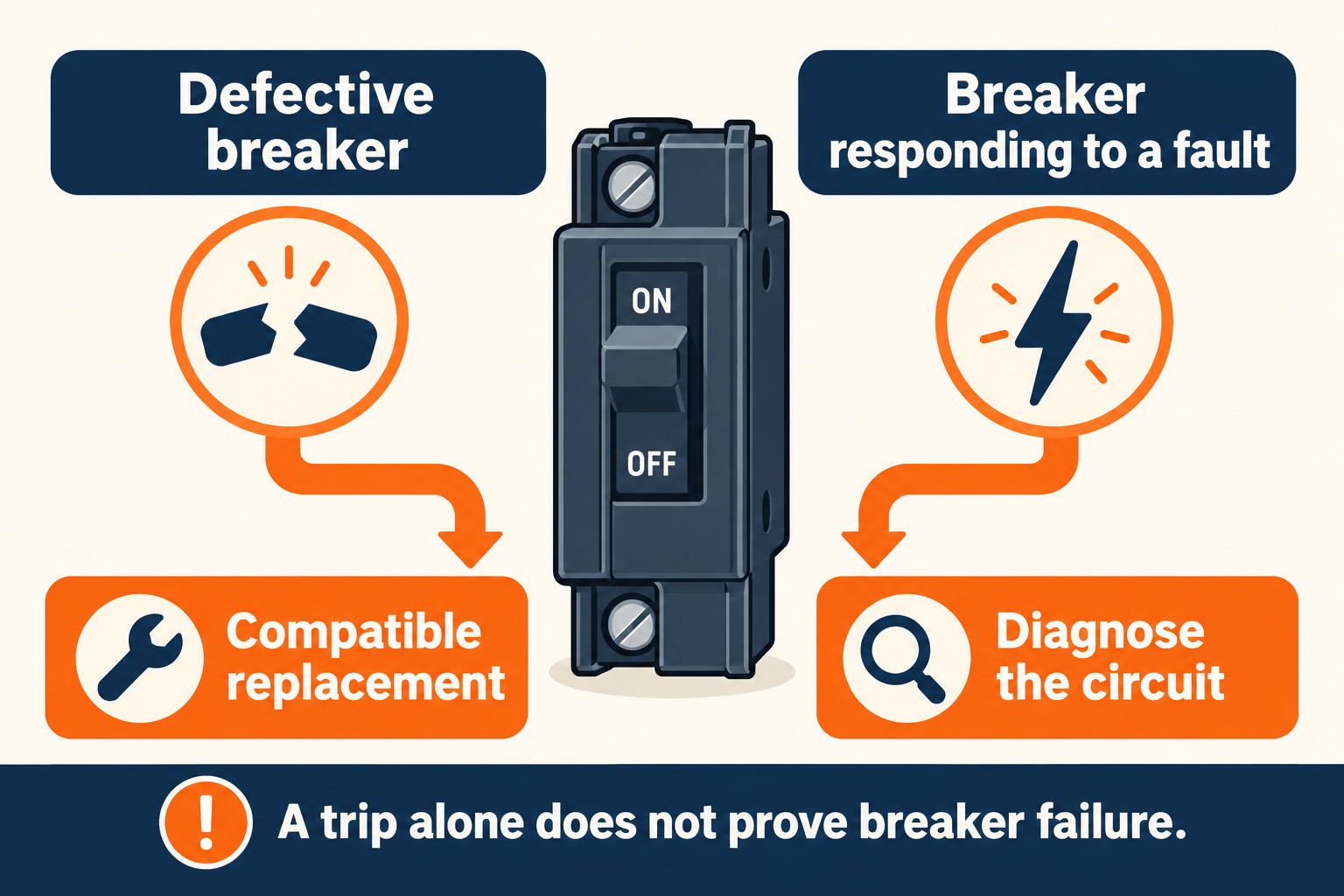
A breaker trips because it is responding to a condition or because the device itself may be faulty. The condition can be an overload, short circuit, connected-equipment fault, damaged connection, branch wiring problem, or protection-device interaction. Replacing the breaker before understanding why it operated can leave the underlying problem in place.
CPSC treats panel work as a qualified-professional task. Do not remove the dead front, move conductors, or substitute a breaker based only on appearance. Compatibility depends on the panel and exact listed equipment, not only amperage or physical fit.
What the price may include
- service call and diagnosis;
- compatible breaker or specialty protection device;
- installation, labeling, and testing;
- investigation of the circuit or equipment that caused the trip;
- panel correction if heat, corrosion, damage, or incompatibility is found;
- permit, notification, or inspection where applicable;
- return visit if the correct part is not available.
For a small repair, the breaker may cost less than the visit. Ask whether a diagnosis-only charge is applied to same-day labor and what a second trip costs.
Standard, specialty, and main-breaker cases
An ordinary branch breaker in a serviceable panel is usually the narrowest case. AFCI and GFCI breakers add protection functions and may trip for reasons that are not solved by substitution. A main breaker affects service equipment and can require shutdown or wider assessment. Older panels may have limited replacement options, and the correct remedy may be panel repair or replacement rather than a component swap.
Scenarios that change the budget
Contained replacement: Diagnosis confirms the breaker is defective, the panel model accepts the replacement, and no wiring damage is found. Expect the service minimum, part, labor, and testing.
Trip-cause repair: The breaker is operating as designed because of load, equipment, or circuit fault. The useful repair may be a dedicated circuit, equipment repair, connection correction, or wiring work—not a breaker replacement.
Panel escalation: Heat, corrosion, obsolete components, repeated failure, or incompatibility makes the panel itself the decision. Compare a defined panel scope rather than adding repeated breaker prices.
Quote questions
Ask for the panel and breaker identification, observed reason for replacement, proposed compatible part, circuit affected, testing included, access and shutdown assumptions, permit/inspection responsibility, and exclusions. If the electrician recommends an AFCI/GFCI device, ask which protection function is being addressed and whether local applicability was verified.
The economical repair is the one that corrects the reason for the breaker work. A new breaker is a component decision; a repeated trip is a diagnostic decision.
When a breaker is the wrong line item
If the breaker trips under a normal load, ask whether the electrician found an overload, connected-equipment fault, wiring fault, protection-device operation, or defective breaker. Each answer changes the economic path. A dedicated circuit may be appropriate for a defined load. A panel replacement may be appropriate for documented equipment condition. Neither follows from a trip alone.
For an older panel, the part may be unavailable or the replacement may not be listed for that enclosure. Ask for the exact panel and breaker identification, not just amperage. A physically similar component is not automatically compatible. If a specialty device is proposed, ask what function it provides and how the circuit will be tested.
Record what the replacement resolves
A breaker can be the failed part, or it can be responding to a condition elsewhere. Ask the electrician to identify the panel and breaker, state the reason for replacement, name the compatible part, and describe the test or observation that confirms completion. If the original symptom was a repeated trip, the record should say whether its cause was corrected or remains uncertain.
Price a defined breaker replacement separately from diagnosis of an overload, connected appliance, branch-circuit fault, protection-device response, or panel condition. For several known non-urgent replacements, a planned visit may reduce repeated minimum charges; an unexplained hot device or recurring trip still needs its own diagnosis. If the correct part is unavailable or not listed for the enclosure, compare a compatible repair with a panel decision instead of authorizing a part based on physical fit.
The quote should also identify shutdown, access, testing, labels, any permit or inspection, and the stop point for broader work. That gives a future electrician enough context to avoid repeating a swap that did not resolve the issue.