
When a permitted project has stalled, first find out what the authority’s record says. An issued permit that is still active, an expired permit that can be extended or reestablished, and a permit that has been revoked or replaced can lead to different approval paths and costs. Local rules control the answer. There is no universal expiry period or standard renewal fee.
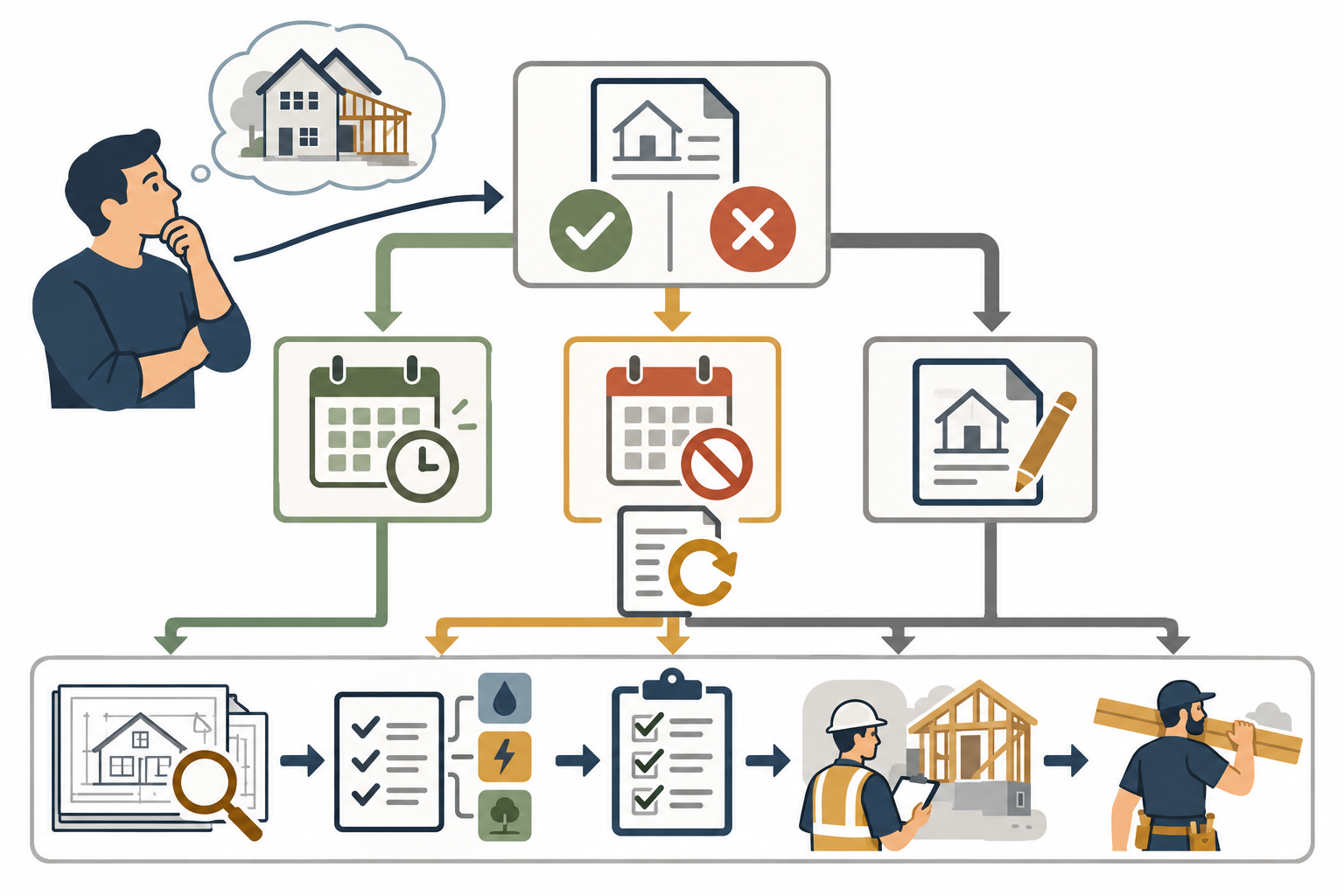
Do not schedule work based only on an old permit card, an application receipt, or a contractor’s recollection. Ask the permit authority to confirm the status of every related approval and what must be approved before work resumes. Paying an extension fee or submitting a request does not itself confirm that the request was granted or authorize a restart.
Start with the permit record
Collect the address, permit number, issue date, approved plan set, inspection history, correction notices, and any planning, zoning, demolition, plumbing, electrical, mechanical, or other related permits. If you bought the property or inherited a project, ask how to access the full record and whether the authority needs proof that you may act for the current owner.
Ask the authority to state in writing:
- Whether the permit is active, expired, void, revoked, suspended, or awaiting a required action.
- What event or deadline determines that status under the permit and local rules.
- Whether an extension or reinstatement path exists, and whether it must be requested before expiry.
- Whether related land-use or trade approvals remain active.
- What construction, inspection, document, or professional evidence is required.
- Which code edition and approved drawing set would govern any remaining work.
“Inactive” may be an administrative description rather than a formal legal status. Ask what it means in the authority’s record and what consequence follows. A project with no inspection for a long time might still have an active permit in one place and an expired planning approval elsewhere.
Extension, reestablishment, and new application are different paths
Some authorities allow a permit holder to request an extension before a stated expiry date. Others allow a limited reinstatement period after expiry. An authority may also require a new application when its renewal criteria are not met or when the scope and applicable rules have materially changed. Similar words can describe different procedures, so use the authority’s form and terminology.
Seattle’s current guidance is a local example, not a national standard. The city says construction, demolition, mechanical, and grading permits typically expire 18 months after issue; eligible permits may be renewed up to 30 days before expiry and may be reestablished if they have been expired for less than one year. Its listed conditions include an unexpired associated land-use permit and an inability to start or finish because of circumstances beyond the permit holder’s control. If a request comes more than 18 months after new or revised building codes take effect, Seattle says it must determine whether the permit complies or can be modified and requires the work to be substantially underway at an approved rate. The city also identifies possible additional evidence for environmentally critical sites. Confirm the rule and fee for your permit type with Seattle SDCI.
Vancouver illustrates a different Canadian process. Under the 2025 Vancouver Building By-law, a permit may expire, in the Chief Building Official’s opinion, if work has not started within six months, is not continuously and actively carried out, or has been substantially discontinued for six months. An owner seeking an extension must apply before expiry and submit the required fee. The Chief Building Official may extend in specified exceptional circumstances, subject to the bylaw’s conditions; a further extension can be requested from Council after an extension by the Chief Building Official. This is Vancouver’s rule and does not establish what another Canadian municipality will do.
Budget for more than the authority charge
The direct government fee may be only one part of restarting. Build separate allowances for:
- Permit administration: extension, reestablishment, amendment, new application, review, record search, or inspection charges.
- Design and professional review: checking whether the old plans still match the site, current code, and remaining scope; updating drawings, calculations, letters, or forms.
- Outstanding approvals: separate planning, zoning, trade, utility, environmental, or heritage reviews that have their own status and charges.
- Inspection and completion work: rescheduled inspections, tests, professional observations, correction work, and final closeout.
- Contractor restart: remobilization, revised pricing, new subcontractor availability, material reordering, temporary protection, or work needed to bring incomplete construction into compliance.
These are not all automatic fees. They are separate questions to resolve. A permit can remain valid while a contractor quote expires; a contractor can be ready while an associated approval has lapsed; or a renewed permit can still require updated documents. Ask each professional to inspect the actual file and describe the work included before treating a rough allowance as a quote.
Vancouver’s 2026 fee schedule shows why the exact route matters. For an applicant-requested extension under the cited bylaw provisions, the schedule lists 50% of the original building-permit fee up to $521; a Council extension has a separate listed charge of $3,420. Those are Vancouver schedule entries, not a price for reinstatement everywhere and not proof that a particular owner qualifies. The same schedule lists separate fees for review of revisions, which should not be merged into an extension amount. Check the current schedule and applicable bylaw before relying on the figures.
Compare restart paths before committing to one
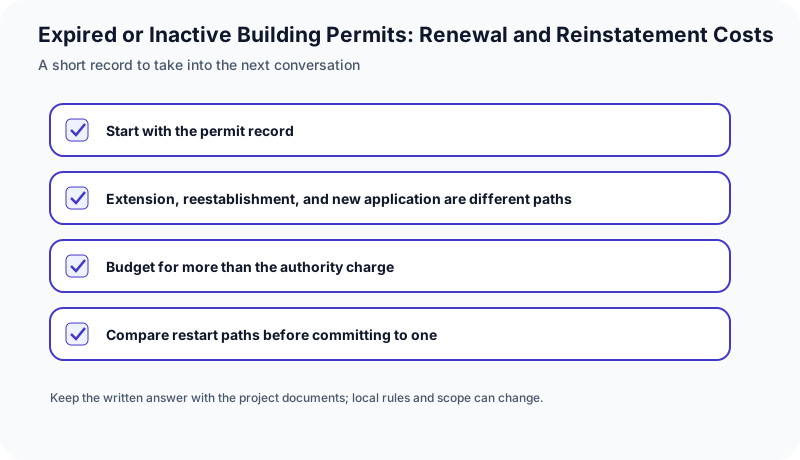
Ask the authority to compare extension, reestablishment, and a new application for the actual permit record. A low renewal fee can still lead to code review, document updates, or additional inspections. A new application may be more expensive upfront but fit a changed project better. The authority, not the owner or contractor, decides which path is available.
Ask the architect or engineer to review the approved set before estimating updates. The original designer may know the assumptions but may no longer be available; a replacement may need time to verify the work before taking responsibility. If the existing construction is incomplete, get a contractor estimate that separates completion, correction, and remobilization.
Keep the authority’s written decision with the current drawing set and share it with every contractor or professional returning to the project. If the work pauses again, record the new inspection and schedule milestones so the same status uncertainty does not recur.
Ask the authority to identify any deadline for submitting additional documents or paying the extension fee. A written request alone may not preserve the permit if the authority requires a complete filing by that date.
Save written confirmation of the renewed or reestablished status before authorizing remobilization.
Check whether the approved design still fits
Before seeking a price, compare the approved set with the project today. Has the structure been exposed to weather? Have site conditions, drainage, utilities, neighboring construction, or ownership changed? Did the owner or contractor change the design, building area, use, materials, or systems? Have relevant codes or local requirements changed since the permit was issued?
If the documents must change, the authority may process the request as a revision, require additional review, or ask for a new application. A renewal does not necessarily authorize a changed design. Read permit revision and resubmittal cost for the professional and government cost layers when plans need to change.
Ask the original architect, engineer, or designer whether they can responsibly rely on the old documents. They may need to review field conditions, verify what was actually built, or update calculations. A new professional should not assume that a drawing set is accurate just because it was once approved.
A written restart-cost checklist
Request one written response from the authority that covers the permit number, current status, available path, application deadline, current fee, review requirements, code basis, associated permits, inspections still required, and whether work may resume before each decision. If the authority provides only a preliminary opinion, label it as such in the budget.
Then ask the designer and contractor for separate estimates:
- What file review or site visit is included?
- Which drawings, reports, calculations, and forms may need updating?
- Are authority fees included or paid directly by the owner?
- What inspections, tests, corrections, or closeout tasks remain?
- What restart, remobilization, storage, or schedule costs are excluded?
- What happens to the price if the authority requires a new permit or code update?
Keep the original permit, written status response, approved drawings, inspection log, and revised approvals together. After work restarts, record new inspections and changes so the project does not reach the end with another uncertain closeout.
For application and review charges, see building permit cost. For pending comments, use plan review timelines; for a completed project that still lacks final sign-off, see permit closeout. If work began without the required approval, retroactive permits covers that different situation.
Verify status before restarting work
Ask the permitting office for the current status in writing and confirm whether inspections, approved revisions, or linked land-use approvals affect the answer. A renewal may preserve an active permit under local rules, while reinstatement can involve additional review or conditions after expiry. Do not assume that paying a listed fee restores every approval or makes old drawings comply with current requirements. Ask which code edition applies, what work remains, and whether another department must act first. Give the contractor the authority’s response before mobilizing, and update the schedule and insurance arrangements to match the permitted scope. The cost decision is therefore tied to status, timing, and unfinished work as well as to the posted charge.