
A building-permit allowance may not include every government charge connected with a residential project. Some local governments also assess a one-time charge when development creates new housing, increases demand on public systems, or meets another trigger in local law. The name may be development charge, impact fee, system development charge (SDC), or another local term. There is no North American rate, and many repairs or alterations owe no growth-related charge at all.
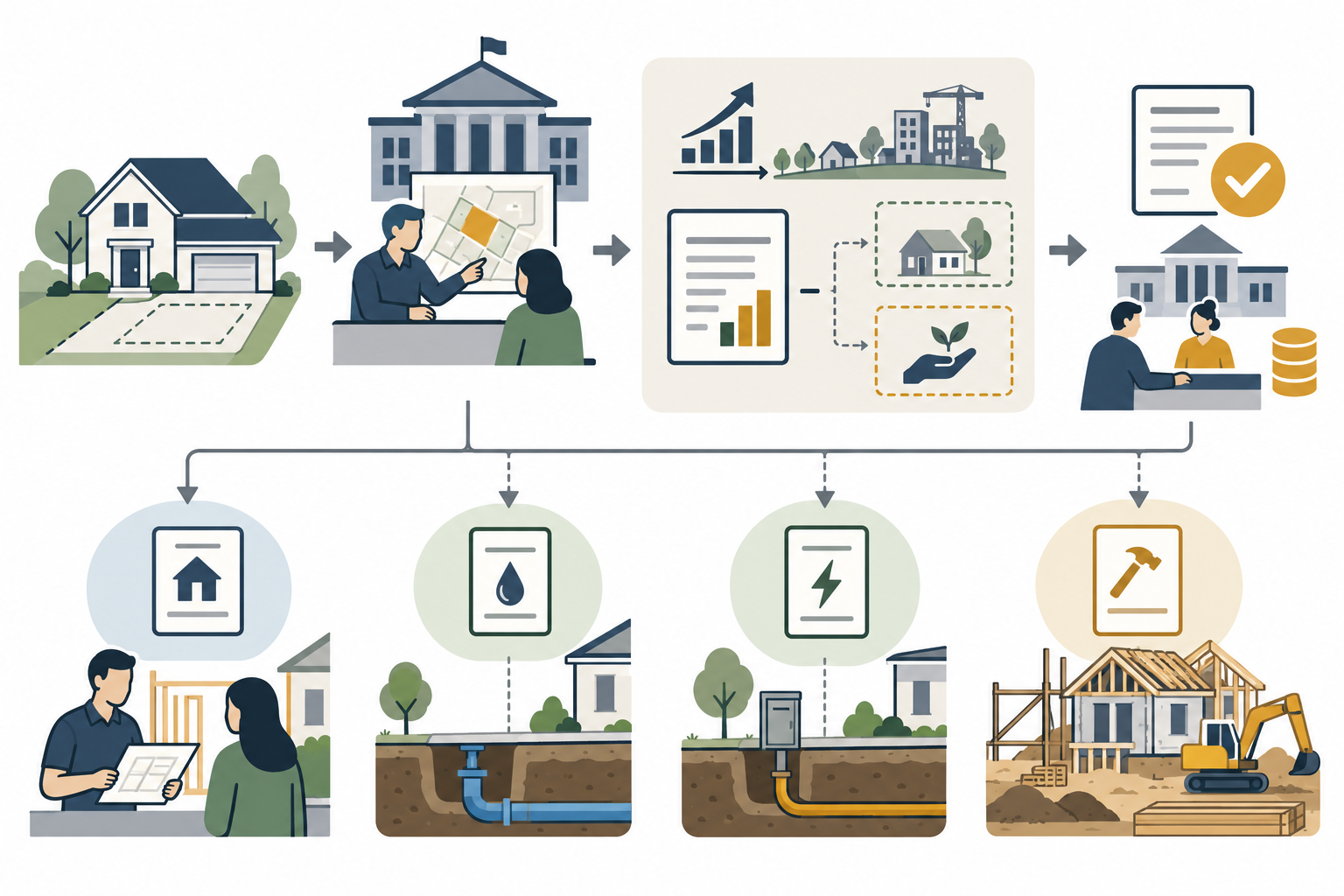
The useful first question is not “What is the average fee?” It is “What local rule applies to this address, this existing use, and this exact project scope?” The answer can depend on unit count, floor area, service area, prior development, application dates, and the authority’s own bylaw or code. Get the authority’s written calculation before treating a charge as a project cost.
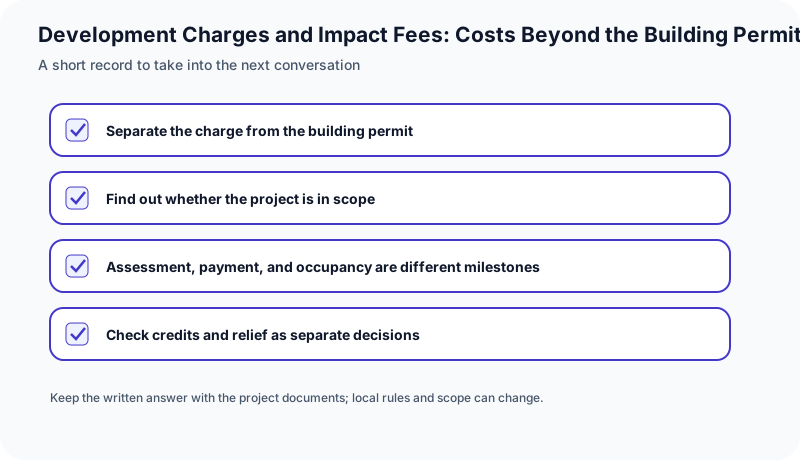
Separate the charge from the building permit
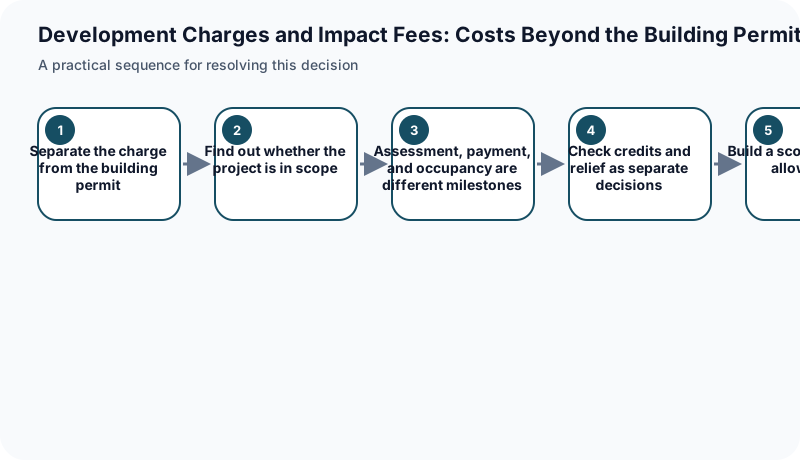
A permit application or plan-review fee pays for an approval service under a local fee schedule. A development charge or impact fee is generally intended to help fund infrastructure or capacity associated with growth. The two may be assessed by the same government, but they have different purposes and calculation rules. A project can owe either, both, or neither.
Keep other lines separate too. A one-time growth charge is not the same as physical water or sewer work, a utility connection fee, a meter, a deposit or security, ongoing utility bills, property tax, or a contractor’s site-work allowance. A charge may be due at a particular approval stage while a contractor installs the physical connection later. Combining these lines into one “permit cost” makes it hard to see what the estimate includes.
Find out whether the project is in scope
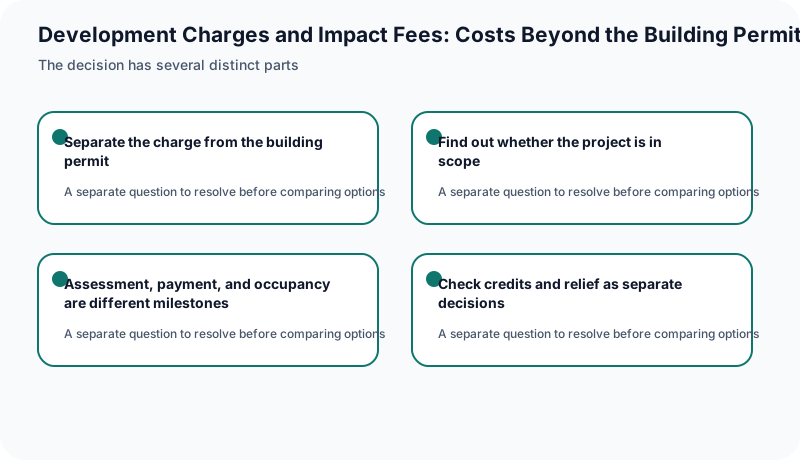
Charges are local. Depending on the applicable law, a new dwelling, an added unit, a conversion, an increase in floor area or service demand, or a change in use could matter. That list is a set of screening questions, not a rule that every such project will be charged. A like-for-like repair, interior alteration, accessory structure, replacement house, or small addition may be treated differently by different authorities.
Give the authority a precise description of both the current and proposed conditions. Include the address, existing legal dwelling and use, units before and after, floor area, bedrooms or other locally used classification, water and sewer arrangement, demolition history, and the project’s expected application and permit dates. Ask:
- Which bylaw, ordinance, service area, and rate schedule would apply?
- What event triggers the assessment and what event triggers payment?
- Is the proposed work classified as new development, an addition, a conversion, replacement, or something else?
- Does an existing unit, previous charge, or prior use qualify for a credit?
- Are separate city, county, regional, utility, or service charges assessed?
The authority’s answer may change if the plans, legal use, unit count, or project dates change. Keep the answer with the plans and fee worksheet it covers.
Assessment, payment, and occupancy are different milestones
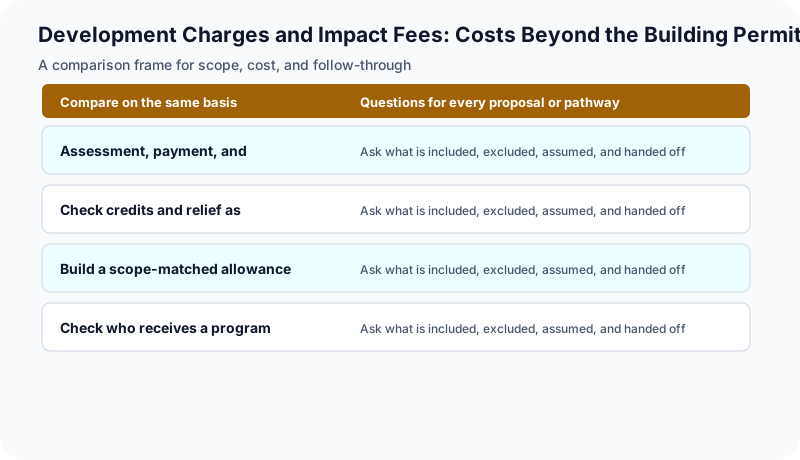
A charge may be calculated when a planning or subdivision approval is granted but collected at building-permit issuance, connection, or another point. The operative rate might depend on the date an application is complete, a permit is issued, construction begins, or an agreement is signed. One date can determine the rate while another date determines when money must be paid.
Ask for each milestone separately. Request the calculation date, the rate schedule and classification used, the event that fixes the rate, the payment deadline, and any required security or agreement. If payment can be deferred, find out whether the arrangement adds interest, administration fees, a lien, or another payment obligation. Deferral changes timing; it does not automatically reduce the amount owed.
An estimate should also identify whether it is preliminary or final. Before plans are complete, staff may only be able to give a range or point to the relevant bylaw. A contractor’s allowance is not a municipal determination, and an old project invoice is not proof of the amount for a new application.
Check credits and relief as separate decisions
Several kinds of relief can look similar in an estimate but work differently:
- A credit may recognize an existing or demolished use, a prior payment, or another amount allowed by local rules.
- An exemption may remove a charge when a legal definition and all conditions are met.
- A reduction or incentive may lower a rate for a defined project, applicant, unit type, or application period.
- A deferral may postpone payment while leaving the underlying charge due.
- A refund may return money only after a qualifying event and an application.
- A security or deposit may be refundable when specified work or obligations are completed.
Do not subtract a possible credit or incentive from the gross allowance until the authority confirms eligibility and documents the amount. A development-charge background study, public announcement, or funding announcement can describe policy without deciding how a specific parcel is classified.
Ontario illustrates why program status and local implementation both matter. The province’s Development Charge Reduction Program describes municipal commitments to reduce residential development charges by 30% to 50% or more for three years. It is a funding program for municipalities, not an automatic rebate paid to each homeowner. Toronto announced reductions of 40% to 60% from 2026 to 2029 depending on unit type. Mississauga’s published incentive page lists a 50% reduction for residential unit types and a 100% reduction for certain purpose-built rental apartment units, with a 25-year rental-tenure agreement and a footing-and-foundation permit deadline. These programs concern qualifying development projects; a buyer or homeowner should not assume the benefit applies to a private renovation or will be passed through in a sale. Check the city’s current rate and project rules.
The provincial DCRP page now says applications for funding are closed. This is the status of new municipal funding applications, not a complete description of each city’s charge schedule: Toronto’s June 2026 announcement describes its unit-type reductions as 40%–60% between 2026 and 2029. A closed provincial intake does not establish whether a particular address, unit type, or permit date qualifies; check the municipality’s current bylaw and rate schedule.
Portland provides a different example. Its ADU SDC waiver is tied to a covenant that restricts short-term rentals across the property for ten years. The city describes the eligible use and agreement requirements, and says violating or revoking the covenant can require payment of 150% of current SDC fees. That is a substantial, continuing obligation attached to a local program, not a generic ADU discount. Portland also distinguishes this waiver from its other SDC rules. A lower initial bill can have a long-term condition, so read the agreement and ask what follows the property if it is sold.
Build a scope-matched allowance
Do not create a “typical development charge” by adding the largest fees you can find. Instead, build a project worksheet with separate rows for:
- Building and trade permit application fees.
- Growth-related charges assessed by each responsible authority.
- Credits that are confirmed and supported by records.
- Conditional reductions or exemptions, shown separately from the gross charge.
- Deferrals, interest, securities, and payment deadlines.
- Physical utility connections, service upgrades, and site construction.
- Professional time to prepare applications, obtain records, or revise plans.
For illustration, write the estimate as “authority’s gross charge, less confirmed credit, with conditional relief shown separately,” rather than showing an unverified net number as money saved. Add a date and assumptions. If eligibility is pending, budget the gross amount until written confirmation arrives or explicitly show the range of cash outcomes.
Check who receives a program benefit
When a government announces infrastructure funding or a rate reduction, ask which applicant receives the relief and how it is applied to the project. A builder’s eligibility does not prove that a homebuyer or homeowner receives the same amount. If a contractor or seller says the price includes a savings, ask for the original gross charge, the local bylaw or program calculation, the qualifying conditions, and the amount actually credited to the owner.
Ask whether the relief attaches to the property, a project, a unit type, a construction milestone, or a named applicant. If it requires a covenant or agreement, get the document before comparing the apparent discount with another design. Ask how resale, a change in use, missed milestones, or program expiry could affect the obligation.
If the project has more than one authority, ask whether each uses a different rate date or collection milestone. A city charge and a regional charge can both apply even when one office prepares the building permit. Obtain a separate written calculation for each payer.
Questions for a written estimate
Send the authority a one-page scope summary and ask for the governing schedule, calculation method, classification, service area, and relevant dates. Ask what evidence supports existing-use credit, whether demolition or replacement changes the calculation, whether another authority assesses a separate amount, and whether any relief requires an application before a permit is issued. Request the program agreement, covenant, or deferral terms before signing.
Ask the designer or contractor to identify who will request the determination, who pays the charge, whether the proposal includes only application fees or also growth charges, and how a later change in unit count or floor area is handled. A line labeled “permits and fees” is not enough to tell you what is included.
Use preconstruction soft costs to organize the wider professional and approval budget. Building permit cost explains application and review fees, while residential project feasibility can help identify an unresolved charge before full design. For a stock plan, permit readiness covers site-specific approval work.