
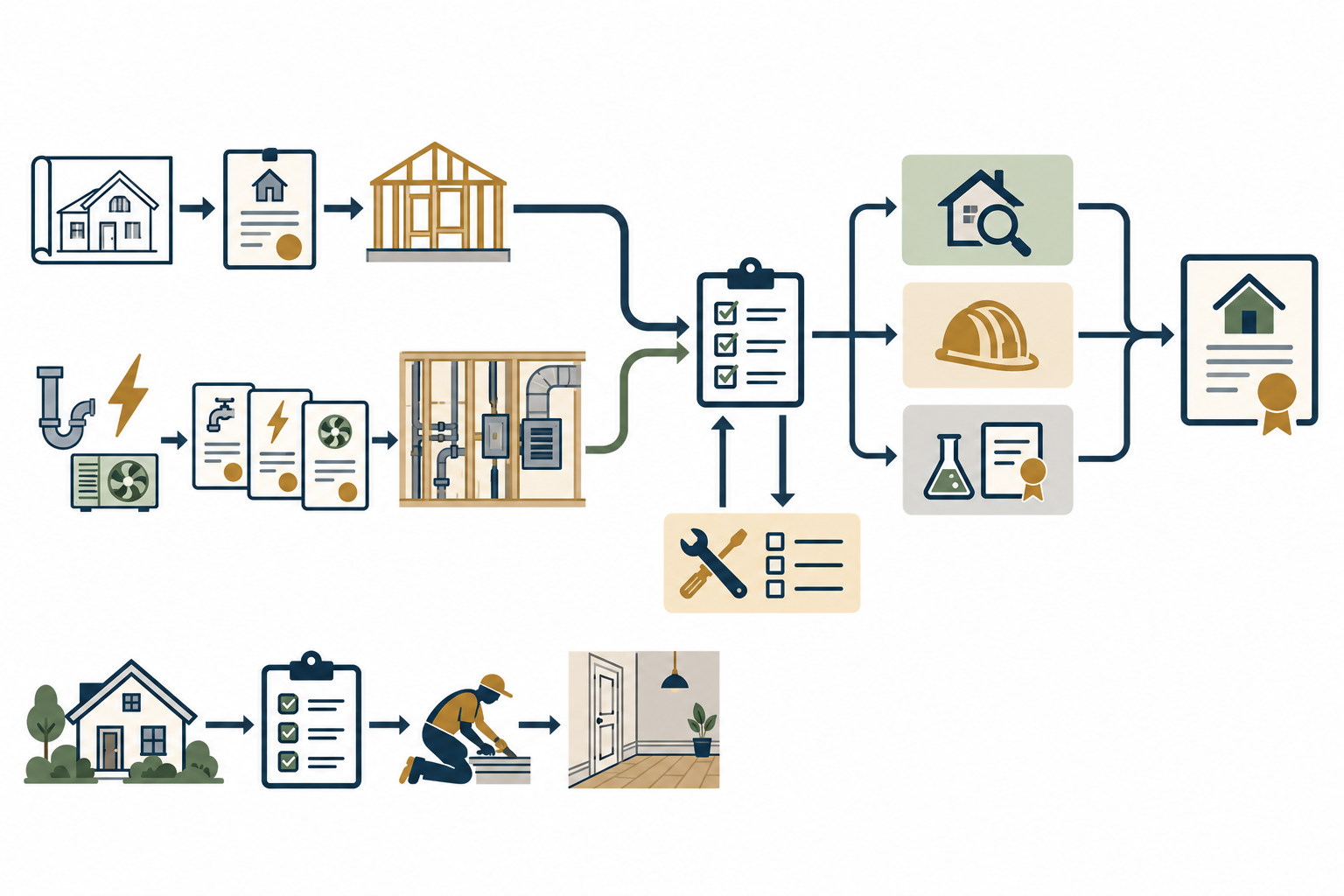
Finishing construction does not always close the permit. The authority may require a final inspection, unresolved corrections, trade-permit sign-offs, certificates, testing, professional letters, or occupancy documentation. The exact terms differ by jurisdiction and permit type.
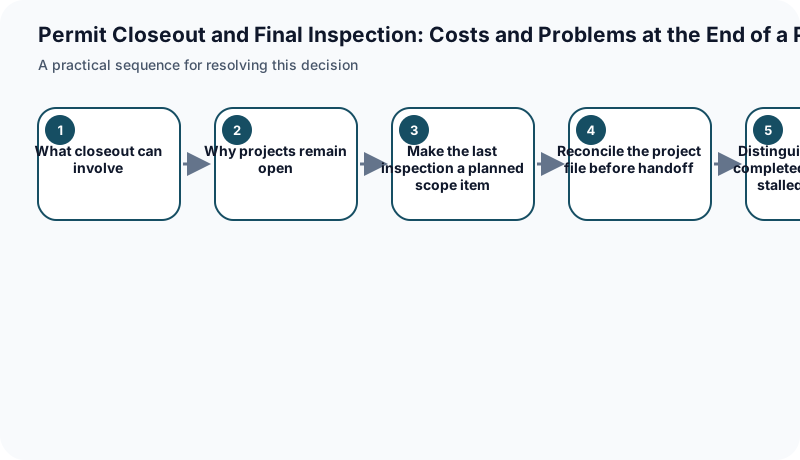
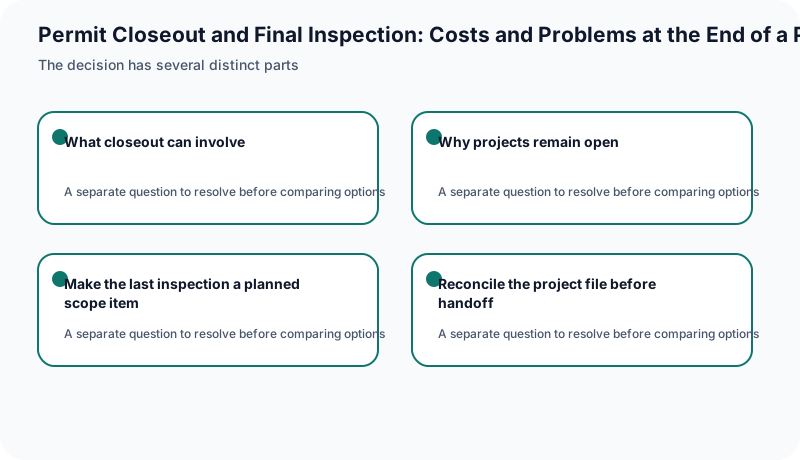
What closeout can involve
The final step may include requesting an inspection, making all work visible or complete, correcting deficiencies, submitting documents, paying a reinspection or outstanding fee, and obtaining a final approval or completion record. Some projects also require a certificate of occupancy or another use-related document; others do not.
British Columbia’s overview lists final inspection as part of permit completion and notes that occupancy or completion-inspection questions belong with the local government. Ontario guidance likewise tells permit holders to contact the municipality about required inspections. These sources establish process logic, not one checklist.
Why projects remain open
- A final inspection was never requested.
- One trade permit was not closed.
- Work differs from approved plans.
- A correction or document remains outstanding.
- Required testing, professional assurance, or occupancy paperwork is missing.
- The owner assumed the contractor handled closeout without confirming it.
An open permit may create administrative work, reinspection cost, redesign, or physical correction. The effect on a sale, refinance, insurance matter, title question, or occupancy decision depends on local records and professional advice; do not make a universal legal claim.
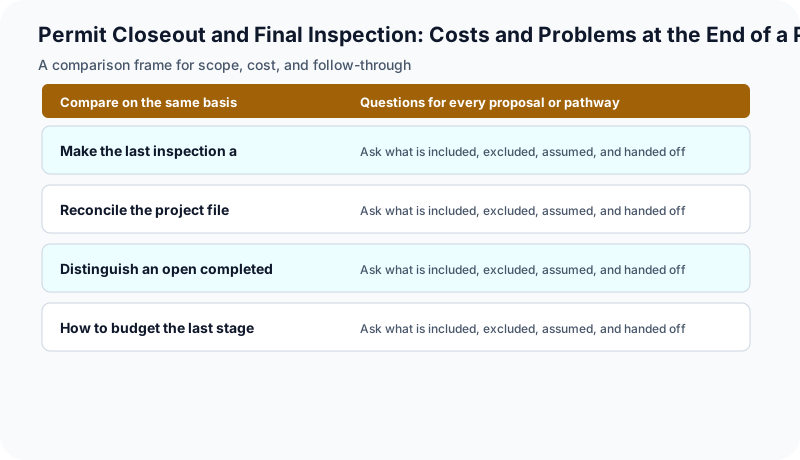
Make the last inspection a planned scope item
Before construction reaches its final stage, ask the authority what remains for each building and trade permit. Identify inspections that must be scheduled, work that must remain visible, testing or commissioning records, professional letters, revised drawings, fees, and any final approval or occupancy record. A general request for “final inspection” may not close every separate permit.
Ask the contractor to provide a completion list that matches the approved documents and inspection record. The list should identify unfinished work, open correction notices, missing product or test information, and who will arrange access. Ask the architect or engineer whether final visits, field observations, record drawings, or assurance letters are in the contract. If not, request a separate fee and define how many visits or document rounds it includes.
An inspection that cannot proceed because an area is concealed or incomplete may require another visit or reopening of finished work. Keep the expected reinspection charge separate from the cost to correct or expose the work. The local fee schedule may show only the authority’s charge; it does not price the contractor labor, finishes, testing, or professional review needed before that visit.
Reconcile the project file before handoff
Keep the issued permit, approved plan set, all revisions, inspection results, correction letters, professional reports, product substitutions, warranties, and payment records in one closeout folder. Record which documents were accepted by the authority and which were only prepared by the contractor. If the built work differs from the approved set, ask the authority and responsible design professional what documentation or approval is needed. A verbal assurance that a difference is minor does not update the public permit record.
At final payment, compare the contract’s closeout obligations with the actual status of all permits and deliverables. Ask who owns unresolved work, who is responsible for an inspection request, and what documents are still outstanding. A final invoice does not necessarily mean the authority has accepted the work, and a passed inspection does not automatically resolve every land-use or utility approval.
Distinguish an open completed job from a stalled project
This article addresses work that is complete or nearly complete but still needs final sign-off. If construction stopped before required inspections or has been inactive for a long period, first ask whether the issued permit remains active and whether the approval can be extended or reinstated. The project may need status review before it can continue, even if the original goal is only to finish closeout. Permit renewal and reinstatement costs covers that separate restart decision.
If the permit is active and the work is complete, focus on the remaining inspection, document, correction, or fee. If the permit has expired or was revoked, do not assume a final inspection request alone will resolve it. Get the authority’s written status and a list of steps before paying to remobilize or close walls.
How to budget the last stage
Ask the authority for the current closeout checklist and status of every related permit. Ask the contractor for a written list of incomplete work and who pays to correct it. Ask the architect or engineer whether final observation, record drawings, letters, or document submission is included.
Keep separate allowances for:
- Authority inspection or document fees.
- Contractor completion and correction work.
- Professional review, redesign, or certification.
- Testing, cleaning, access, and restoration.
- Delay while the authority schedules the final step.
Reconcile every permit and correction
Create a closeout list by permit number and authority. For each one, record the last inspection, open correction, required test or document, fee balance, next appointment, and person responsible. A general contractor’s punch list is useful but may not include a separate trade permit or land-use condition.
Ask whether the authority needs a final inspection request, professional letter, updated drawing, test result, payment, or online completion form. Confirm whether any documents need the contractor, architect, engineer, or owner to sign. If a change was made in the field, ask whether it must be documented or approved before the final visit.
Coordinate final costs and payment
Keep authority fees, contractor completion work, professional services, testing, and access or restoration separate. Ask the contractor to identify incomplete work and the cost to finish it before final payment. Ask the design professional whether closeout observations and record drawings are included. If another visit is required, confirm its fee and schedule.
Do not rely on a paid invoice as proof that a permit is closed. Obtain the authority’s completion record or written status and store it with the approved plans. If a permit remains open despite a completed project, ask what exact administrative step remains.
Plan closeout from the start
At project kickoff, ask the authority for the inspection sequence and final deliverables. Add each permit number, required inspection, responsible contractor, and expected closeout document to the project schedule. This is easier than reconstructing the requirements after the work is complete.
At each stage, save inspection results and correction notices. If work changes, keep the revised drawing and authority response with the field record. At substantial completion, compare the file with the authority’s checklist and ask the contractor to identify anything they have not completed.
Handle an open permit after ownership changes
If you bought a home with a permit still open, ask the authority what inspections and documents remain and whether the permit is active. Ask the seller or prior contractor for the approved plans and work history. The authority may need a new owner or agent to update contacts, but do not assume that ownership transfer changes the permit’s status automatically.
Get a written closeout estimate from the contractor and any design professional whose certification or observation is required. Keep record search fees, inspections, professional work, corrections, and any remaining construction distinct.
Confirm the authority’s final record
Ask whether the authority closes the permit automatically after the final inspection or whether the owner must submit a form, document, or fee. Request a copy of the completion status for each permit number. If an online record remains open after approval, ask whether it is an administrative update or a remaining condition.
Store the final record with warranties, contractor invoices, approved drawings, and inspection reports. That package can help a future owner or professional understand what was permitted and completed.
If the authority will not issue a final record until a fee or document is submitted, ask for the exact amount, payee, and acceptable document form. Keep proof of payment and delivery with the final permit status.
If the home may be sold or refinanced, ask the relevant transaction professional which permit records they need and give them the official documents rather than a contractor’s summary.
If a final certificate is not issued, ask what document the authority uses to show completion for this permit type.
Certificate of occupancy is not universal
Some authorities issue a certificate or permit record tied to occupancy or use. Others use final approval, completion status, or different terminology. Ask what record proves completion for your project and who can request it. Never assume that a passed building inspection answers zoning, heritage, utility, or private-association requirements.
If work was done without approval, read unpermitted work and retroactive permit cost. If the concern is a private quality check rather than government approval, read independent construction inspection.
Confirm the record that closes the permit
Before scheduling final inspection, ask the authority whether it needs completed trade permits, test reports, engineer letters, energy documents, or other sign-offs. Compare the approved plan with built work and disclose any changes rather than expecting the inspector to resolve them on site. Confirm whether access is needed to all relevant areas and whether utilities must be operating. After the visit, obtain written confirmation of the result and any remaining conditions. Store that confirmation with the permit number, approved drawings, inspection history, and warranties. If the authority uses a different completion record than a certificate of occupancy, ask which document proves the status for this property’s intended use.