
A whole-house replacement is a project portfolio, not one large version of a single-window job. The home may contain simple fixed or hung windows, projecting units, specialty shapes, patio doors, difficult upper-floor openings, and openings with different frame or finish conditions. Multiplying one per-window number can understate the expensive outliers.
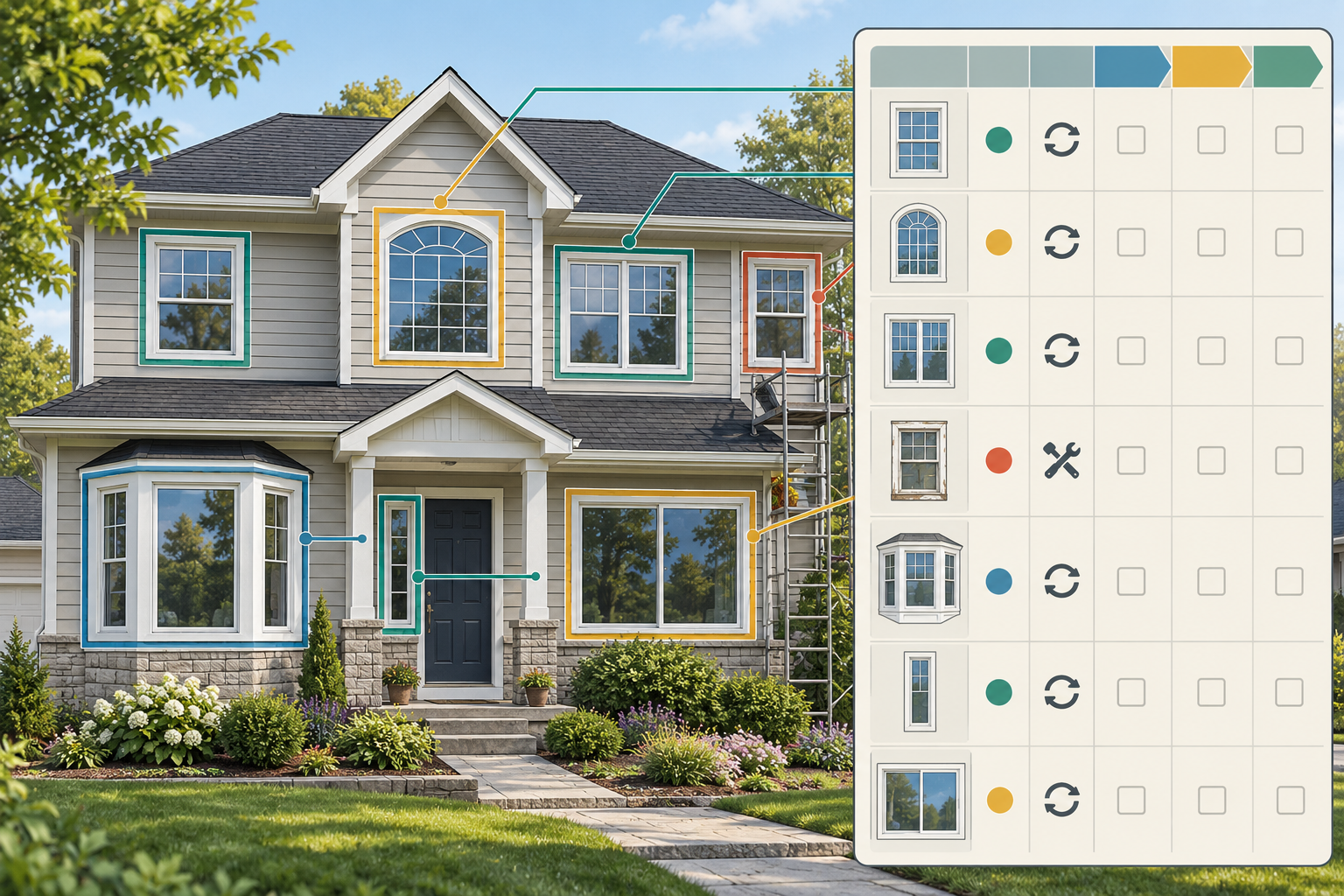
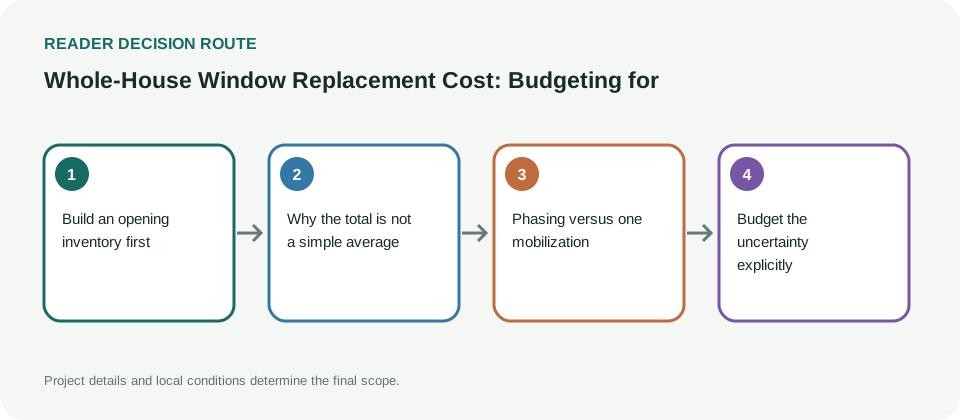
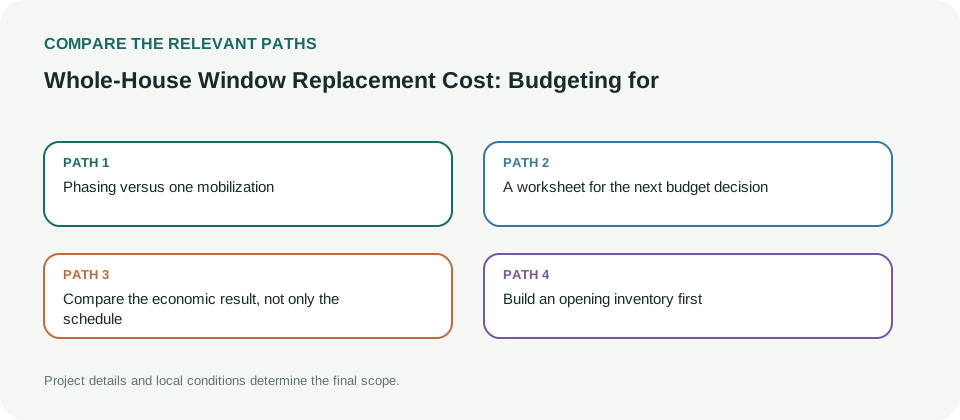
Build an opening inventory first
For each opening, record its approximate size, operating type, number of panes, frame material, floor level, interior and exterior finish, visible damage, and whether the opening must remain available for ventilation or emergency escape. Mark patio doors and skylights separately; they have different product and access economics.
Record the room or site use when it changes the decision. A bedroom escape window, a hard-to-reach upper floor, or a historic opening may need a different scope even when two units look similar from outside.
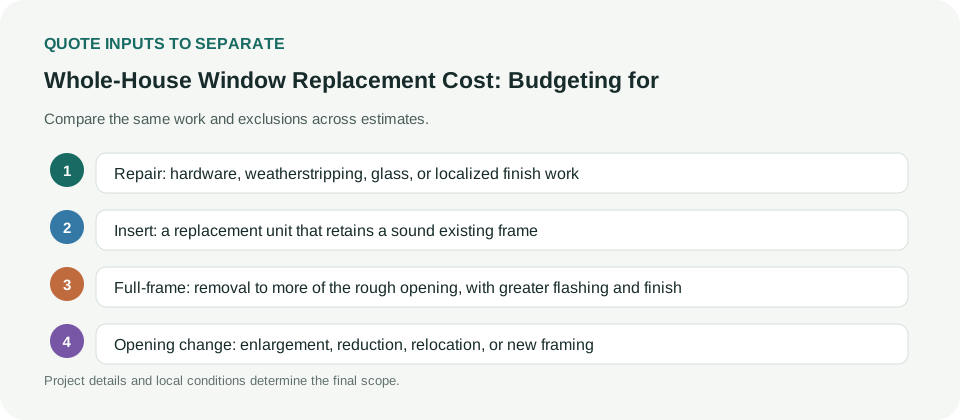
Then classify the likely intervention:
- Repair: hardware, weatherstripping, glass, or localized finish work.
- Insert: a replacement unit that retains a sound existing frame.
- Full-frame: removal to more of the rough opening, with greater flashing and finish exposure.
- Opening change: enlargement, reduction, relocation, or new framing.
This inventory turns an attractive “replace all windows” concept into a set of quoteable scopes.
Why the total is not a simple average
The mix of openings changes labor, product, and restoration time. A group of standard existing-opening replacements may be relatively predictable, while a bay window, masonry opening, rotten sill, custom shape, or upper-floor installation can add disproportionate cost. A contractor may offer packaging or volume pricing, but neither a discount nor a particular mobilization charge is universal.
Flashing and water management deserve their own line. Building America guidance treats the sill, side, and head flashing as part of a continuous drainage-plane system. If siding, brick, stucco, interior casing, or drywall must be removed to correct that system, the whole-house budget needs a restoration allowance rather than a vague “installation” line.
Phasing versus one mobilization
Replacing everything at once may reduce repeated setup and disruption, but it concentrates cash flow, interior access, and the risk of discovering multiple concealed conditions at once. Phasing can prioritize openings with active leakage, failed operation, severe drafts, deteriorated frames, or a safety-related need. A first phase can also show how a contractor handles flashing and finish restoration before the homeowner commits to every opening.
The lowest-cost phase is not always the best first phase. A window that is merely unattractive may reasonably wait behind an opening that is allowing water into the wall or cannot serve its intended emergency-escape function.
Budget the uncertainty explicitly
Use a base scope plus separate allowances for rot, trim and cladding restoration, interior patching, access equipment, disposal, engineering or permits where applicable, and older-home hazard controls. Do not hide all unknowns in an unlimited contingency. Each allowance should state what observation or discovery would activate it.
In U.S. homes built before 1978, EPA RRP requirements generally apply to paid work that disturbs painted surfaces, and window replacement is specifically covered. In Canada, Health Canada recommends checking older painted surfaces before renovation; other older materials may also require project-specific assessment. Obtain the responsible contractor’s current compliance plan rather than assuming every opening has the same risk.
Turn the inventory into comparable quotes
Give each bidder the same numbered opening list and ask for a line per opening or a clearly grouped set of equivalent units. Keep patio doors, bay or bow units, skylights, and unusual shapes separate because their products, interfaces, and access can differ from ordinary windows. Ask bidders to identify which openings are assumed to have sound frames and reusable trim, and which require inspection or an allowance.
Normalize what is included: product, removal, installation, flashing, air sealing, interior and exterior finish restoration, disposal, access equipment, taxes, schedule, warranty, and exclusions. Separate the all-at-once scope from each phase so a lower total does not hide omitted openings or work. If one quote combines openings into a package, ask which line items change if a damaged unit is postponed.
What volume can and cannot do
Ordering many similar units can simplify delivery, setup, and scheduling. A contractor may offer a package price or may spread mobilization across more openings. That is a commercial choice, not a guaranteed bulk discount. Volume does not remove the cost of custom sizing, upper-floor access, concealed damage, interior protection, or finish matching.
Standardization can also create tradeoffs. Selecting one operating type or frame finish may lower ordering complexity, but it may not suit every room’s ventilation, cleaning, view, or emergency-escape need. Replacing a group of windows with the same product without reviewing orientation and climate can also produce a less useful performance result than a mixed, deliberate selection.
Contingency should describe a condition
Whole-house contingencies work best when they are tied to recognizable findings. Examples include localized sill rot, deteriorated sheathing, inaccessible upper-story openings, damaged trim, masonry repair, utility conflicts, interior patching, disposal, temporary weather protection, and qualified older-material work. Ask whether each allowance is per opening or applies to the project as a whole, what discovery activates it, and whether it is a cap or a placeholder pending approval.
Building America guidance treats each opening as part of a wall drainage plane. If a contractor must remove cladding or trim to reconnect flashing, that is not simply a product upgrade; it is a water-management and finish-restoration scope. A project can therefore move from predictable replacement to investigation and repair after the first opening is opened.
Choose a phase that solves a defined problem
When the full project does not fit the available budget, rank openings by the condition they address rather than by which room is easiest to quote. A leaking or deteriorated opening may need attention before a window that is simply less efficient. A difficult upper-story unit may be more economical to include during the same access setup as nearby work, while a sound opening can remain in service. The inventory should make both the reason and the dependency visible.
A phased plan needs a stable product and installation specification. Ask whether the same series, frame color, hardware, and glazing package will remain available and whether later work will require remobilization, repeat protection, or a new permit. Do not assume a future order will match exactly. If appearance consistency matters, obtain current availability and a written proposal for the planned phases before committing to the first group.
For each phase, distinguish immediate work from deferred work. Record which openings will remain, what limitations they still have, and whether temporary maintenance is needed to prevent additional damage. A staged project can spread cash flow, but it can also repeat setup costs or leave some performance and appearance differences. Compare the total staged cost with one mobilization, then weigh that against financing, disruption, and the risk of allowing a known defect to continue.
A practical inventory uses one row per opening: location, dimensions, style, visible condition, leak or operation issue, proposed frame method, finish scope, priority, and estimate uncertainty. That lets a homeowner ask for a base phase and a separate alternate without treating the entire house as one undifferentiated package. If the contractor proposes a discount for doing all openings, ask how it is calculated and which work actually shares labor, access, or delivery; a package total alone does not show whether the savings are real.
A worksheet for the next budget decision
For each phase, record the openings included, gross price, items that may qualify for a verified incentive, cash due before reimbursement, and the work deferred. Keep an incentive as a conditional line until the program confirms the address, product, contractor, funding, and invoice date. A program’s existence does not establish that the household qualifies or that funds remain available. This prevents a tentative award from making an otherwise unaffordable first phase look affordable.
Also compare schedule risk. A long lead time, temporary protection, or repeated mobilization can change the cost of phasing. Ask the contractor to distinguish fixed setup charges from per-opening work and to state how a later phase would be priced if the product series remains available. The worksheet does not forecast future prices; it simply makes today’s assumptions visible.
Compare the economic result, not only the schedule
For each phase or quote, ask which openings are included, what remains untouched, what product metrics are being compared, and what future work is likely. Compare repair or attachment options for sound lower-priority openings rather than assuming every unit should be replaced. Energy savings, comfort, noise, operation, appearance, and water protection are different benefits and should not be combined into one vague promise.
A strong whole-house plan gives each opening a known decision, gives unknowns a named allowance, and gives the homeowner a defensible reason for phasing or proceeding. It avoids the false comfort of a single average that no individual opening actually matches.
The most useful whole-house budget identifies the worst-case openings without pretending that every window will cost the same. Replace the openings that solve the most important condition first when a full project is not yet justified.