
An exterior storm window or interior insulating panel adds a secondary layer to an existing opening. It can be a lower-disturbance way to improve comfort or reduce leakage when the primary window and frame are sound. It cannot correct rotten framing, an unresolved wall leak, failed operation, or every performance limitation.
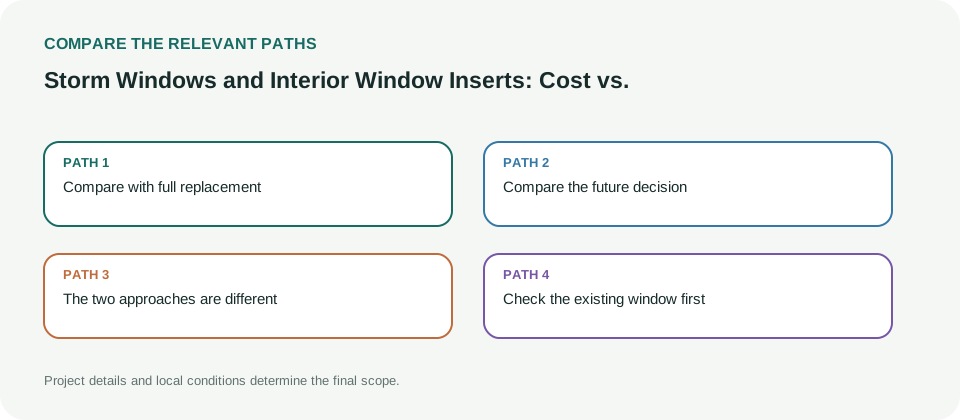
The two approaches are different
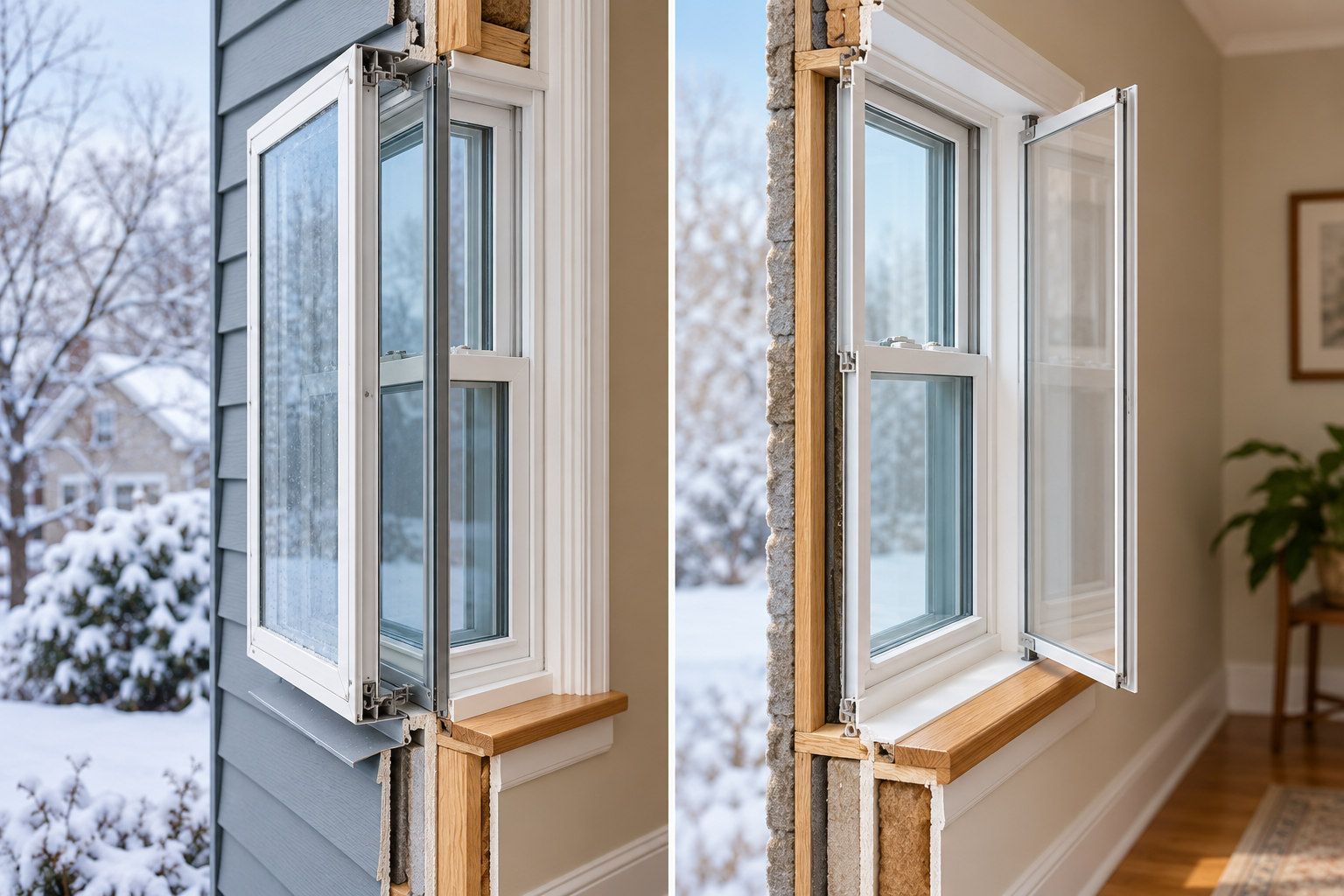
- Exterior storm windows attach outside the primary window and must fit the opening, trim, exposure, drainage, and operation. They can add weather and thermal protection but remain exposed to weather and maintenance.
- Interior panels or inserts create a secondary interior layer. They can reduce drafts and preserve exterior appearance, but affect access, cleaning, ventilation, condensation behavior, and interior trim.
DOE research models storm-window panels and surface-applied films as distinct attachment categories with results dependent on emissivity, transmittance, pane count, and gap or gas fill. These results are not a promise of a specific household saving.
Check the existing window first
An attachment is a poor investment when the frame is rotten, the opening leaks, the sash will not close, or the wall drainage path is failing. Repair the source or define the limitation before adding another layer. A sound historic window may be a strong candidate when preservation and low-disturbance work are important, but consult the appropriate preservation guidance when appearance or original fabric matters.
Fit and operation are practical cost drivers. Confirm the finished opening, screens, access to locks, cleaning, ventilation, emergency-escape function where relevant, condensation behavior, and maintenance. The product must be compatible with the primary glazing; do not assume every panel is suitable for every window.
Compare with full replacement
| Question | Attachment may fit | Full replacement may fit |
|---|---|---|
| Main goal | Comfort, draft reduction, seasonal use, or lower disturbance | A failing unit, frame, opening, or major performance/configuration change |
| Existing condition | Sound and reasonably square | Rotten, distorted, leaking, or repeatedly failing |
| Scope tolerance | Appearance and access can accommodate a second layer | Broader demolition and finish restoration are acceptable |
| Evidence needed | Product fit and tested performance | Complete rated product, installation, flashing, and warranty |
There is no reliable universal current U.S. or Canadian installed-price ratio between attachments and replacement. Ask for product, fitting, installation, maintenance, finish, and removal costs separately.
Decide what the secondary layer must accomplish
An exterior storm window and an interior panel are not interchangeable. An exterior unit must fit the outside opening, trim, exposure, drainage, and access to the primary window. An interior panel changes the room-side boundary and may affect cleaning, ventilation, condensation, appearance, and how the primary window is operated. Both depend on the condition of the existing frame and the quality of the fit.
Define the target before comparing prices: reduce a sash draft, improve comfort near cold glass, add a preservation-sensitive layer, moderate solar gain, reduce noise, or postpone a disruptive replacement. An attachment can be a good answer to one target and a poor answer to another. It cannot replace rotten framing, a failed wall drainage detail, or a window that must be opened for an emergency-escape purpose.
Scope and cost drivers
| Item | Exterior storm window | Interior panel or insert |
|---|---|---|
| Fit | Outside trim, mounting surface, exposure, and drainage | Interior casing, reveals, storage, and room clearance |
| Installation | Exterior access, fasteners, seals, and weather exposure | Interior measurement, removable fit, and air-seal detail |
| Operation | Must coexist with the primary sash and screen | May need removal for ventilation, cleaning, or escape |
| Maintenance | Weather-facing frame, screens, glass, and seals | Cleaning, storage, seals, and condensation management |
Price the product, measurement, custom fabrication, installation, access, screen or panel options, trim preparation, removal, disposal, and future maintenance. A low product price can become a higher installed cost when every opening is a different size or the existing trim is not a usable mounting surface.
Performance is not a blanket promise
DOE research distinguishes storm panels and surface-applied films as different attachment categories and reports modeled results under stated assumptions. It supports considering attachments as alternatives to full replacement; it does not guarantee a specific household saving or comfort improvement. The final result depends on the primary window, air leakage, glass, frame, installation, climate, and orientation.
Building America guidance also treats an opening as part of the wall drainage plane. Do not cover a leak or damaged sill with a secondary layer and call the opening repaired. Confirm that water can drain, the primary unit remains serviceable, and the new attachment does not trap damaging moisture.
When an attachment is a better fit
An attachment may suit a sound existing window where the homeowner wants lower disturbance, seasonal operation, preservation of exterior appearance, or a lower initial project scope. It can also be useful when only selected openings need an intervention or when the homeowner wants to defer full replacement while the frame remains serviceable.
Full replacement is more plausible when the frame is distorted, rotten, or leaking; the sash will not operate; the opening must change size; the product cannot support the added layer; or the homeowner needs a complete performance and finish reset. A storm window is not impact protection unless the actual product is tested and certified for that purpose. Ordinary storm doors and windows should not be described as hurricane protection.
Choose the secondary layer around the existing window
An exterior storm window and an interior panel can both add a layer, but the location and attachment create different tradeoffs. An exterior unit is exposed to weather and must fit the outside frame and drainage details. An interior panel can preserve the outer appearance and may be easier to remove seasonally, but it changes the room-side condensation boundary and needs a suitable fit. Low-emissivity surfaces, ventilation, and the gap between layers can affect performance; use product-specific guidance rather than assume every panel behaves alike.
Before pricing an attachment, check whether the primary window opens, latches, drains, and remains weather-tight. A secondary layer can make a sound old window more comfortable, but it does not repair rot, a failed sash lock, or water intrusion. Historic openings may benefit from a reversible interior panel when preservation is important, while an exterior storm unit may better match a particular façade or operating need. Confirm any appearance review before ordering.
Compare quotes for the exact openings and include measuring, custom fabrication, mounting, air sealing, hardware, finish, delivery, and any seasonal removal or storage. Ask whether the unit can be cleaned and serviced, how it affects primary-window operation, and how condensation between layers should be monitored. Where a secondary unit covers an older window, ask what sign would indicate that moisture is accumulating or the original assembly needs repair.
A replacement window is a different alternative. It may address a damaged or poorly fitting primary unit, but it can require more removal and finish work. A storm or insert may be a smaller first-cost intervention when the existing opening is serviceable and the performance goal is modest. Compare the expected comfort or energy effect, appearance, maintenance, and remaining limitations instead of treating the cheapest product as automatically equivalent to a complete replacement.
For an older window, the choice can also depend on whether preserving the original sash and exterior profile is important. An interior panel may avoid exterior fastening or visual change; a storm window may protect the outside and preserve a familiar room-side surface. Confirm local historic-review expectations before ordering custom work, and ask how the chosen system will be removed for repair or cleaning. Reversibility can be an economic benefit when future façade work is likely.
For seasonal panels, ask where the removed unit will be stored and whether storage or reinstallation is part of the service. These recurring tasks can affect whether an interior insert remains a practical choice.
If the homeowner expects to remove panels seasonally, ask whether the product has a labeled storage orientation and whether replacement seals are available. This can help protect a custom panel and avoid repeat measurement costs.
Compare the future decision
Ask how long the attachment is expected to last, how it is removed for service, whether the primary window’s warranty is affected, and whether replacement remains possible later. For historic openings, preserve trim and reversibility if those are the stated objectives. For a draft, verify whether the gap is in the sash or perimeter before purchasing a second layer. For a noise complaint, ask whether walls and other openings remain limiting paths.
Older painted or suspect materials can be disturbed when trim, stops, or mounting surfaces are prepared. U.S. EPA RRP guidance generally covers paid work disturbing paint in pre-1978 housing; Canadian guidance recommends assessing lead paint and asbestos-suspect materials before renovation. Ask who manages testing, containment, cleanup, and disposal.
The useful quote defines the existing opening, target outcome, attachment type, fit, installation, performance evidence, maintenance, and limits. Choose the secondary layer because it solves a defined problem, not because its product price appears below a replacement window.
Before work on older painted or suspect materials, confirm the applicable U.S. lead-safe or Canadian hazard requirements. Choose the smallest scope that solves the actual problem without hiding a failing frame or wall.