
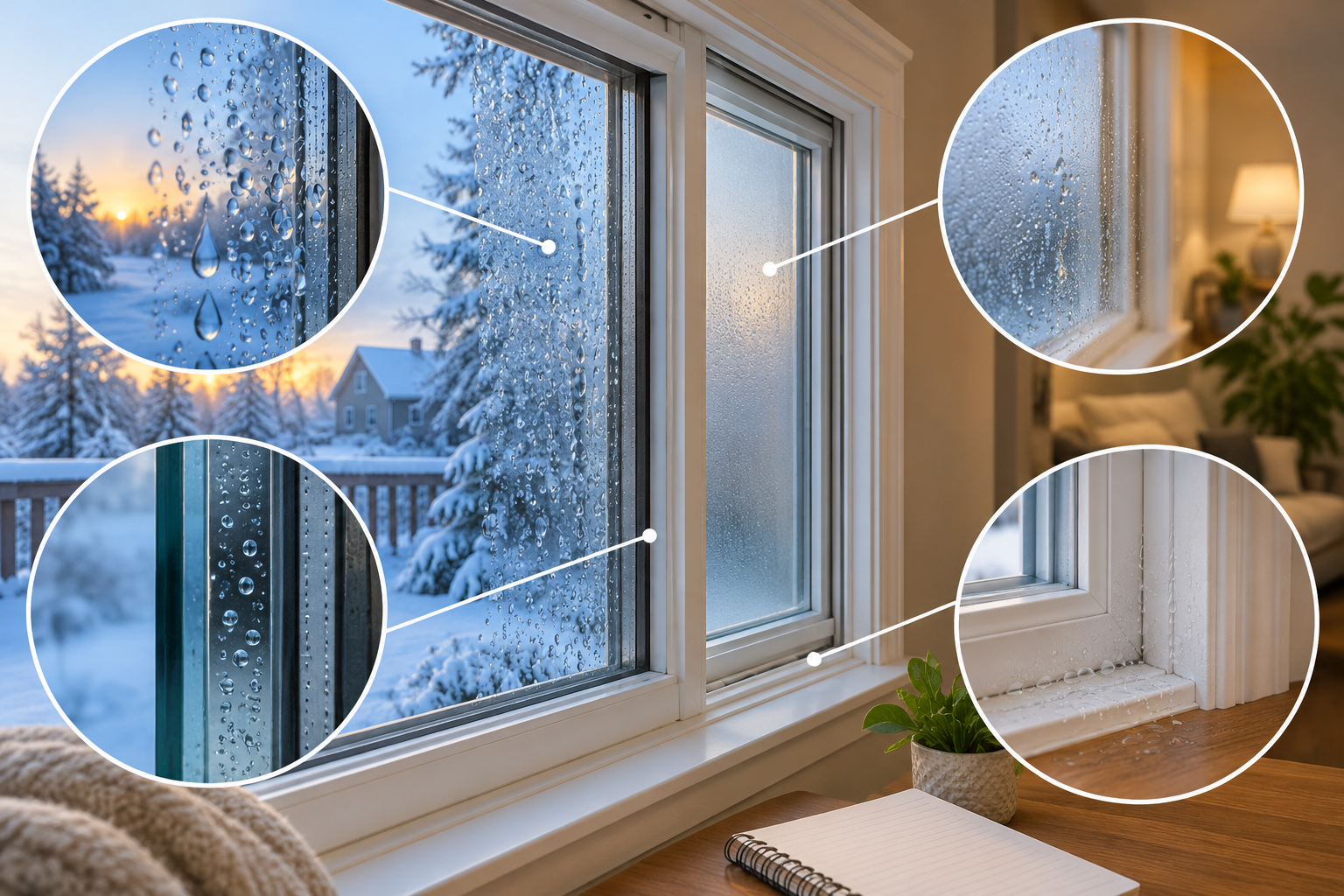
Condensation is moisture that forms when a surface is colder than the dew point of nearby air. It does not, by itself, prove that a window is defective. The location of the moisture is the first useful diagnostic clue.
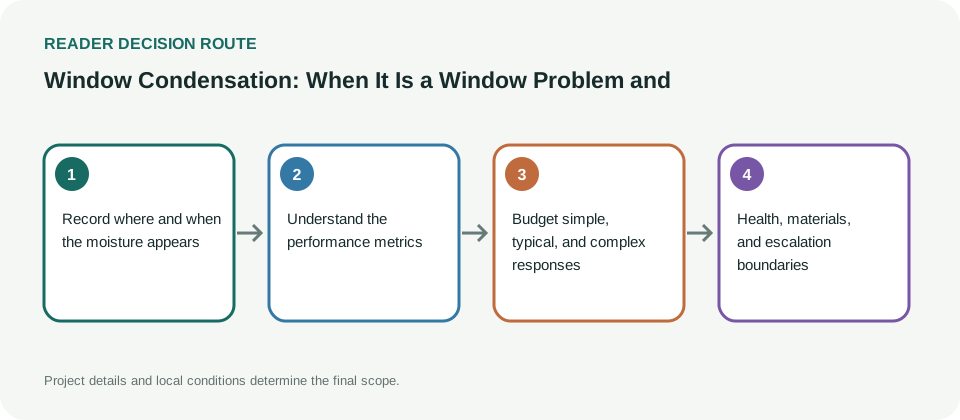
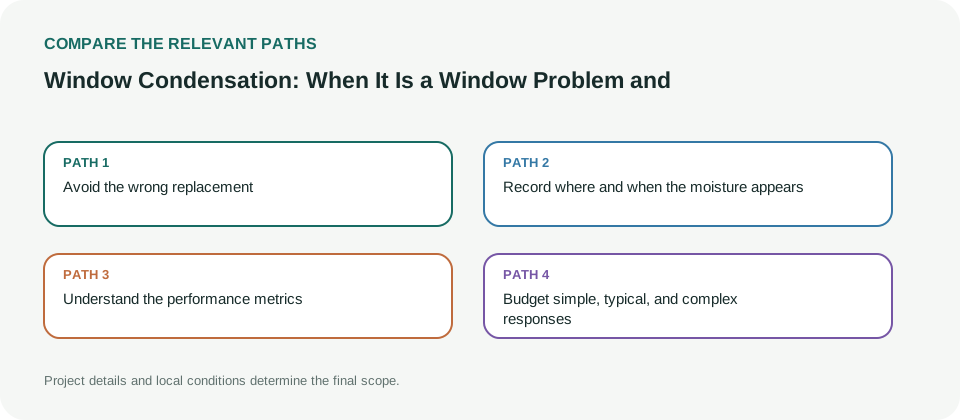
Record where and when the moisture appears
Before choosing a repair, record whether moisture is on the room side, outside, between panes, at the glass edge or frame, or on nearby trim and wall material. Note the room, weather, time of day, whether the window was covered or closed, and moisture-producing activities or exhaust use nearby. Repeat observations can help a professional identify a pattern, but a location or photograph alone does not prove the cause.
| Observation location | Investigation or repair path to consider |
|---|---|
| Room-side glass or frame | Review indoor moisture sources, ventilation, air movement, surface temperature, window condition, and enclosure interactions. This does not establish that the window itself has failed. |
| Outside glass | Often a weather and surface-temperature condition. Check whether it is temporary and whether the product otherwise functions; do not treat it as proof that replacement is needed. |
| Between panes | A failed sealed insulating-glass unit is possible. Confirm the assembly, its condition, and any warranty or compatible glass path before ordering a replacement. |
| Glass edge, spacer, or frame | Product, spacer, frame, installation, surface temperature, and indoor conditions can interact. Inspect the whole opening rather than assigning fault to one visible edge. |
| Trim, wall finish, sill, or spreading material damage | Treat this as a broader inspection boundary. The water or air path may involve the opening, wall transition, flashing, roof, plumbing, or indoor conditions, and cosmetic repair alone can leave the source active. |
ENERGY STAR explains that interior condensation forms when the window surface falls below the dew point of humid indoor air. It also notes that even certified products can condense in cold weather. Venting dryers and kitchen or bath fans outdoors, using fans during moisture-producing activities, allowing air movement over the glass, and managing indoor humidity can be relevant operational steps, but the appropriate target depends on climate and the building.
Understand the performance metrics
DOE guidance identifies U-factor, solar heat gain coefficient, air leakage, visible transmittance, and condensation resistance as different metrics. Lower U-factor means less heat flow through the product; lower SHGC reduces solar heat gain, with the desirable value depending on climate and orientation; lower air leakage generally means less infiltration; and higher condensation resistance indicates greater resistance under rating conditions.
Those values do not eliminate condensation in every home. A window can be well rated and still condense when indoor moisture is high, temperatures are unusually low, airflow is blocked, or the surrounding frame and wall are colder. Ask for the complete product and installation context rather than comparing a single number.
Budget simple, typical, and complex responses
A simple response may involve observing indoor moisture sources, improving exhaust use, or correcting a localized seal. A typical response may include measurement, humidity or temperature evaluation, weatherstripping, perimeter air sealing, or replacement of one failed IGU. A complex response may require finish repair, wall investigation, ventilation changes, broader enclosure work, or several replacement windows.
Request separate lines for diagnosis, product, installation, finish, access, testing, and conditional work. Ask what result the contractor expects and how it will be checked. If the proposal promises that a new window will end all condensation, ask which mechanism supports that conclusion.
Health, materials, and escalation boundaries
Persistent moisture can damage paint, wood, drywall, flooring, or insulation. It can also contribute to conditions that need qualified indoor-environment assessment. Do not assume visible mold, staining, or dampness has one cause or one remediation cost. If a wall or finish must be opened, include the water or air source correction and not only cosmetic replacement.
Older materials can be disturbed during trim, glazing, or drywall work. EPA’s U.S. RRP guidance generally covers paid work disturbing paint in pre-1978 housing, and Canadian health guidance warns about lead paint and asbestos-containing materials in older homes. Confirm current local requirements and qualified assessment before disturbance.
Avoid universal humidity targets or a diagnosis based on one photograph. Ask the professional to state the observation, the uncertainty, the proposed intervention, the product or enclosure assumptions, and the condition that would move the job to a broader investigation. That approach protects both the budget and the accuracy of the repair decision.
Distinguish the moisture before budgeting
The location of water gives the first useful clue. Moisture on the room side of glass or frame is different from moisture trapped between panes, and exterior condensation has a different meaning again. Record which surface is wet, whether the film wipes off, which rooms and orientations are affected, and whether it appears after cooking, bathing, overnight occupancy, or a rapid weather change. This information helps a professional distinguish a possible glass-unit failure from indoor humidity, air leakage, or normal exterior conditions.
A product condensation-resistance rating describes the product’s tested resistance under defined conditions; it does not diagnose a particular installed window. An installed opening is affected by indoor humidity, surface temperature, air movement, frame details, curtains, ventilation, and the surrounding enclosure. A high or low rating should not be used alone to decide that a window is defective or that replacing it will solve a room-wide moisture problem.
For simple room-side moisture, a homeowner may first review moisture sources, ventilation operation, and how air reaches the glass, while avoiding changes that create a separate health or combustion risk. If water is recurring, damaging finishes, or appearing in several locations, ask whether a building-enclosure or ventilation assessment is appropriate. If moisture is between panes, compare a sealed-unit or sash repair with full-window replacement only after confirming the product and repair path.
The budget changes with the cause. A moisture-management response can involve operation or ventilation checks; a failed IGU may involve glass fabrication and glazing labor; persistent water damage can add trim, drywall, insulation, or wall repair. Request a quote that states which mechanism it addresses and what evidence supports the diagnosis. A quote for replacement should identify whether it is intended to cure a confirmed unit defect, improve a cold-surface complaint, or correct a wider air or moisture problem. Those are different outcomes and may require different work.
A short observation log can make the first professional visit more useful. Note the weather, room activity, ventilation setting, window covering, affected surface, and whether moisture returns after wiping. Take a photo that shows both the glass and frame. This record does not diagnose the cause, but it can reveal whether the pattern is tied to one product or to room conditions and help avoid pricing a replacement before the symptom is understood.
If a glass unit is under warranty, ask whether the remedy covers only the replacement glass or also labor, shipping, access, and the surrounding finish. Record the exact product and date before authorizing a paid glass order. A warranty may address between-pane seal failure but not room-side condensation or damage from indoor humidity; the written terms control.
If the moisture damages paint, trim, or flooring, price the restoration separately from correcting the source. A replacement window quote may not include repair of these interior materials.
If condensation persists after a basic ventilation or humidity change, ask a qualified professional to evaluate the room and window together. Do not assume a new window alone will correct a moisture condition across the home. The estimate should name the symptom it addresses, any measurements taken, and what other causes remain possible.
For between-pane moisture, record whether it is intermittent or persistent and which unit is affected. A failed insulated-glass seal may be a different quote from room-side condensation. Ask the contractor to identify the glass assembly and state whether the estimate covers the IGU, sash, glazing labor, access, and finish.
If moisture is accompanied by visible mold or damaged materials, ask a qualified professional to assess the building condition; a window replacement quote alone does not address the entire concern.
If the proposed fix is a humidifier or ventilation adjustment, ask how the recommendation accounts for the household’s climate, occupancy, and other combustion or air-quality needs. Avoid a change that creates a separate problem. A qualified professional can help distinguish a window symptom from a broader building condition.
After any repair or retrofit, continue recording where moisture appears and under what conditions. A change in one room may not resolve the same symptom elsewhere. If the pattern persists, use those observations to reassess the cause instead of repeating the same product replacement.
Avoid the wrong replacement
Replacing a window will not correct a clothes-dryer exhaust problem, high indoor moisture, a missing perimeter air seal, or a broader cold surface elsewhere. Conversely, reducing humidity will not repair a failed sealed unit that is fogging between panes. Use the diagnosis to separate those paths.
If paint, caulk, drywall, or suspect older materials will be disturbed, include the applicable lead, asbestos, containment, cleanup, and qualified-work checks. Do not use a generic humidity threshold as a diagnosis or a universal code rule.
Ask for the moisture location, observations, proposed outcome, product ratings, ventilation or enclosure assumptions, finish restoration, and conditions that would change the scope. The right budget follows the mechanism, not the word “condensation.”