
Pane count is one part of a window package, not a complete performance answer. Frame, coatings, gas fill, spacers, air leakage, U-factor, solar heat gain coefficient (SHGC), condensation resistance, orientation, climate, and installation all affect the outcome.
What pane count changes—and what it does not
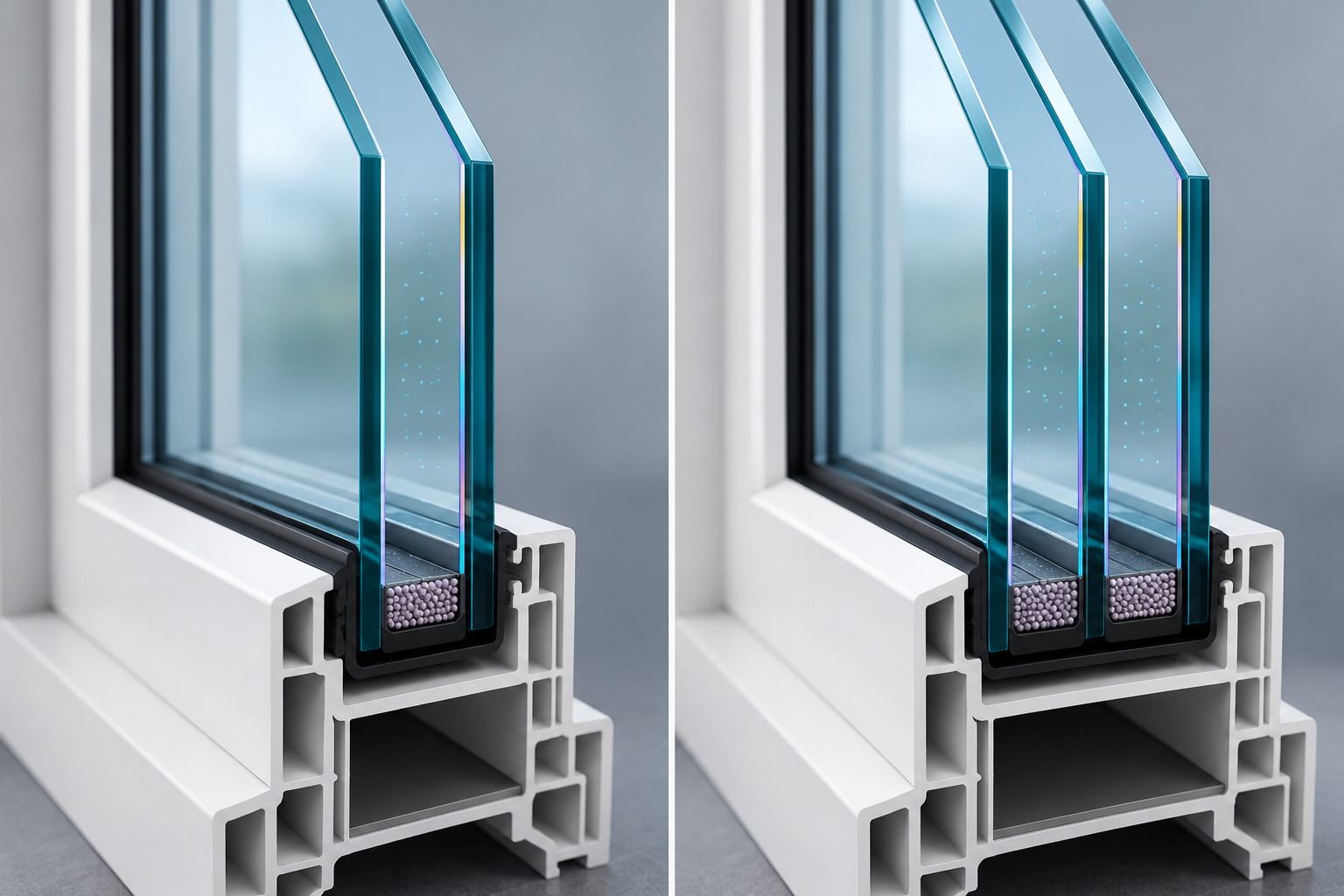
An additional pane can change heat flow, glass temperature, weight, thickness, daylight, and the configuration of the sealed cavities. It does not by itself determine the window’s U-factor, SHGC, air leakage, condensation resistance, or sound performance. Coatings, gas fills, spacers, frame construction, edge details, operation, and installation all contribute to the complete product.
Compare the actual labels or technical documents for the two products. A better double-pane assembly can be a more useful fit than an entry-level triple-pane product with a less suitable frame or solar-gain value. Conversely, triple glazing may be worth considering where cold-glass comfort, condensation resistance, or a demanding climate matters and the opening can support the product.
Cost scenarios
A simple comparison holds size, operation, frame, color, screens, installation, and finish constant while changing the glazing package. A typical project also changes the product line, sash weight, hardware, delivery, or frame depth. A complex project may need rough-opening adaptation, new trim, full-frame work, or structural and finish changes because the new unit is not a direct fit.
Ask the bidder to separate the incremental glass or product cost from installation, shipping, hardware, trim, flashing, access, disposal, and conditional work. The current evidence does not establish a universal U.S. or Canadian installed premium. Keep the markets separate and do not create a Canadian price by converting a U.S. quote.
Match metrics to the problem
| Homeowner goal | Metrics or facts to examine | Common mistake |
|---|---|---|
| Lower heat flow | U-factor, frame, installation, and climate | Treating pane count as the whole efficiency rating |
| Limit solar gain | SHGC, orientation, shading, and cooling load | Choosing the lowest SHGC for every orientation |
| Reduce drafts | Air leakage, operation, weatherstripping, and perimeter seal | Replacing glass while leaving the air path |
| Reduce condensation risk | Condensation resistance, surface temperature, humidity, and airflow | Assuming a high rating prevents all condensation |
| Improve noise | Current assembly-specific acoustic data and leakage | Calling triple glazing soundproof |
The DOE guidance defines visible transmittance and air leakage separately from U-factor, SHGC, and condensation resistance. A single headline rating cannot carry the whole decision.
Climate and country matter
U.S. ENERGY STAR criteria use climate zones and include U-factor and, where applicable, SHGC thresholds. That program context does not establish Canadian code or product requirements. Canadian homeowners should request documentation applicable to the products and market under consideration and verify any local requirements. Within either country, orientation, shading, heating and cooling equipment, and exposure change the useful balance of metrics.
In a cold climate, lower heat flow and condensation resistance may be important, but high indoor humidity or a poor perimeter seal can still cause moisture. In a sunny climate, solar gain and exterior shading can matter more than simply adding a pane. In a mixed climate, the best choice can vary by orientation. A whole-house order should not assume every exposure needs the same glass package.
Decide whether the premium buys a result you need
The relevant comparison is the added cost of the triple-pane option over a comparable double-pane unit, not the full replacement cost against an imagined energy bill. Keep frame material, size, operating style, spacer, coatings, gas fill, installation method, and finish as similar as possible. If the bids differ in several of these features, the price gap cannot be attributed to pane count alone.
Then connect the selected performance metrics to the home. U-factor, solar heat gain, air leakage, and condensation resistance describe different properties. A lower U-factor may be important in a heating-dominated climate, while solar gain and shading can matter more in a high-sun room. A product rating is not an estimate of the actual savings at one address, and a high-performance glass package cannot correct a poor installation or a leaky wall joint.
A simple economic screen is to ask for the incremental premium and identify which replacement openings are already required. If the old window must be replaced for condition reasons, the efficiency decision is about the extra cost of the triple-pane upgrade. If the existing window is serviceable and replacement is proposed only for energy savings, the full replacement cost belongs in the comparison. Include any verified incentive only after checking current program terms and household/product eligibility; do not use a closed or expired program to reduce the estimate.
There may also be non-energy reasons to choose the thicker glass package, such as reduced cold-surface discomfort or a particular noise goal. Those should be considered separately from bill savings and confirmed for the complete product. Ask the seller to state the assumed baseline, climate, energy price, and time period behind any payback claim. If the answer is a broad national average, use it only as an illustration and keep the home-specific uncertainty visible.
Scenarios where pane count is not the first decision
If a window is damaged, leaking, difficult to operate, or at the end of its serviceable condition, replacement may already be part of the plan. In that case, compare the incremental cost of triple-pane glass with a similar double-pane product and decide whether the additional performance is worth that premium. If the window is sound and the only reason to replace it is energy savings, compare the full replacement cost with lower-cost air sealing, storm-window, or interior-panel options first.
In a cold climate, a warmer interior glass surface may be a comfort benefit even if the payback is long. In a sunny room, solar gain and shading can matter alongside U-factor. In a noisy room, pane count alone does not define acoustic performance; glass thickness, asymmetry, frame seals, and the sound path also matter. These are different reasons to pay more and should not be collapsed into a single claim that triple pane “saves more.”
Ask for the actual whole-product ratings for each quoted configuration and check that they apply to the size and operating style being purchased. Compare similar frames, spacers, coatings, gas fill, and installation method. If a vendor provides modeled savings, keep the baseline, weather assumptions, utility rates, and the estimated incremental premium with the quote. That creates a useful comparison even when another provider uses a different model.
A heavier glazing package can also affect the operating hardware and sash. Ask whether the quoted frame and operator support the selected glass weight and whether the window size changes the manufacturer’s available configuration. A triple-pane option that is unavailable in the chosen style or size is not a like-for-like comparison. Confirm that the model number, dimensions, and ratings on the quote match the product that will be delivered.
If sound is a secondary goal, request the acoustic documentation for the complete assembly and compare it with a dedicated acoustic alternative. A third pane does not guarantee a particular reduction in traffic, aircraft, or low-frequency sound. State the noise problem separately and verify that the selected glass, frame, and seals address it.
When a homeowner is comparing products for several rooms, ask whether the same glass package is available in every required size and operating type. A fixed window may offer one configuration while a large operable sash uses another. The proposal should identify any exceptions rather than use one performance label for the entire order.
For a replacement set, ask the vendor to identify any openings where the performance package changes because of size or operation. Keep those exceptions in the comparison instead of assuming the same glass is available everywhere.
Sound and comfort are not the same as payback
The historical NRC digest says that layer separation, glass thickness, frame transmission, and air leakage affect sound. It also cautions that a third layer does not necessarily improve sound reduction substantially unless separation is large, and that STC does not fully represent strong low-frequency outdoor sources. Use that history to ask for current tested data, not to promise a decibel result.
Comfort can justify a premium even when a simple energy payback is long. If energy is the primary objective, ask for the baseline window, climate, orientation, energy prices, modeled service life, installation assumptions, and alternative measures such as air sealing or storm panels. Treat modeled savings as a scenario rather than a guarantee.
The right choice is the complete product that solves the stated problem at the opening’s actual condition. Pane count is a useful specification to compare, but it is not a decision rule on its own.
List the baseline window, the symptom, the target metric, the climate and orientation, the installation method, and the cost of alternatives such as weatherstripping, air sealing, storm windows, or interior panels. If the goal is lower bills, treat modeled savings as scenario results. If the goal is comfort, condensation, or noise, name that outcome separately. Choose the package that solves the defined problem, not the highest pane count by default.