
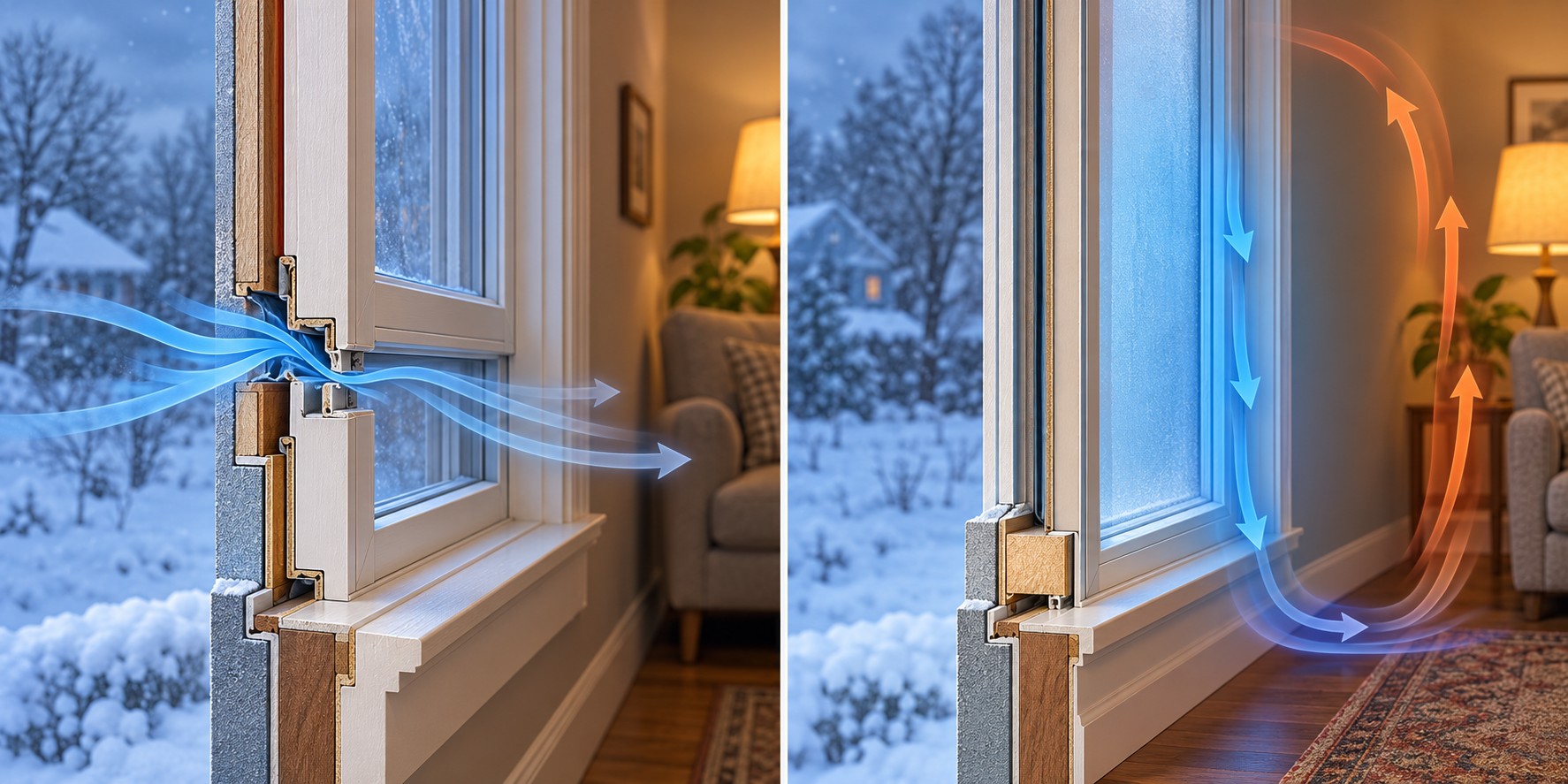
“Drafty” can mean air entering around a sash, air leaking between the frame and wall, a cold interior glass surface, or moving air caused by temperature differences. A hand near the trim may identify a symptom but not the repair. Start with the smallest intervention that addresses the confirmed source.
Sort the likely causes
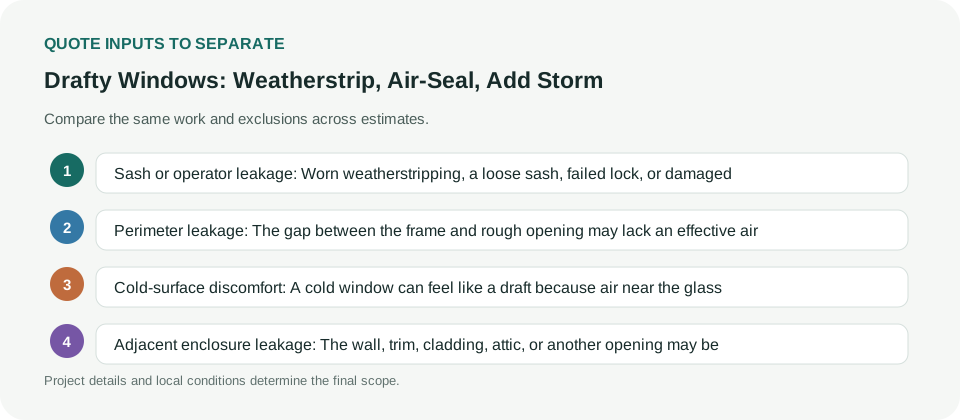
- Sash or operator leakage: Worn weatherstripping, a loose sash, failed lock, or damaged hinge can leave a gap when the window is closed.
- Perimeter leakage: The gap between the frame and rough opening may lack an effective air seal or may be disturbed by an earlier installation.
- Cold-surface discomfort: A cold window can feel like a draft because air near the glass falls and moves through the room even when there is no hole.
- Adjacent enclosure leakage: The wall, trim, cladding, attic, or another opening may be contributing to the sensation.
ENERGY STAR notes that air can leak around windows, doors, skylights, wiring holes, and other parts of a home. Whole-envelope diagnosis may be more useful when the symptom occurs at many openings.
Find the air path before pricing the fix
Start by locating the sensation with a smoke pencil, tissue, pressure-related observation, or another appropriate diagnostic method performed safely by the person evaluating the home. The useful question is whether air moves through the sash and weatherstrip, around the frame, through trim and the frame-to-wall joint, or from an adjacent wall, attic, floor, or another opening. Feeling cold air near glass is not proof of an opening leak.
A loose lock, worn weatherstrip, failed operator, or distorted sash can leave a direct path through the window. A missing perimeter air seal can leave a path around it. Cold glass can create downward convection that feels like a draft even when the assembly is closed. Many similar complaints throughout the house suggest a broader enclosure or pressure problem rather than one failed window.
Compare the intervention ladder
| Intervention | Best fit | What it cannot do |
|---|---|---|
| Adjustment or hardware repair | Sash, lock, hinge, or operator is the bounded cause | Correct rotten frames or a wall leak |
| Weatherstripping or local sealing | Closing gaps at a sound sash or frame | Replace missing flashing or damaged structure |
| Perimeter air sealing | Frame-to-wall leakage is confirmed | Fix a poorly performing glass package by itself |
| Storm window or interior panel | Primary window is sound and a secondary layer fits | Correct failed operation or concealed water damage |
| Insert or full-frame replacement | Condition or performance justifies broader work | Solve whole-wall leakage or every comfort issue |
The intervention ladder is economic decision support, not a guarantee that every home should proceed from the smallest line to the largest. A drafty window with active water damage needs the water source addressed first. A sound historic window may be a better candidate for a secondary layer than replacement. A distorted frame may make repeated sealing a poor investment.
Cost drivers and scenarios
A low-complexity job may be one accessible window with a compatible weatherstrip or adjustment. A middle scenario may include trim removal, perimeter air sealing, interior protection, and finish touch-up. A high-complexity project may include upper-floor access, many openings, wall investigation, cladding disturbance, a full-frame replacement, or broader air-sealing work.
Ask whether the quote includes diagnosis, testing, parts, access, furniture protection, removal, disposal, trim, insulation, air sealing, flashing, finish, and a return visit. Keep a whole-home evaluation separate from a single-window repair when the symptom is widespread. The cost of finding the air path can prevent paying for a replacement that leaves the main leakage untouched.
Energy, comfort, and noise are separate outcomes
Sealing a gap may improve comfort immediately without producing a measurable whole-home energy change. A new window may improve operation, condensation resistance, or noise while having a long energy payback. ENERGY STAR’s U.S. modeled savings are scenario results affected by climate, orientation, shading, existing windows, installation, HVAC loads, and energy prices. DOE attachment modeling is also based on stated assumptions.
For an energy decision, record the baseline, the product’s U-factor, SHGC, air-leakage information, orientation, shading, heating and cooling fuel, and installation scope. For a comfort decision, describe the rooms and conditions affected. For a noise decision, consider walls, doors, vents, and the source frequency. Do not use one benefit to imply another.
A practical order for narrowing the cause
Start by locating when and where the discomfort occurs. Note whether it is limited to one window, appears only on a windy side, follows a cold snap, or affects several rooms. A moving curtain or cold sensation near glass is not enough by itself to identify the path: outdoor air may pass through a sash or perimeter gap, while a cold glass surface can create a downward air movement that feels like a draft.
If the sash is loose, hard to lock, or visibly out of square, adjustment or hardware work may be the first scope to evaluate. If air passes at a frame joint, the repair may involve weatherstripping or a seal at the installation perimeter. If multiple openings and wall penetrations feel similar, a whole-envelope assessment may be more informative than replacing one unit at a time. Ask a contractor to show where the suspected path is and how the proposed repair addresses it.
A sensible intervention ladder begins with correcting operation and worn seals, then evaluating targeted air sealing or a secondary window layer, and considering replacement when the unit or opening condition warrants broader work. The least expensive step is not always appropriate if it hides water damage, blocks drainage, or prevents required operation. Likewise, replacement is not a proven energy investment simply because the room feels more comfortable.
Compare proposals by expected outcome: reduced air movement, easier operation, warmer interior glass, lower measured energy use, or a quieter room. These outcomes are different. Ask what was measured, what assumptions were used, and what limitation will remain. If the primary benefit is comfort, say so and compare it with the cost of less extensive sealing, curtains, or inserts where suitable. If lower bills are the goal, use the household’s climate, fuel cost, existing product, installation quality, and actual incremental project cost rather than a broad savings promise.
Define a testable outcome in the proposal
Before approving work, agree on what observation will show that the repair helped. For a sash adjustment, that may be smooth closure and even weatherstrip contact. For perimeter sealing, the proposal should identify the joint treated and which surfaces remain unchanged. For replacement, the intended outcome may be improved operation or reduced air movement, but a new product cannot promise that every room will feel the same if other leakage paths remain.
If comfort differs by room, compare one targeted repair with a whole-house investigation. A cold bedroom with one loose casement may need a local intervention; similar discomfort across several elevations may reflect a broader pressure or ventilation pattern. Ask whether testing is included, what it measures, and what it cannot establish. Do not pay for a test whose result would not change the work choice.
This distinction also helps with budgeting. A smaller fix can be a reasonable first step when the problem is localized and reversible. If it fails, retain the observations and ask the next contractor to build on them instead of repeating the same diagnostic visit. When the homeowner chooses replacement for comfort, document that goal separately from any modeled energy savings.
Keep the original symptom separate from the proposed remedy in the estimate. If the concern is airflow, ask what gap or joint will be sealed; if it is cold glass, ask what product characteristic is expected to change. This prevents a quote from promising a broad comfort result based only on replacing the window unit.
When a whole-envelope review is justified
If several windows, doors, outlets, attic edges, or floor lines feel drafty, the building may need a broader air-leakage or pressure assessment. Category-level enclosure work can be more valuable than replacing one opening at a time. That does not mean a window cannot be the local cause; it means the quote should identify the boundary of the problem.
Older-home work can disturb painted trim, putty, caulk, or surrounding materials. U.S. EPA RRP guidance generally covers paid work disturbing paint in pre-1978 housing; Canadian guidance recommends checking lead paint and other suspect materials before renovation. Ask who handles assessment, containment, cleanup, and disposal.
Choose the smallest responsible scope that addresses the confirmed air path. A good proposal explains the symptom, the diagnosis, the expected outcome, and the work that remains outside the quote.
A repair can reduce a cold sensation without producing a measurable whole-home energy change. A replacement may improve comfort, noise, operation, or appearance even when its simple payback is long. ENERGY STAR’s U.S. modeled savings are scenario-based; climate, orientation, shading, installation, existing windows, HVAC loads, and energy prices change the result.
Choose the scope that solves the actual symptom, then compare the cost of the remaining problem. Sealing one opening is not a substitute for a broader enclosure assessment when the same draft appears throughout the home.