
Essential-load generator backup usually reduces cost by limiting the circuits and simultaneous loads. Whole-house coverage can require greater generator output, transfer scope, fuel capacity, and load management. “Whole house” should mean a documented simultaneous-load capability, not simply that every breaker is connected to a transfer device.
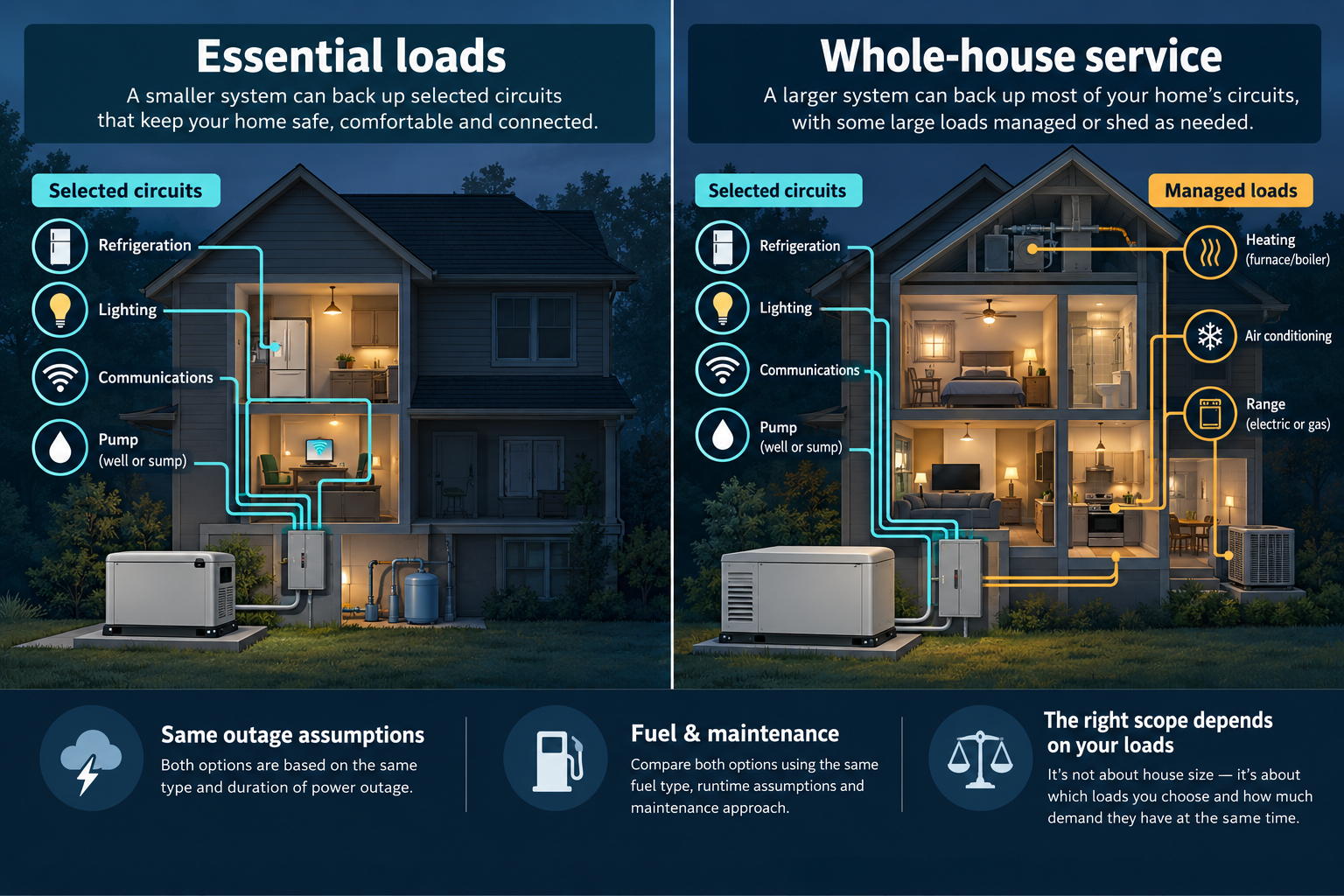
Essential-load coverage
An essential-load plan may protect refrigeration, communications, lighting, selected receptacles, a well pump, a sump pump, or controls. The list should identify what can run together and what must be delayed. The generator must still handle motor-starting demand and the transfer equipment must be designed for the service.
This approach may require a critical-load panel, circuit relocation, transfer switch, or managed controls. It can reduce generator size and fuel use, but it introduces a decision about what the household will live without during an outage.
Whole-home coverage
Whole-home service is convenient when the system can support the home’s important loads, but large electric heat, central air, ranges, dryers, and EV charging can dominate demand. The design may use load shedding or priority controls. Ask for the exact loads that disconnect when the generator is at capacity.
Cost drivers
Generator output, starting power, fuel infrastructure, transfer equipment, service configuration, panel work, installation location, permits, commissioning, and maintenance affect both choices. Essential-load work can have its own electrical cost, so do not assume the smaller generator always produces an equal project saving.
Decision cases
Choose essential-load coverage when the priority is protecting a defined set of life-safety-adjacent household functions, outages are infrequent, or large loads are not worth supporting. Choose broader coverage when convenience, automatic operation, or the inability to manage loads has meaningful value and the property can support the required installation.
The correct comparison uses the same outage assumptions and includes fuel and maintenance. Do not derive generator size from house square footage. Obtain equipment-specific professional sizing and local quotes; the current evidence does not establish a universal savings ratio.
Motors and seasonal loads matter
Starting demand can change the source size even when average energy use is small. A well pump, sump pump, refrigerator, or compressor may start at the same time as another load. Electric heat and air conditioning change the continuous demand by season. Ask for a load calculation based on actual equipment rather than a square-footage shortcut.
The panel is not the whole decision
Essential-load coverage may require a panel, transfer equipment, circuit relocation, or load controls. Whole-home coverage may require a larger generator, fuel system, or load management. Include permits, commissioning, maintenance, and future service in both options. If a proposal excludes the controls that make its claimed coverage possible, its price is not comparable.
Choose the architecture that preserves the loads the household actually needs during the likely outage. Paying for unused capacity is not automatically safer or more reliable.
Include the human operating plan
Essential-load coverage may require turning off or delaying large loads and deciding which circuits take priority. Whole-home coverage may still use automatic load shedding. Ask how the system behaves when a pump starts, when fuel is low, or when multiple large loads request power. The practical operating plan belongs beside the equipment and installation price.
Compare future changes
An added heat pump, electric vehicle, or electric water heater can change the design. Ask whether the quote assumes current loads only and whether service or fuel infrastructure leaves a documented path for future work. Paying for capacity that cannot be used is wasteful, but ignoring a known future load can make a lower-cost essential system short-lived.
What “essential” means in practice
Essential loads are not identical for every household. One property may prioritize a well and freezer; another may prioritize a sump pump, medical-support equipment, communications, refrigeration, and heating controls. Make the list explicit and include the consequence of each exclusion. This turns a vague smaller system into a deliberate service choice.
Fuel and maintenance scale with the choice
Whole-home output can increase fuel consumption and run-hour service. Essential-load coverage may use less fuel but can still require transfer equipment, circuit work, and manual load decisions. Include starter battery, exercise, fuel availability, and service response in both cases. A generator that cannot be serviced locally may be a poor fit even when its output is adequate.
Compare with a managed system
Some installations use load controls to make broader coverage possible without supporting every load at once. Ask which devices disconnect, how priority is set, and whether the behavior has been commissioned. A managed middle path can be useful, but it should be compared by actual operation and future service rather than by the number of connected circuits.
A smaller system still needs a complete design
Essential-load coverage is not simply a smaller generator. It still requires an approved transfer arrangement, a circuit list, source sizing, starting-load review, fuel plan, commissioning, and maintenance. Ask what happens if two priority motors start together or if an excluded load is accidentally energized. Those answers reveal whether the lower price reflects thoughtful scope or missing engineering.
Revisit after a property change
Renovation, electrification, a new freezer, an added pump, or a change in occupancy can alter the priority list. Keep the original load calculation and ask what must be revisited before adding equipment. A good essential-load decision preserves flexibility without paying for every possible future load today.
Compare the source with the actual load sequence
Whole-house coverage is not determined by floor area. It depends on which loads operate together, which motors start, how electric heat or cooling is managed, and how the transfer equipment handles a source limit. Essential-load coverage may exclude large or intermittent loads, but the circuit list still needs to account for controls and starting demand. Ask for the assumed sequence rather than accepting a generator size selected from a square-footage rule.
Use a short outage, prolonged outage, and changed-property case. In the short case, convenience and automatic operation may dominate. In the prolonged case, fuel availability, maintenance, service response, and load shedding matter more. In the changed-property case, a future heat pump, vehicle, freezer, pump, or occupancy change may make today’s essential list inadequate. These cases reveal what the lower initial price gives up and what it preserves.
Price the human operating plan
An essential-load system can require the homeowner to know which outlets, appliances, or controls are available and which must remain off. Whole-home coverage reduces some decisions but can increase source, fuel, transfer, and maintenance cost. If the property is vacant or occupants cannot reliably manage loads, the value of automatic controls and notification may exceed the cost difference. If the property is occupied and outages are rare, a documented circuit plan may be the more economical choice.
Ask for labels, load-shedding behavior, commissioning, instructions, and the first service response in both bids. A smaller source is acceptable only when the excluded loads, starting limits, fuel plan, and failure response are explicit. Otherwise the apparent savings may be an unpriced operating risk.
Keep the operating boundary current
Store the load calculation, circuit schedule, source limits, fuel assumptions, and commissioning record with the property. Revisit them after a new appliance, renovation, electrification project, occupancy change, or fuel-system modification. A system that was adequate when designed can become an essential-load system in practice if the home’s largest loads change.
This record also supports a future upgrade decision. It shows whether the next dollar should buy a larger source, a control change, a second source, or a different circuit list. The owner does not need to purchase every future capability today, but should know the cost and approval consequences of crossing today’s boundary.