
A sump pump can have a small daily energy requirement and still need a serious outage plan. During the same storm that causes a power failure, inflow may make the pump cycle frequently or run almost continuously. Backup cost therefore depends on pump voltage, running and starting power, cycling, water conditions, desired runtime, transfer controls, and whether another water-management strategy is being considered.
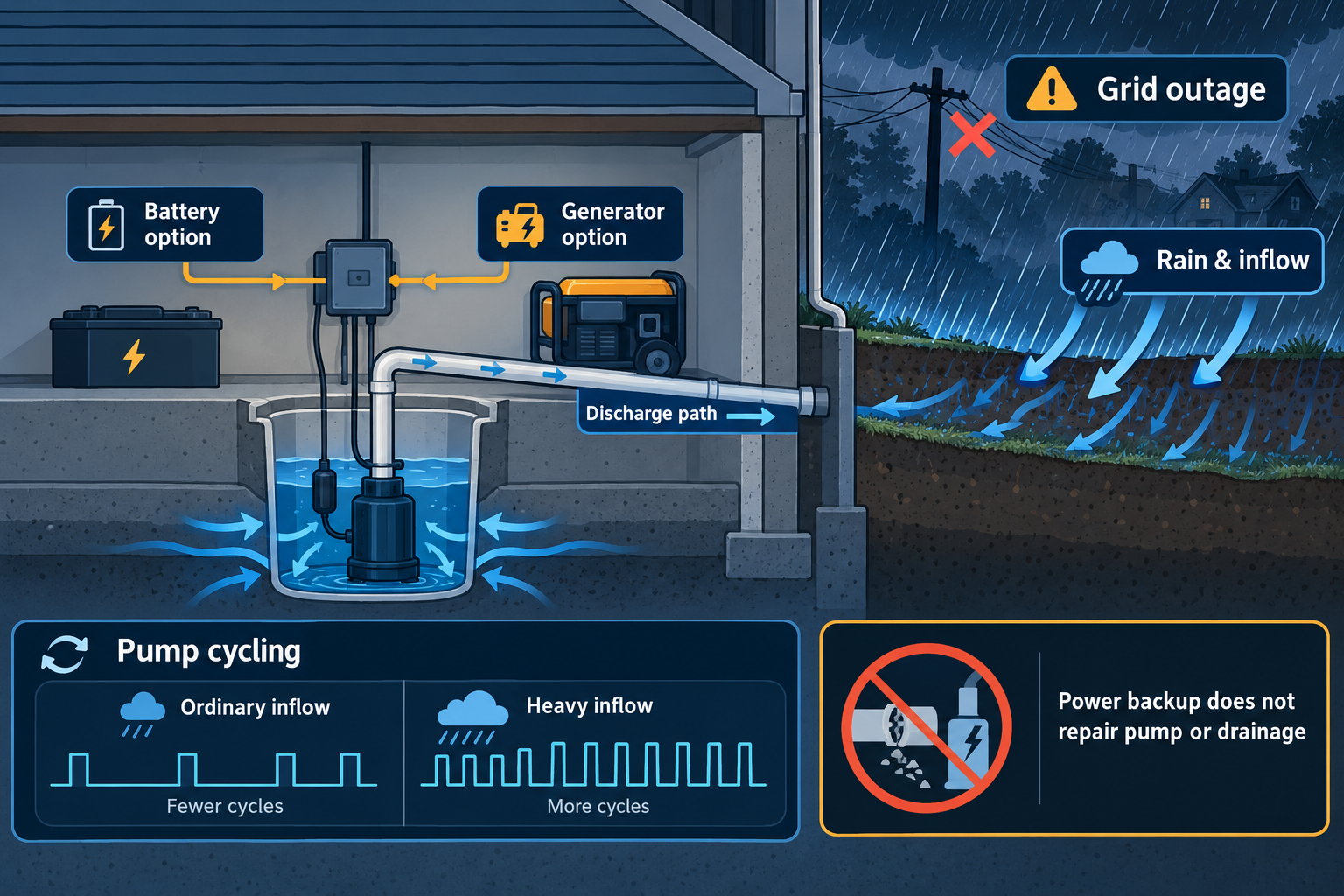
Define the existing duty
Record the pump model, circuit, voltage, rated power, discharge arrangement, float controls, and observed cycling in ordinary and wet conditions. A nominal battery capacity cannot predict runtime without a duty assumption. A pump that cycles occasionally and one that runs nearly continuously during a storm are different projects.
As one model-specific example, Zoeller’s February 2024 Model 53 sheet lists a 3/10 hp pump available at 115 V or 230 V and a motor-current range of 4.8–9.7 A. It does not map that range to each voltage or state startup current. Its maximum head of 19.25 ft and maximum flow of 43 gpm are not a single simultaneous operating point. Use the installed pump’s actual nameplate and site conditions; the example does not establish generator size, runtime, or project price.
The sump pit, drainage, discharge, and alternate pump strategies belong to the below-grade-water category. This guide prices electrical continuity for the existing primary pump. If the discharge is blocked, the pit is undersized, or inflow exceeds pump capacity, more backup power will not solve the underlying water problem.
Battery option
A battery or dedicated backup supply can protect the pump through a critical circuit if its inverter supports the startup demand and its usable energy matches the expected cycling. Ask whether it transfers automatically, whether it can recharge, what other loads share it, and how it signals low reserve. A larger kWh rating does not solve insufficient surge output.
Generator option
A standby or portable generator may provide longer operation while fuel is available. It still needs an approved transfer arrangement, safe outdoor placement, fuel, and enough starting capacity. Portable-generator CO and backfeed hazards are high-consequence concerns; do not use improvised household connections.
Cost scenarios
Occasional cycling: A focused battery or critical circuit may cover the likely outage if startup and reserve are verified.
Storm-and-outage coincidence: More energy, a generator, or a hybrid plan may be required because pumping demand peaks with the outage.
Near-continuous pumping: The correct response may include drainage or pump-system investigation in addition to power. Fuel supply, recharge, and runtime dominate the decision.
Compare the quote
Require pump data, measured or documented duty assumptions, starting and continuous output, usable energy, backed-up circuits, transfer equipment, runtime, recharge or fuel plan, monitoring, commissioning, and exclusions. Model low, expected, and heavy-inflow cases. Do not guarantee a runtime from a label or use a generic household load estimate.
The evidence does not establish one universal current price for sump-pump backup. Obtain local electrical and below-grade-water advice, keep USD and CAD evidence separate, and compare electrical backup with any properly designed alternate pumping strategy. The cheapest reliable plan is the one that matches the pump’s worst relevant duty, not its average day.
Put storm coincidence in the quote
Ask for runtime under ordinary cycling and heavy-inflow cycling. A battery or portable source that is adequate for occasional starts may be inadequate when rain continues and the utility remains down. A generator can extend operation while fuel is available, but transfer, safe placement, fuel storage, and maintenance become part of the plan. Solar may recharge storage only under conditions the design can actually achieve.
Check the discharge system too
Power backup cannot correct a blocked discharge, frozen line, failed check valve, undersized pump, or inflow that exceeds the system. Those below-grade-water questions belong to the adjacent scope, but they change the value of preserving power. Ask the water-system professional what condition the pump and discharge must be in for the backup plan to work.
Compare dedicated and whole-home backup
A dedicated pump circuit can reduce the source size and keep the priority visible. A whole-home battery or generator may already include the pump but can let large household loads consume the available power. Compare the dedicated design, critical-load system, and whole-home option using the same heavy-inflow case. Do not price the pump by its average wattage alone.
Use the worst relevant storm, not an impossible one
Ask which inflow and outage combination the design is intended to cover and which conditions fall outside it. A battery may cover short cycling but not continuous pumping. A generator may cover longer operation but still require fuel and safe transfer. A secondary pump or drainage improvement may reduce risk, but those are below-grade-water decisions and should be priced separately.
Put the failure boundary in writing
The backup quote should identify the pump, source output, transfer equipment, runtime, charging or fuel assumption, monitoring, and what happens at low reserve. The water-system quote should identify pump condition, discharge, pit, and inflow assumptions. Separating those scopes makes it clear whether the homeowner is buying electrical continuity, water-system capacity, or both.
Decide how much risk to retain
The homeowner may accept a brief interruption, protect only the primary pump, or pay for a longer source and a second water-management measure. State what happens if the outage exceeds the planned runtime or inflow exceeds the pump. A clear limit is more useful than an unsupported promise that backup power will prevent all basement water.
Model inflow, discharge, and starting demand together
The electrical source is only one part of sump protection. Pump horsepower, starting current, cycle frequency, discharge routing, pit condition, check valves, inflow, and any secondary pump can change the required service. A battery may have enough energy but insufficient surge output; a generator may have enough nameplate capacity but an unsuitable transfer or circuit arrangement. Ask for the actual pump and control information rather than sizing from a generic household load.
Use a short-event case, a prolonged-storm case, and a difficult case with repeated cycles or a failed primary pump. The expected runtime should state whether another source can recharge the battery or whether fuel remains available. If a second pump, pit modification, discharge correction, or below-grade repair is needed, keep that water-management scope visible and separate from the electrical backup price.
Decide what failure the project is buying down
A dedicated pump circuit may be enough when the main risk is a grid outage and the primary pump is reliable. Whole-home backup may be sensible when refrigeration, communications, heating controls, or other priority loads must operate together. A second pump or water-management improvement may address a mechanical or inflow risk that more electrical capacity cannot solve. Compare these paths using the consequence of water intrusion and the acceptable interruption, not only the source’s advertised output.
Test the completed protection chain
The useful closeout is more than a powered receptacle. Within the qualified installer’s scope, it should identify how the source transfers, whether the pump starts, how repeated cycles affect the source, what happens at low reserve or fuel, and how the system returns to normal utility operation. Keep the pump and control information, circuit schedule, source limits, discharge assumptions, and test result together. If the primary pump fails mechanically, the backup source may operate correctly and still not prevent water entry; that boundary should be explicit.
A homeowner can then choose a reserve based on consequence. A vacant property may accept a shorter duration with remote notification, while an occupied property with severe storm inflow may justify more capacity, a second pump, or another water-management measure. The additional cost is worthwhile only when it addresses the failure mode that matters.