
Fuel choice changes both installation and outage economics. Natural gas can avoid on-site tank storage where an adequate service is available, but piping, meter or regulator capacity, and utility continuity must be confirmed. Propane can provide stored fuel where gas service is absent, but tank purchase or enlargement, piping, delivery access, and site requirements add scope.
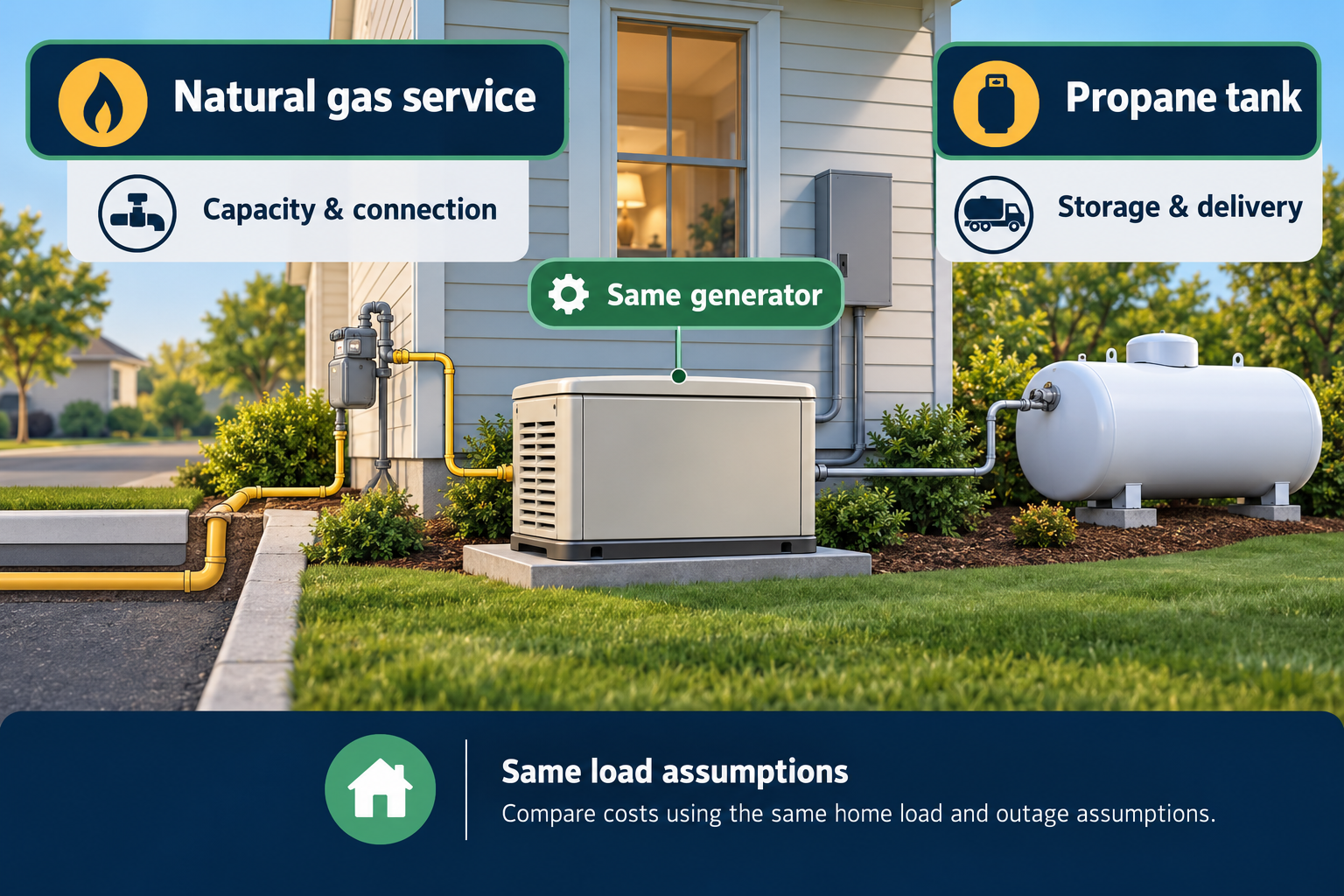
Installation comparison
Natural-gas installation should confirm the service can support the generator with other appliances operating. Distance, piping route, regulator or meter work, trenching, and local approvals affect cost. Do not infer line sizing from a generic generator label; the fuel professional must design the system.
Propane installation may include a tank, pad or supports, piping, excavation, delivery access, permits, and commissioning. Existing tank capacity and delivery arrangements may not match the generator’s intended runtime. A rural property may value stored fuel while paying more for the initial infrastructure.
Operating and outage tradeoffs
Compare delivered fuel price, consumption at the expected load, minimum supply, delivery reliability, seasonal demand, and outage duration. A fuel with a lower normal price is not necessarily cheaper if it requires a tank upgrade or is difficult to replenish during a regional event. Maintenance remains a generator cost regardless of fuel.
Two dated U.S. references show why the fuel bill needs local inputs. On October 5, 2026, the EIA residential-heating propane series reported $2.598 per gallon nationally, excluding taxes; this is not a generator contract price, and regional averages differed. For one specific product, Generac model 7210, variant G0072101 lists 2.53 and 3.9 gallons of LP per hour at 50% and 100% rated load, versus 203 and 306 cubic feet of natural gas per hour. Its maximum continuous output also differs by fuel: 24 kW on LP and 21 kW on natural gas. These model-specific test points are not a complete consumption curve or a household operating-cost estimate; compare the same load using current local fuel terms and the exact generator model.
Three property scenarios
Existing adequate gas service: Natural gas may avoid a new tank, but capacity and local approval still need confirmation.
Existing propane tank: Propane may be convenient if capacity, regulator, delivery, and placement are suitable. A larger generator can change those assumptions.
No dependable fuel infrastructure: Compare new propane infrastructure with a different backup technology or location. The fuel project may determine whether standby generation is sensible at all.
Make the quote comparable
Ask for generator equipment, transfer equipment, fuel connection, meter or regulator work, tank, trenching, pad, permits, commissioning, fuel assumptions, and maintenance separately. Confirm whether the quote assumes a specific load, runtime, pressure, or tank fill level. Fuel and electrical work should be performed by qualified trades under local rules.
The evidence does not establish universal fuel prices or installation costs. Use current local supplier and contractor information, keep market currencies separate, and choose the fuel whose availability and infrastructure fit the actual outage plan—not the fuel with the most attractive unqualified unit price.
Make fuel availability part of the price
Compare normal delivered cost with outage availability, consumption at the intended load, minimum supply, delivery access, and seasonal demand. Natural gas may be continuously supplied but can depend on utility service. Propane may be stored on site but may require a fill, tank capacity, and a delivery route during the same regional event. These are property-specific risks rather than universal fuel rankings.
Maintenance and future changes
Include fuel-system inspection, generator service, tank or regulator work, and changes in household load. A future addition such as electric heat, a heat pump, or a vehicle may change the generator and fuel requirement. Ask the installer to state whether its proposal assumes current loads only or leaves documented capacity for future changes.
Rural context
Remote properties may value stored propane, but delivery distance, service availability, winter access, and tank placement can dominate the economics. That is a connection to the rural-property context, not a reason to apply a generic rural premium. Obtain local fuel and service quotes.
Use the same load and runtime assumptions
Fuel comparisons are meaningless when one quote assumes a small critical-load generator and the other assumes whole-home operation. Use the same output, expected load, outage duration, and maintenance horizon. Then add each fuel’s infrastructure: piping or tank, regulator, trenching, pad, approvals, delivery, and restoration.
Treat marketing fuel estimates cautiously
Consumption at one test load does not predict a household’s total outage cost. Ask how the estimate changes at the expected load and during a long event. Include a case in which delivery is delayed or utility service is interrupted. The correct choice is a resilient local supply with a supported installation, not a generic ranking of gas and propane.
A fuel quote is not a generator quote
Require separate generator, transfer, gas or propane, pad, trenching, permit, inspection, commissioning, and delivery assumptions. Confirm whether the fuel professional has verified capacity under the generator’s intended load. A generator can be available while the infrastructure needed to run it is not.
Model a prolonged event
Compare expected consumption at the household’s load, not only a manufacturer’s test point. Include a long outage, a period of high demand, a delayed delivery, and an interruption to utility service where relevant. Stored propane may provide a different risk profile from pipeline gas, but tank size, access, and local rules determine whether that advantage is real.
Ownership horizon
For a short ownership horizon, installation cost and resale documentation may dominate. For long ownership, service access, fuel price exposure, tank or meter changes, maintenance, and future electrification matter more. Keep the comparison local; the evidence does not support a universal fuel price or a USD-to-CAD conversion.
Build a three-case fuel model
Use a normal-operation case, a prolonged-outage case, and a supply-disruption case. The first shows installation and routine fuel economics. The second tests consumption, refill or pipeline availability, service access, and whether the generator can carry the intended load without continuous homeowner intervention. The third asks what happens if delivery is delayed, roads are blocked, gas pressure is limited, or the tank cannot be refilled when the regional outage affects other customers too.
Keep the generator load and load-shedding behavior constant in each fuel comparison. Otherwise one option can appear cheaper because it is quietly modeled with fewer appliances, shorter runtime, or a smaller source. State whether the fuel estimate covers only consumption or also tank rental, delivery, minimum purchase, connection, inspection, and future service. These are property- and supplier-specific assumptions, not universal rates.
Include future property changes
Fuel infrastructure can conflict with a later addition, driveway change, landscape project, service upgrade, or electrification plan. Natural-gas piping and propane tanks have different access, inspection, and modification implications. Ask what must be moved if the generator is replaced, the load grows, or the property changes ownership. A documented route, shutoff, capacity assumption, and service boundary can have resale value even when fuel prices change.
Choose the fuel that supports the actual outage objective with an acceptable supply chain and service path. A small installation premium can be worthwhile if it improves reliable delivery and access; a low unit-fuel price is not a saving if the infrastructure cannot support the generator when it is needed.
Check the outage supply chain
Ask how fuel reaches the property during a regional outage. Pipeline service, tank delivery, winter access, road conditions, supplier capacity, and a homeowner’s ability to monitor supply can matter as much as per-unit price. Use a no-delivery or delayed-delivery scenario when the backup objective is critical.
Do not separate fuel from load management
A generator carrying electric heat or several motors consumes fuel differently from one serving refrigeration and lights. If the system sheds loads, fuel use changes with the priority sequence. Compare both fuels using the same load-management behavior and require the installer to identify what is assumed rather than presenting one consumption number as universal.