
Fuel infrastructure can turn an apparently simple standby-generator purchase into a multi-trade project. The added scope may include natural-gas piping, meter or regulator review, propane tank work, trenching, pad or supports, permits, inspection, pressure or system checks, and coordination with electrical commissioning. The available evidence does not support one universal current price.
Natural-gas work
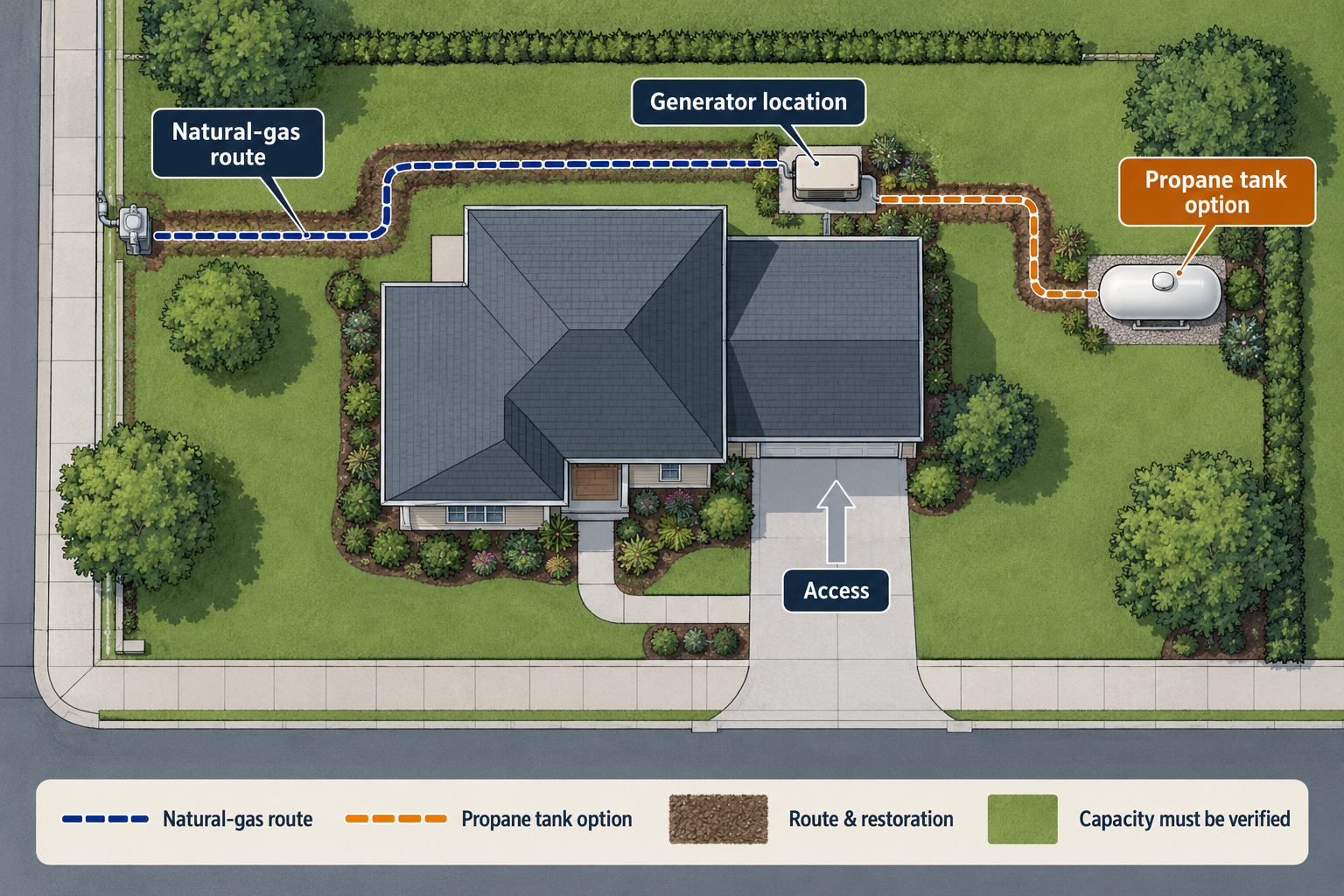
The fuel contractor must determine whether the existing service and regulator can support the selected generator alongside other appliances. Pipe distance, route, access, excavation, connection points, and restoration affect labor. A service that works for current household loads may not have spare capacity for a generator.
Do not accept a quote that says “gas hookup” without identifying the assumed service, route, regulator, meter work, trenching, and authority approvals. Gas-line sizing and installation are not homeowner calculations.
Propane work
Propane scope can include a new or enlarged tank, pad, piping, regulator, excavation, delivery access, permits, and commissioning. Ask how the quoted tank size relates to load, runtime, weather, and delivery assumptions. A tank that is physically present may still be unsuitable for the selected generator or desired outage duration.
Site and coordination costs
The generator location affects trench length, pad, access, noise or placement review, and restoration. Electrical and fuel contractors need a shared equipment location and load assumption. If one trade arrives before the other has confirmed the design, rework or a change order can follow.
Three planning cases
Existing service near the equipment: Short, accessible connection with adequate capacity. The infrastructure scope may be limited but still needs professional approval.
Moderate route or tank changes: Piping, regulator, tank, pad, or trenching adds a separate mobilization and restoration package.
Capacity or access problem: Utility upgrade, long excavation, rock, difficult access, or a different generator location changes feasibility and price. Obtain this branch before signing a generator-only contract.
Normalize the quote
List fuel source, distance, pipe or trench assumption, meter or tank work, pad, permits, restoration, inspection, testing, and responsibility for failed capacity review. Keep the generator, transfer equipment, electrical work, and fuel work separate enough to see which assumption drives the total.
Fuel infrastructure is worth paying for when it supports a justified backup objective and reliable runtime. It is a warning sign when the generator is selected first and fuel feasibility is left as an undefined allowance.
Ask who owns each unknown
The generator installer, electrician, utility, gas contractor, propane supplier, and permitting authority may each control a different part of the answer. Require one coordinated schedule showing which party verifies capacity, obtains approval, excavates, restores surfaces, tests the fuel system, and commissions the generator. A handoff gap can become a change order even when each individual quote looks reasonable.
Add future operating conditions
Fuel demand depends on output and load. A generator sized for occasional critical circuits has a different infrastructure requirement from one intended to carry electric heat through a prolonged event. Include desired runtime, peak load, delivery limitations, winter conditions, and a no-delivery scenario in the design discussion.
Compare alternatives before excavation
If new piping, tank, or trenching dominates cost, compare a different generator location, critical-load scope, battery, solar-plus-storage, or hybrid plan. The alternative should be evaluated for the same outage service. Do not choose a cheaper fuel connection that cannot support the intended equipment safely or reliably.
Separate fixed and event costs
Fixed infrastructure includes the tank, piping, regulator, pad, trenching, permits, and restoration. Event costs include fuel consumed during an outage, deliveries, service, and repairs. A fuel choice with a lower installation price may carry more delivery or runtime exposure, while a higher fixed cost may buy stored supply. Put both categories into the ownership model.
Check the route before committing
Show the fuel route on the site plan and identify crossings, access, restoration, equipment service space, and future property work. Ask what happens if excavation encounters rock, an existing utility, or inadequate capacity. These are conditional construction issues; they must be resolved by the appropriate professionals and authority.
The most expensive assumption is often capacity
An existing gas service or propane tank may look ready while lacking the capacity, pressure, regulator, or runtime required by the proposed generator. Ask for verification under the intended load and for documentation of the authority or supplier requirement. Do not let a visual connection determine the project.
Restoration and access remain real work
Trenching may require surface removal, backfill, paving, landscaping, or driveway repair. A tank may require delivery access and service clearance. A generator pad may need to be relocated if the route or authority review changes. Include these items in the site plan and contingency rather than treating them as free consequences of the fuel choice.
A staged decision
First verify the outage load and generator. Then confirm fuel feasibility and approval. Only after those gates should you compare fuel prices or sign an installation contract. If the infrastructure makes the project disproportionate, revisit critical-load coverage, battery storage, solar recharge, or a hybrid system.
Read allowances carefully
An allowance for gas, propane, trenching, or restoration is not the same as a fixed price. Ask what quantity, route, capacity, surface, and approval assumption supports it. Require notice before the contractor exceeds the allowance and identify whether you can change the generator location or load scope.
Fuel infrastructure affects serviceability
The route should leave room to inspect, repair, refill, and access the generator and controls. A technically possible connection can be poor value if service equipment is inaccessible or future property work will disturb it. Include access and records in the closeout, not only the initial connection.
Test capacity before choosing the fuel
Fuel selection should begin with the generator’s actual demand under the intended load, the supply capacity at the property, the duration of the outage, and the conditions under which delivery may be delayed. A natural-gas connection can look simple until pressure, regulator, meter, or local capacity must be confirmed. Propane can look flexible until tank size, refill access, winter demand, or placement requirements become limiting. The fuel is feasible only when its infrastructure supports the complete operating plan.
Request a site walk that identifies the route, surface, crossings, shutoffs, clearances, equipment access, and restoration. Ask which assumptions are fixed and which are allowances. A long trench or difficult surface may cost more than the visible piping; a capacity change may make the generator choice itself unsuitable. If the route crosses a future driveway, roof project, or landscape plan, include that lifecycle conflict now.
Price the event after installation
The infrastructure may need inspection, service access, seasonal preparation, refill coordination, and future modification. Record shutoff locations, as-built routing, supplier responsibility, and restoration boundaries. This documentation reduces the cost of troubleshooting and makes a future generator replacement less disruptive. A low initial fuel quote is not a complete saving if it leaves the homeowner unable to refill, service, or operate the source during the outage it was meant to cover.
Connect infrastructure to the load plan
Fuel demand is not independent of generator sizing. A source carrying a few essential circuits may need less fuel infrastructure than one expected to run electric heat, cooling, pumps, or several motor loads together. Load management can change both operating cost and supply duration, but it must be specified rather than assumed. Ask for the load sequence and fuel condition used in the design.
If the fuel route or supply capacity is uncertain, keep the generator purchase conditional until that question is resolved. Otherwise the homeowner may own equipment that cannot deliver the intended output without another service upgrade. A staged investigation can cost less than excavation followed by a redesign, especially when access or restoration is difficult.