
Standby-generator ownership includes recurring service even when the engine rarely runs. Maintenance can include inspection, exercise or testing, oil and filter service, spark plugs where applicable, starter battery, fuel-system checks, repairs, and a service call after a failed start. Exact intervals come from the product documentation; one brand’s schedule is not universal.
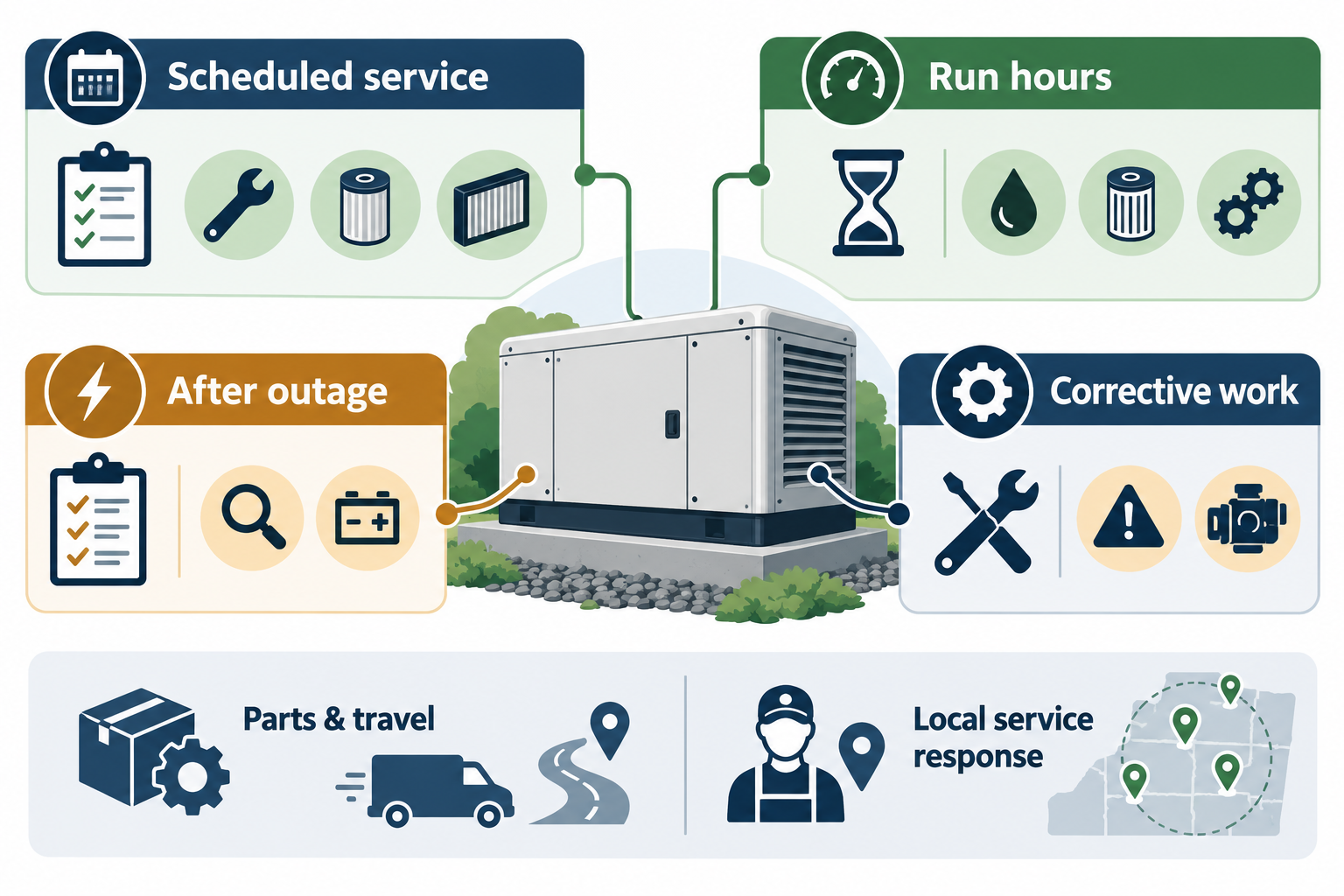
Routine versus corrective work
Routine service verifies condition and replaces scheduled consumables. Corrective work responds to a fault, weak battery, failed start, fuel problem, control error, or damage. Ask a service provider whether the plan includes emergency visits, parts, batteries, load testing, and travel, or whether it only covers a scheduled inspection.
Infrequent use can create a false sense of readiness. An automatic exercise cycle may show that controls start, but it does not guarantee performance under the home’s actual load or a prolonged outage. Commissioning and maintenance records should state what was tested.
What changes annual cost
Generator size, engine type, runtime, climate, fuel system, brand, service distance, local labor, and maintenance-plan terms affect cost. Heavy use during repeated outages can bring run-hour service forward and increase oil, filter, and repair consumption. A remote property may pay more for mobilization.
The starting battery is a recurring replacement item. Fuel infrastructure and transfer equipment have their own maintenance or inspection obligations. Include them when comparing generator ownership with a battery, whose lifecycle costs are different.
Three ownership cases
Light-use household: Scheduled service and a battery reserve may be the main recurring costs.
Frequent outages: Run hours, fuel, consumables, and corrective service become more important.
Remote or difficult service: Travel, delayed parts, and a second mobilization increase the value of a documented maintenance plan and spare planning.
Build the budget
Request the manufacturer’s schedule for the exact model, local labor and travel assumptions, included parts, battery treatment, emergency rates, and warranty conditions. Add a reserve for non-routine repairs and eventual generator replacement. Do not publish one annual price as if it applied to every size, fuel, brand, or region; reliable comparable current pricing was not established.
Maintenance is part of the purchase decision. A generator that is affordable to install but difficult to service may be more expensive to own than its equipment quote suggests.
Maintenance plan versus service call
Ask whether the plan covers scheduled service only or also failed starts, travel, parts, battery replacement, load testing, and emergency response. A plan that excludes the items most likely to matter during an outage is not equivalent to full readiness. Keep the exact model schedule with the ownership records.
Run hours change the budget
An exercise cycle and a prolonged outage create different service demands. Add a run-hour reserve for oil, filters, battery, fuel checks, and repairs when outages are frequent. If the generator is remote, include travel and the time needed to obtain parts. These costs can outweigh a small difference in annual service pricing.
Readiness is not a promise of unlimited supply
Maintenance can improve starting reliability but cannot create fuel, correct an undersized transfer system, or make an unsafe placement acceptable. Review the whole system when the property, fuel source, load list, or local requirements change. The economic value of maintenance is keeping a suitable design ready for its stated objective.
Budget a failed start
Routine service and outage repair are different economic events. Include a reserve for a weak starter battery, failed control, fuel issue, weather-related service call, or delayed part. Ask whether the provider offers priority response during regional outages and what travel or emergency charges apply.
Service records protect the investment
Keep model, serial number, service dates, run hours, parts, fault history, fuel-system work, and transfer tests. Records help a new technician diagnose a problem and help a buyer understand the system. They do not make an unsuitable generator suitable, but they reduce avoidable rediscovery cost.
Maintenance follows the actual model
Ask the manufacturer or authorized service provider for scheduled time, run-hour, oil, filter, battery, spark-plug, control, and fuel-system requirements for the exact unit. Record which items the local service plan includes. Do not transfer an interval or part requirement from another brand simply because its generator looks similar.
Routine readiness tests have limits
An exercise cycle can reveal a weak battery or control issue, but it does not answer whether the generator can carry the home’s starting loads for a prolonged event. Include an appropriate load or system test within professional scope and record the result. A maintenance plan should make its test boundary clear.
Decide whether the service market fits
Ask how quickly parts and technicians are available, what travel costs apply, and how the provider responds during regional outages. A lower annual plan with no local response may be less useful than a more expensive plan with defined service. Include this availability risk when comparing a generator with battery storage.
Read the maintenance scope line by line
Confirm whether scheduled labor, consumables, starter battery, exercise review, load testing, travel, emergency response, and parts are included. Ask how warranty service interacts with the plan. A low annual fee may cover only an inspection while the homeowner still carries the costs that matter after a failed start.
Link service to the outage objective
A generator for occasional lights has a different service burden from one expected to carry pumps, heating, or long events. Update the plan when the load list or fuel changes. Maintenance should preserve the capability the homeowner bought; it should not be treated as a generic annual ritual detached from the system’s actual design.
Use run hours to update the budget
An annual service plan may be adequate for a lightly used standby unit, but a prolonged outage, repeated exercise, or frequent load testing can change consumables, inspection, battery, and corrective-work needs. Track run hours and the events that caused them. Ask whether the plan covers only scheduled service or also the parts and labor that become more likely after extended operation.
The fuel system and transfer equipment deserve their own review. A generator can start correctly yet fail to carry the intended load because of supply capacity, control, transfer, or load-management problems. Maintenance should verify the capability that matters to the property within the service’s approved scope. It cannot make an undersized or improperly installed system adequate.
Decide whether local service is a cost driver
Travel distance, provider availability, emergency response, parts support, and warranty coordination can matter more than a small difference in annual plan price. A cheaper plan with no practical response path may provide less outage value than a more expensive local service arrangement. Ask who responds after a failed start, what is included outside business hours, and whether records are retained for the next technician.
Use the maintenance quote to compare a serviceable generator with a battery or hybrid alternative over the planned ownership horizon. Include starting battery, fuel, exercise, repairs, replacement, and the cost of an unavailable system—not just the scheduled visit.
Budget for the service outcome
The useful question is whether the generator will perform its stated duty when the outage occurs. For a pump, that includes starting and repeated cycling. For heating or cooling, it includes the controls and simultaneous loads that the source is expected to carry. For a vacant property, it may include notification and a response path. Maintenance cannot guarantee every external condition, but a service plan should identify which checks support the chosen outcome and which risks remain outside the plan.
Ask for the service interval, run-hour triggers, inspection tests, consumables, parts process, records, and response after a failed start. If the provider cannot support the actual equipment or fuel system, a low maintenance price may not preserve useful backup. Local serviceability is an economic feature of the generator, not a separate convenience.