
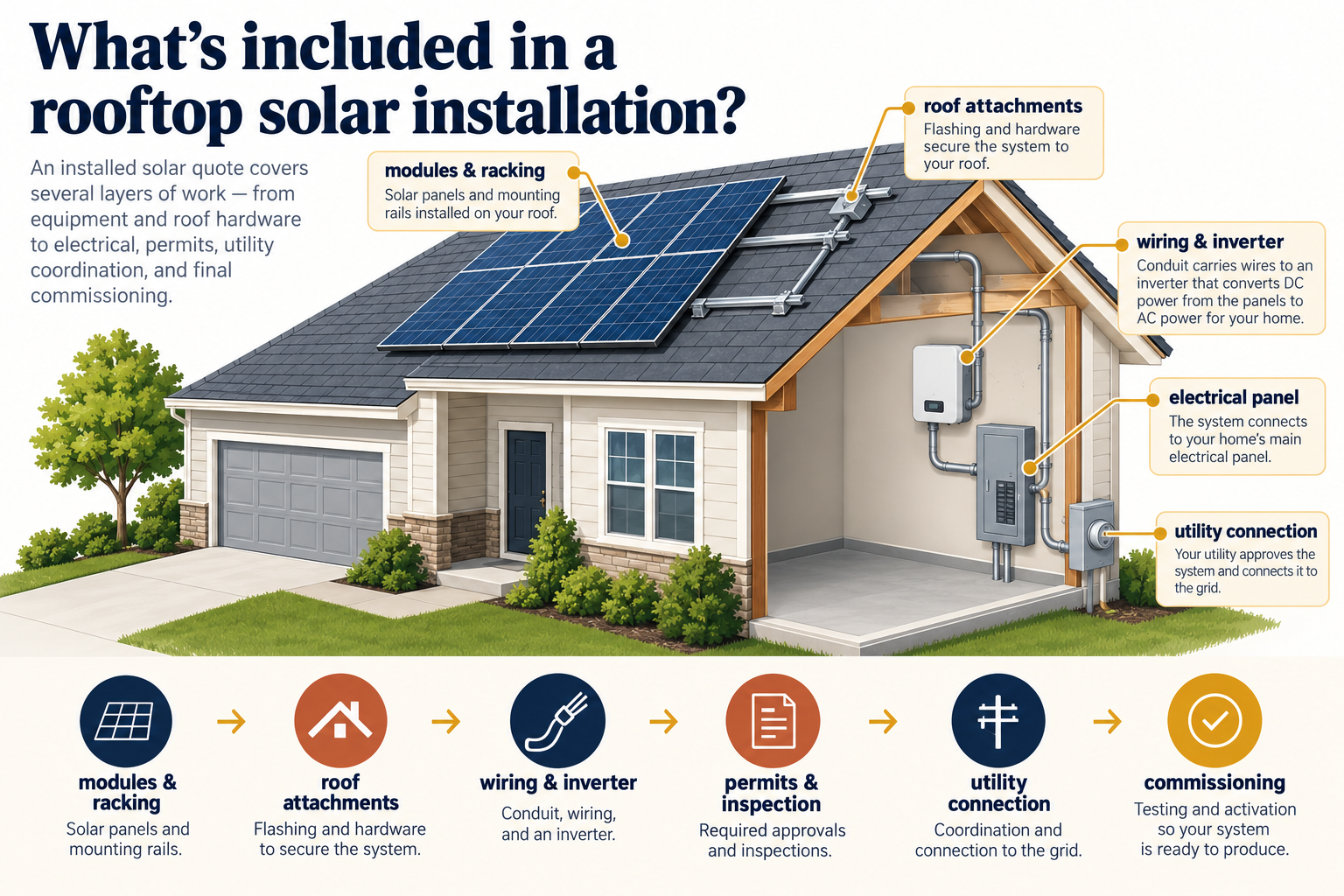
A rooftop solar quote is the price of a small electrical and structural project, not the price of the panels alone. The installed total can include modules, racking, inverters, wiring, roof attachments, design, labor, permits, inspection, utility interconnection, commissioning, and contractor overhead. Storage and roof replacement are separate decisions unless the proposal explicitly combines them.
What a complete quote should include
Start by asking for one scope that names the proposed system and one price schedule that explains it. The equipment section should identify module quantity and rating, inverter architecture, racking, monitoring, disconnects, and any rapid-shutdown or control equipment required by the design. The construction section should identify roof attachments, flashing treatment, conduit paths, attic or exterior access, wiring, and cleanup.
The soft-cost section matters too. Design, structural review where needed, permit preparation, local inspection, utility application, meter work, interconnection review, and commissioning can occur before or after the physical installation. DOE describes permitting, inspection, and utility connection as distinct stages, and local rules and fees vary. A quote that says “turnkey” without showing which stages are included is difficult to compare.
Cost per watt is not the total price
Installers often use cost per watt as a comparison metric. It can help compare systems with similar scope, but it does not replace the total project price. A small array may carry nearly the same design, mobilization, permitting, and interconnection work as a larger one. A roof with several planes may require more labor and equipment per watt than a simple roof even when its annual production is similar.
Compare the proposed annual production, system size, equipment, roof work, and included administrative scope together. Do not select a bid because its unit metric is lowest if it omits electrical prerequisites, a new main panel, difficult access, or utility work.
The main cost drivers
The first driver is system design: household consumption, expected future loads, roof orientation, shading, available area, and desired production. A homeowner adding an electric vehicle, heat pump, or electric water heater may need a different system and service review than a household replacing none of its major loads.
Roof geometry and condition drive labor. Multiple roof planes, steep pitch, fragile material, obstructions, long conduit routes, limited staging, and difficult access increase installation effort. A roof may also need repair or structural review before mounting. Those costs belong in the roof or engineering scope, but they can change the solar decision.
Equipment choice affects both initial and later cost. String inverters, microinverters, optimizers, monitoring equipment, and battery-ready or hybrid architectures have different replacement and expansion implications. The best choice depends on the design, not on a universal claim that one architecture always produces more savings.
Local approvals and utility conditions add uncertainty. Permit fees, inspection arrangements, interconnection applications, meter changes, engineering review, system-size limits, or customer-funded upgrades may apply differently by jurisdiction. Ask whether the installer includes ordinary approval work and what happens if the utility requires a study or upgrade.
Three useful project scenarios
Simple rooftop project: The roof is serviceable, the array fits one or two accessible planes, the service has capacity, the equipment is standard for the market, and no unusual utility work is required. The quote should be relatively easy to normalize because most cost sits in the array, racking, wiring, and ordinary installation.
Typical complicated project: The roof has several planes or some shading, conduit needs a longer route, the array is split across orientations, and the installer must coordinate permit and interconnection details. Production modeling and the exact roof attachment plan matter as much as equipment price.
Difficult project: The roof needs repair or structural investigation, access is restricted, the service requires changes, trenching or long conductors are involved, or the utility requires additional review. In this case the solar equipment may be only one part of the budget. Obtain the conditional costs before treating the proposal as a firm total.
Incentives, financing, and net cost
Financing changes the economic question. Cash, a loan, a lease, and a power-purchase agreement can differ in upfront payment, financing cost, control, maintenance responsibility, incentive access, and property-sale obligations. A lower initial payment is not automatically a lower lifetime cost.
Incentives are time- and jurisdiction-sensitive. Current U.S. tax guidance may apply only to a specific tax year and does not establish Canadian treatment. Utility rebates and export programs also have eligibility, equipment, application, and approval conditions. Treat an incentive as a conditional reduction only after confirming that the household, property, equipment, timing, and program all qualify.
For a dated U.S. comparison point, Lawrence Berkeley National Laboratory’s August 2026 data update reports a 2025 median up-front installed price of $3.60 per watt of DC capacity for host-owned residential stand-alone PV, before incentives. The dataset excludes third-party-owned systems; it is a national observation, not a current local quote or a Canadian price. Treat it as context for asking why bids differ, not as a target price.
Québec has a separate, local example. As of September 27, 2026, Hydro-Québec’s LogisVert program offers a grant of $1,000 per installed kilowatt, capped at 40% of eligible solar-panel purchase and installation costs. Eligibility depends on program conditions, including installation date and final connection authorization. The grant does not establish a project’s total installed price or its eligibility. Confirm the current program terms before subtracting it from a quote; neither the amount nor the rule applies across Canada.
For a separate Canadian cost reference, the IEA PVPS National Survey Report of PV Power Applications in Canada 2024, published in December 2025, reports CAD $2.30–$3.90 per watt for 5–10 kW grid-connected residential rooftop systems in 2024. The report’s system-price definition includes installation but excludes VAT, recurring service costs, remote sites, and specialized installations. It is an approximate historical market range, not a 2026 installer quote. Keep it in Canadian dollars and verify local scope and current quotes before using it as a budget.
Normalize competing bids
Put competing proposals into the same table. Record system size, expected production, module and inverter models, roof planes, racking, conduit, monitoring, battery readiness, service work, structural review, permit and interconnection responsibility, warranty terms, exclusions, and payment schedule. Add the expected cost of roof work or future removal if those are not included.
Then test a low, expected, and difficult case. The low case uses the stated scope with no upgrade. The expected case includes the most likely access, approval, and minor electrical work. The difficult case asks what happens if the service, roof, utility, or equipment compatibility is not as assumed. A bidder who cannot explain those branches has not made uncertainty visible.
Questions before signing
Ask who assesses the roof, who owns the roof attachment and flashing warranty, and whether a reroof later requires removal and reinstallation. Ask whether the design allows future electrical loads, how production was modeled, what happens if the utility rejects the interconnection as submitted, and whether monitoring and commissioning are included. Request equipment and layout records for future service.
The most defensible rooftop-solar budget is a scoped local quote with visible assumptions. Use broad market context to compare the structure of bids, then investigate any price difference that comes from omitted work rather than genuine efficiency.
If the roof or ownership arrangement rules out on-site panels, an off-site community-solar subscription is a different payment-and-credit decision, not a rooftop installation quote. If the homeowner plans to end solar use permanently, include removal and system retirement with any roof or property work rather than treating disposal as a panel-only fee.
Read the production promise carefully
Production is not the same as installed capacity or bill savings. Ask whether the estimate assumes current shade, roof orientation, snow or soiling, degradation, downtime, and future changes in household use. Confirm whether the proposal is modeling self-consumption, exported energy, or both. A system can meet a production target and still produce a different financial result when export compensation is lower than the retail rate.
Separate prerequisites from optional upgrades
An electrical service upgrade may be necessary for the proposed design, or it may be an option for a larger future load. A roof repair may be essential before attachments, or it may be unrelated improvement. Ask the installer to label each item as required, recommended, or optional and to state what happens if it is deferred. This keeps a large proposal from presenting every possible improvement as one unavoidable solar cost.
Ownership horizon changes the comparison
For a short ownership horizon, include transfer or payoff terms, documentation, roof condition, and whether a buyer will understand the system. For long ownership, give more weight to inverter replacement, service availability, roof coordination, monitoring, and equipment compatibility. Do not assume a new array recovers all of its cost at resale.
A useful quote table
| Scope | What to record | Why it matters |
|---|---|---|
| Generation | module count, capacity, modeled production, shading | Establishes what is being bought |
| Conversion | inverter type, models, monitoring, shutdown equipment | Drives compatibility and service |
| Building | roof attachments, flashing, access, structural review | Exposes roof and labor risk |
| Administration | permits, inspection, utility application, meter work | Separates included approvals from contingencies |
| Future work | removal, roof timing, expansion, battery path | Prevents a low first price from hiding lifecycle cost |
If a bidder cannot fill this table, the offer is not yet comparable. Use the range to investigate scope, not to make an unsupported national price claim.
When the property changes the economics
Two homes with the same target output can have very different project totals. A simple roof plane with clear access may keep structural review, attachment work, conduit, and labor predictable. A difficult roof can add multiple planes, special access, attachment coordination, restoration, or a separate electrical route. A ground option may remove roof risk while adding trenching, grading, longer conductors, vegetation control, and site approvals. The production target should stay constant while those property-specific layers are compared.
Roof timing is especially important. If the covering or deck may need work during the ownership horizon, the solar quote is incomplete until removal and reinstallation consequences are modeled. If electrification or an added battery is likely, service capacity, inverter architecture, monitoring, and expansion limits deserve a place in the initial design. These are not automatic upgrades; they are decision points that prevent a low first price from creating a second mobilization.
A practical bid-normalization example
Suppose one bid includes permit handling, monitoring, and roof access while another lists only modules, racking, inverter, and installation labor. The second bid is not cheaper until the missing items are priced or explicitly assigned to the homeowner. Compare the same production assumption, module and inverter scope, structural responsibility, electrical work, approval path, commissioning record, warranty boundaries, and exclusions. Then create low, expected, and difficult totals for the items that are still conditional.
The useful question is not which bidder has the lowest headline price. It is whether both bids buy the same operating service and leave the same future responsibilities. A modestly higher complete scope can be the lower-cost choice if it avoids an uncertain service upgrade, repeated roof access, or an unsupported equipment platform.