
Ground-mounted solar can avoid a difficult roof, provide a preferred orientation, or leave room for future roof work. It also turns part of the project into site infrastructure. Foundations, racking, clearing, grading, trenching, longer conductors, access, fencing or protection, permits, and interconnection may make the installed cost higher than a comparable rooftop array even when the panels are identical.
Start with the site, not the panel count
The usable site is the area that can accept the array while preserving access, drainage, setbacks, vegetation management, and any applicable property restrictions. A shaded or wet area is not made economical merely by being unused lawn. The design should show array location, orientation, foundation approach, conduit route, equipment location, and access for installation and later service.
Ground mounting may be attractive when the roof is old, structurally uncertain, heavily shaded, or divided into unsuitable planes. It may be a poor choice when the only available land requires major clearing, retaining, long trenching, or a new route across a driveway or wet area.
What the installed cost contains
The generation equipment remains familiar: modules, inverters, racking, wiring, monitoring, and commissioning. The site package is what changes. It can include a geotechnical or structural assessment, driven or cast foundations, steel support, excavation, conduit, trench backfill, vegetation removal, grading, erosion control, and restoration.
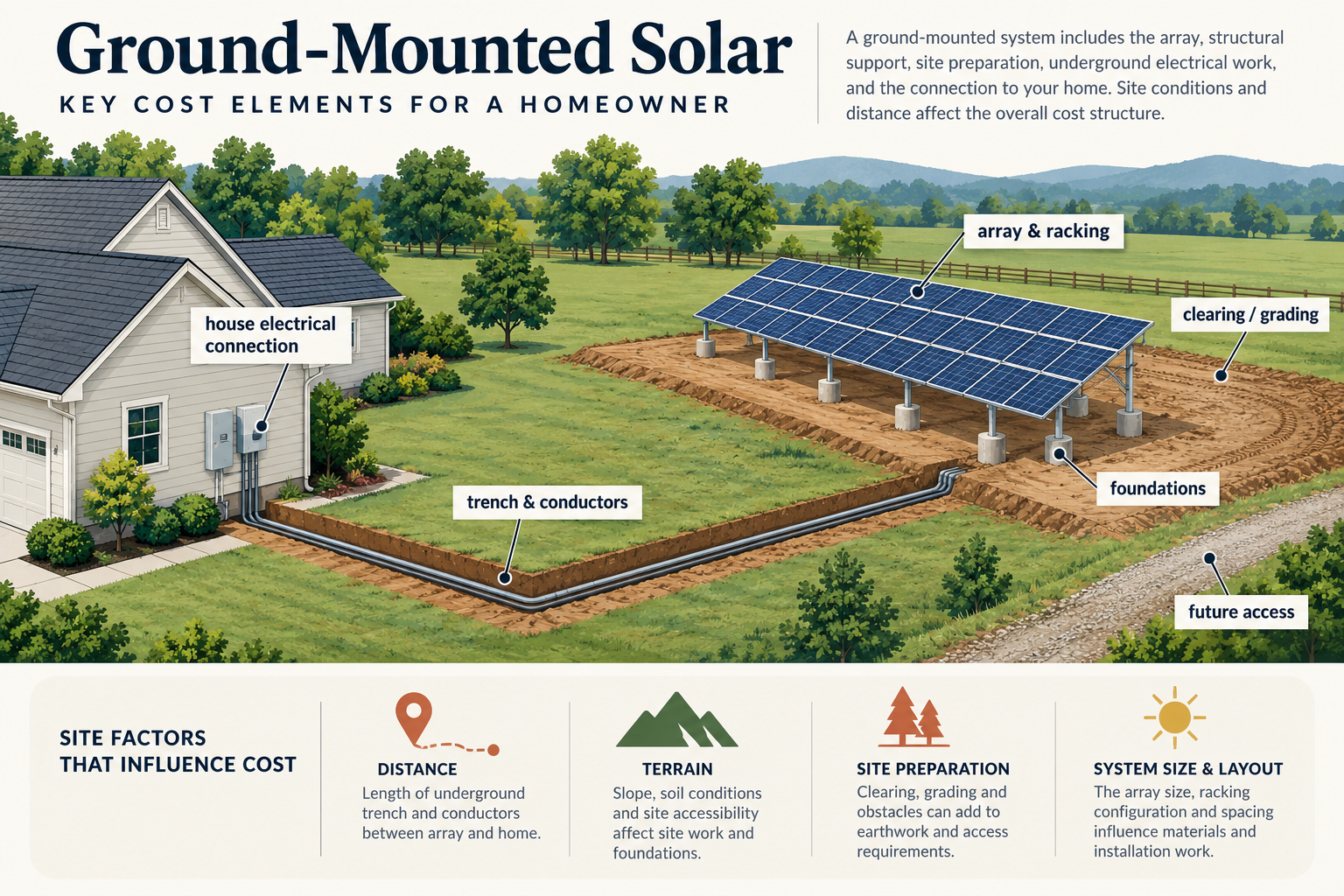
Electrical distance matters. A ground array farther from the house or service may need more conductor, larger raceways, additional disconnects, or equipment at the array. The electrical design must also account for future loads and the utility’s interconnection requirements. Do not compare only module and inverter line items against a rooftop quote.
Three site scenarios
Simple ground mount: The array is close to the house, on accessible stable ground, with little clearing and a straightforward foundation and conductor route. The main premium is the racking and foundation package.
Typical rural or suburban site: The array needs a trench, some vegetation work, equipment protection, and coordination with drainage or driveway access. Restoration and mobilization become visible line items.
Difficult site: Rock, steep slope, wet ground, uncertain soil, retaining work, long conductors, limited equipment access, or utility-side changes dominate the uncertainty. A proposal should make these conditional items explicit rather than burying them in an allowance.
Rooftop comparison
Rooftop solar generally uses the existing building as the mounting structure, but it brings roof access, penetrations, shading, and future reroofing into the decision. Ground mounting can simplify roof maintenance and allow easier module-level access, but it requires land and creates its own exposure to vegetation, snow, animals, equipment damage, and site drainage. It may also be more visible or subject to additional local review.
Compare lifetime scope, not just first installation. A roof-first decision may avoid site construction but create later panel removal. A ground mount may avoid that rework while adding site maintenance and longer wiring. If the array is distant from the home, include the cost and risk of access for future repair.
If the owner plans to end solar use rather than relocate or replace the array, include the separate professional retirement and removal scope, including ground-foundation removal or site restoration where the quote requires it.
Permits and interconnection
Permit and setback rules are local. The available evidence does not establish one universal residential ground-mount rule for the United States or Canada. Ask the installer which authority reviews the structure, electrical system, grading, and land use, and which fees or studies are excluded. Utility approval can still be required even when the array is not on the roof.
Interconnection costs can depend on system size, service capacity, meter configuration, and utility infrastructure. Ask for a written treatment of customer-funded upgrades, transformer review, application failure, and schedule risk. Do not treat a preliminary solar design as proof that the utility will accept the final system.
Is the premium worthwhile?
Ground mounting can make economic sense when it materially improves solar access, avoids a near-term roof project, allows a better layout, or makes service and future expansion easier. It is harder to justify when the site requires extensive civil work or when the rooftop system already has adequate production and a sound roof.
Model the two options using the same production and ownership assumptions. Include equipment, mounting, labor, design, permits, interconnection, roof or site work, future access, and maintenance. For Canada, obtain independent local CAD proposals; do not convert an American rooftop or utility-scale figure into a residential Canadian ground-mount price.
What to ask for in the quote
Require a site plan, foundation assumption, trench length and restoration scope, conductor route, access plan, drainage treatment, equipment protection, vegetation responsibility, permit responsibility, utility assumptions, and exclusions. Ask what condition triggers a price change after excavation and whether the contract allows a different foundation method without your approval.
The right question is not whether ground-mounted solar has one standard premium. It is whether the site’s added construction and future-service costs buy a meaningful advantage over the roof. Price that advantage as a complete project before choosing the location.
Site investigation can change the project
An early site visit should identify slope, soil or rock uncertainty, wet areas, drainage paths, vegetation, equipment access, and the route from the array to the home. A design that looks inexpensive on a satellite image may require a different foundation method after excavation. Ask what findings trigger a new price and whether the contract allows you to approve that change before work proceeds.
Trenching is more than a linear-foot allowance. The route may cross a driveway, tree roots, drainage, fencing, or an area that must be restored. The quote should state excavation method, conduit, backfill, surface repair, and responsibility for unknown conditions. Those details belong to the qualified designer and local authority; they are not a homeowner trench specification.
Future access and expansion
Ground arrays can be easier to reach for inspection, snow, vegetation, and module service than roof arrays, but access is not free. Preserve a route for equipment and future repairs. If expansion is a goal, price spare inverter capacity, racking space, conductor pathways, and utility limits now. Do not clear or grade extra land without a defined future need.
Compare value rather than location alone
Use the same production target for rooftop and ground options. Add roof removal/reinstallation risk to the rooftop lifecycle case and site maintenance, vegetation control, fencing, and restoration to the ground case. Include the possibility that a ground location is later needed for another property purpose. The preferred location is the one with the lower credible lifetime cost and acceptable access, not simply the one with the best orientation.
Civil and access work deserve their own budget
The array structure is only one part of a ground project. The site may need clearing, grading, drainage treatment, trenching, conduit, equipment access, fencing, vegetation management, or restoration. Rock, ledge, wet ground, steep slopes, limited construction access, or a long route to the house can move the project into a difficult case even when the array design itself is conventional. Ask the installer to identify which observations are confirmed and which are allowances pending a site visit.
Do not assume that a larger parcel provides a cheap installation location. The best location may be far from the service equipment, exposed to future construction, or difficult to maintain after a storm. Conversely, a nearer location may need more grading or shading control. Price the route, working area, and long-term access as part of the generating system, not as incidental landscaping.
When a ground array is a poor bargain
Ground mounting may be attractive when the roof is shaded, structurally constrained, nearing replacement, or too small for the production goal. It may be poor value when the site requires extensive civil work, recurring vegetation control, a new access route, or a long electrical run for modest additional production. A rooftop design with less ideal orientation can still win if it avoids those costs and risks.
Before choosing, ask what would happen if the array needs a module, wiring, inverter, or attachment repair in five years. The answer should include access equipment, vegetation condition, records, and who restores disturbed ground. The lowest initial site price is not the lowest ownership cost if routine service requires recreating the original construction effort.