
There is no universal solar payback period. The result depends on installed cost, household consumption, production, roof orientation and shade, utility rates, export compensation, ownership, financing, incentives, maintenance, and how long the system is used. A credible model explains those assumptions instead of publishing one attractive number.
Define payback
Simple payback asks how long cumulative bill savings and other credited value take to equal the net cash cost. It is not the same as investment return, net present value, or a guarantee of savings. A financed system also needs a payment schedule and interest cost. A lease or PPA requires contract payments rather than an equipment-cost subtraction.
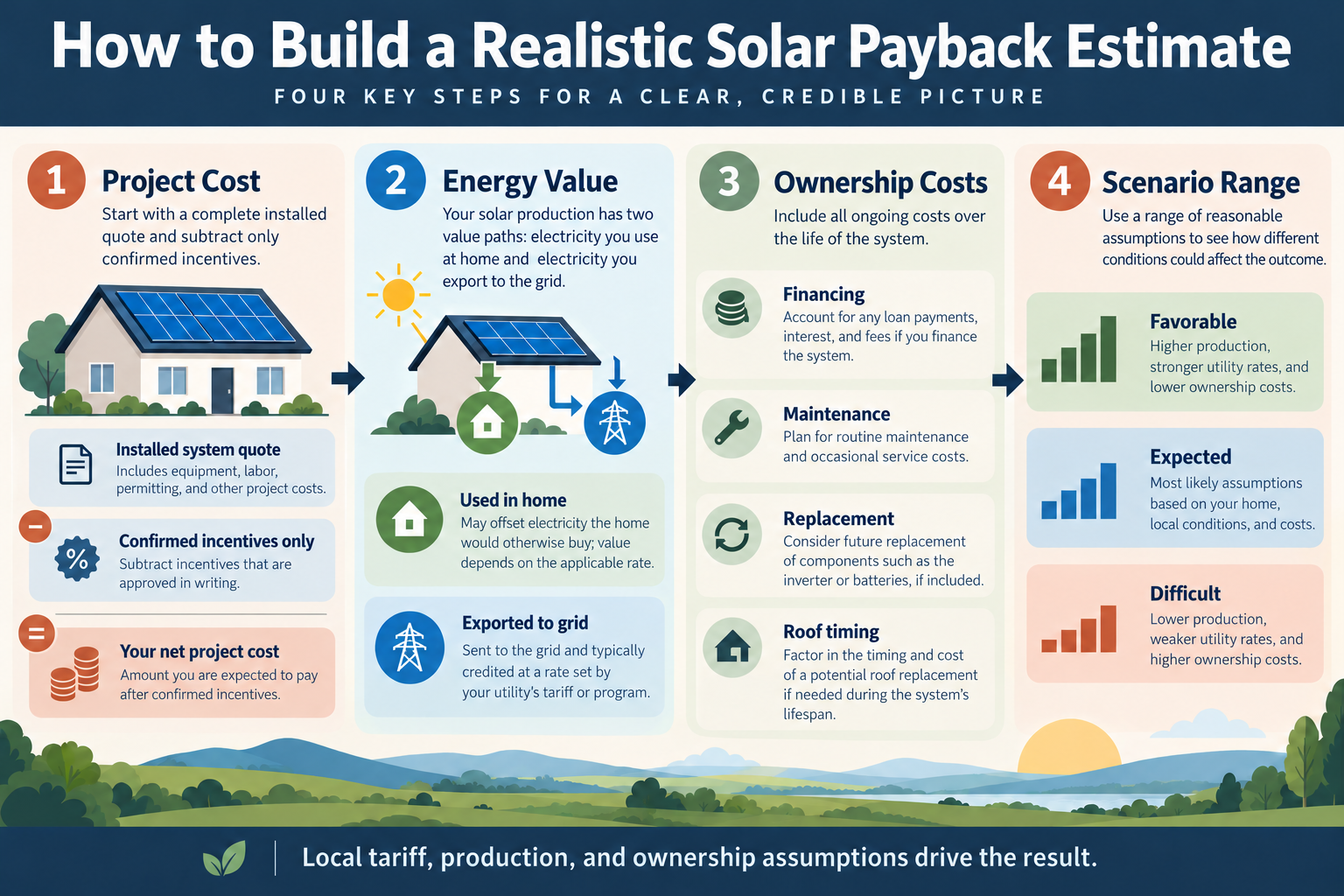
Start with the actual installed price. Include design, equipment, roof and electrical work, permits, inspection, interconnection, commissioning, sales or financing charges, and any battery if it is part of the decision. Subtract only incentives for which the household and project are confirmed eligible.
Estimate value without overstating it
DOE identifies consumption, system size and production, roof direction and sun, utility rates, export compensation, and ownership as relevant solar-savings inputs. Separate energy used in the home from energy exported. A kilowatt-hour that avoids a retail purchase may have a different value from one compensated under a utility export program.
Use a production estimate that identifies shading, orientation, weather, degradation assumptions, downtime, and system losses. Use the actual rate structure where possible, including fixed charges, time-of-use periods, demand elements, and export rules. Do not count a reduction in fixed utility charges as solar savings unless the tariff really allows it.
Model scenarios
Favorable: production meets the model, household consumption aligns with output, rates and export value are supportive, financing is inexpensive, and the system operates without major repair.
Expected: production and consumption differ seasonally, export value is lower than retail value, routine service occurs, and the utility or incentive follows its stated conditions.
Difficult: shade or weather reduces production, the roof needs work, an inverter fails, export treatment changes, the homeowner moves, or financing and contract costs exceed the sales illustration.
The expected case is more useful than a single optimistic payback. For a Canadian home, use local CAD costs and local utility treatment. Never create Canadian economics by converting a U.S. result.
The IEA PVPS 2024 Canadian national survey, published in December 2025, reports a CAD $2.30–$3.90/W range for 5–10 kW grid-connected residential rooftop PV in 2024. It is a historical market benchmark, not a current quote, tariff, or export rate; use a local CAD proposal and current utility terms in the household model. The report’s 2024 incentive table is not current 2026 program guidance.
What can change the answer
Roof timing can add future removal and reinstallation. A changed household load can make more production valuable—or can require service capacity and a different design. Financing can increase total cost. Storage may increase self-use or provide outage value, but its resilience benefit should not be counted as ordinary solar bill savings unless the model states that separate value.
Export programs and incentives are local and time-sensitive. The available BC Hydro evidence is one British Columbia example, not a general North American rule. Verify current eligibility, rate, cap, application, interconnection, and treatment of batteries.
A quote and model checklist
Record installed cost, system size, production, self-use, export, utility rates, incentives, financing, maintenance, replacement reserve, roof assumptions, ownership period, and resale or contract obligations. Ask the installer to show production and savings separately from assumptions supplied by the household.
Solar may be worth it when the system serves a real load, the complete price is credible, the roof and approvals are understood, and the owner expects to keep it long enough to capture value. If the result changes completely when one uncertain tariff, roof repair, or financing assumption changes, the right conclusion is sensitivity—not a precise payback promise.
Include costs after installation
Set aside for inverter or control replacement, monitoring, roof coordination, insurance changes if applicable, maintenance, and eventual removal or replacement. These costs may occur outside a simple payback window. If a loan, lease, or PPA is involved, include interest, escalators, transfer, and buyout terms rather than comparing only cash price with annual bill savings.
Do not double-count benefits
A battery’s outage value is not automatically a solar bill saving. A roof replacement avoided by a ground mount is not a solar saving if the roof still needs replacement for another reason. An incentive should be counted only once and only if eligibility is confirmed. Separate bill value, resilience value, tax value, and property value so the model shows what each assumption contributes.
A practical threshold
Use payback as one decision input. If the system remains attractive under an expected production case, conservative export value, realistic financing, and a repair reserve, the conclusion is more robust. If it works only under the best rate, full export credit, or an unverified incentive, postpone commitment or obtain the missing local evidence.
Payback is sensitive to use timing
A household that consumes solar output during production may capture more value than one that exports most of it, but behavior should not be assumed without a load profile. Seasonal heating and cooling, work-from-home schedules, vehicle charging, and future appliances change the split. Model the loads that are actually likely, then show how the answer changes if behavior does not follow the plan.
Include a no-savings floor
A conservative case can show value from reduced purchases only, with no unverified export bonus, incentive, or resale premium. It should still include maintenance, downtime, financing, and roof timing. This is not a prediction that the system will earn nothing; it is a guard against making the entire decision depend on the least certain inputs.
When payback is not the only decision
Some homeowners value outage support, predictable energy exposure, or reduced fuel use separately from bill payback. State those objectives and compare them with batteries, generators, efficiency, or no project. A solar decision is stronger when the owner can say which service is being purchased and what evidence would change the choice.
If on-site ownership is not realistic, compare the separate contract and bill-credit method in the community-solar subscription guide. Subscription value is not the same as payback on a system installed at the home.
Build a range instead of one payback date
Use low, expected, and difficult cases. The low case can assume lower production, less favorable export treatment, no unconfirmed incentive, and higher maintenance or financing cost. The expected case should identify its load, tariff, production, and roof assumptions. The difficult case can include approval delay, a component replacement, roof coordination, or a change in the home’s occupancy. The purpose is not to predict every outcome; it is to show which assumptions control the result.
Payback should be calculated from the homeowner’s incremental cost and incremental value. Do not count a battery’s outage value as solar bill savings, count an incentive before eligibility is confirmed, or count exported energy at the retail purchase rate unless the tariff supports that treatment. If the system displaces a future purchase, state when that purchase would otherwise occur. A simple model with visible assumptions is more useful than a precise result built on hidden optimism.
Include the cost of preserving the plan
Roof condition, service capacity, monitoring, inverter support, removal and reinstallation, maintenance, insurance, and future storage can change the economic horizon. These items do not all belong in the initial solar price, but they belong in the decision if the project creates or avoids them. A roof-first project may improve the solar sequence; a deferred battery may preserve capital; efficiency work may reduce the array size needed for the same household objective.
Choose solar when its conservative value and non-financial objectives justify the capital and uncertainty. If the result is sensitive to one incentive, export rule, or rate forecast, treat that sensitivity as the decision—not as a footnote.