
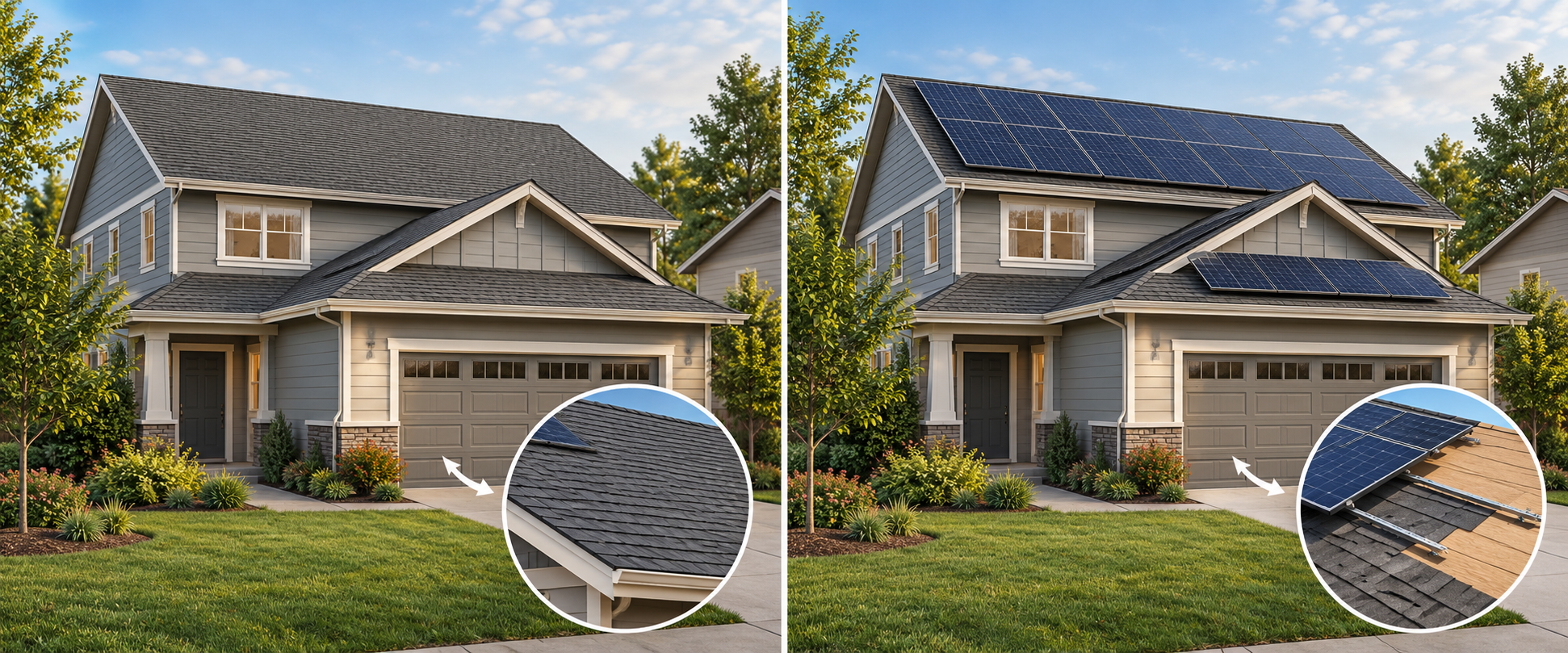
Replacing a marginal roof before solar can avoid paying later to remove, store, and reinstall the array. Replacing a sound roof too early destroys useful life and ties up capital. There is no universal minimum number of “years remaining” that resolves the decision.
Use roof condition, uncertainty, solar layout, ownership horizon, and the real cost of future rework.
Begin with an independent roof assessment
DOE homeowner guidance includes roof condition and structural suitability in solar planning. The assessment should consider covering, flashing, penetrations, deck clues, leak history, repairability, and the area under the planned array. A free solar-site survey may not equal a roof condition report.
Ask the inspector to state what is visible, what remains concealed, and whether focused repair could create a credible service horizon. Exact remaining life is still an estimate.
Compare two timelines
Reroof now: pay roof cost before solar, coordinate mounts with the new system, avoid near-term removal/reinstall, and start the solar period with a renewed roof.
Install solar now and reroof later: preserve roof life and defer capital, but accept future array removal, storage, reinstall, downtime, hardware, coordination, and possible permit or utility work.
Estimate future removal/reinstall as a separate local quote. Do not assume it is free, covered by warranty, or covered by insurance.
Conditions favoring reroof first
- active leaks or distributed deterioration;
- brittle or poorly repairable covering;
- several aging flashings or prior patches;
- likely deck work that would be harder beneath an array;
- planned array covers most of the affected slope;
- roof and solar work can share access or financing without hiding scope;
- ownership horizon makes near-term rework likely to remain your cost.
Conditions favoring waiting
- roof is serviceable and defects are localized;
- remaining system is compatible with expected ownership horizon;
- array layout leaves repairable areas accessible;
- future removal/reinstall cost is modest and contractually clear;
- early replacement would discard substantial material value;
- cash constraints make phased work economically superior.
Do not let a solar sales deadline substitute for roof diagnosis.
Material and mounting considerations
Asphalt, metal, tile, slate, wood, and low-slope systems use different mount and flashing approaches. Structural support, attachment, waterproofing, and product warranties require exact-system review. A roof that is acceptable as weather protection may still need mounting or structural analysis.
Coordinate mount locations with roof drainage, flashings, vents, valleys, fire/access requirements, and future service paths.
Three decision scenarios
Recent sound roof: Inspection finds no material concern. Install solar with documented mount details and preserve reroof records.
Middle-aged roof with one repair: Compare focused repair plus solar with early reroof. If the field remains workable, repair can preserve value.
Aging roof with scattered defects: Future array removal is foreseeable. Reroofing first is often the cleaner lifecycle purchase, especially if flashings and deck need access.
Uncertain structure or concealed moisture: Pause both bids and obtain the needed evaluation. Solar installation should not bury an unresolved high-consequence condition.
Contract coordination
Document who penetrates and flashes the roof, who warrants that interface, how the roofer’s warranty treats solar, how the solar provider treats future roof work, and who removes/reinstalls equipment. Keep photographs and layout records.
The economic answer is not “always replace an old roof.” Replace first when avoided rework and renewed system value exceed the useful roof life surrendered. Otherwise, preserve the existing roof and budget transparently for future coordination.
Put numbers around the decision
Estimate reroof-now cost, focused repair cost, future removal/reinstall quote, likely future roof cost, financing, and remaining ownership. Model at least an early-failure and longer-life case. If reroofing now costs $18,000 and future removal/reinstall is $4,000, the $4,000 alone does not justify discarding a sound roof; the timing and probability of the $18,000 expense also matter.
Use actual local quotes and conservative time horizons. Do not assign a fixed service life from age or warranty.
Array layout can preserve options
Where design permits, leaving vulnerable flashings, drains, valleys, and service paths accessible can reduce future roof labor. That is a coordination consideration, not a reason to compromise solar design, structural support, fire access, or production. Roofer and solar designer should review the same plan.
Material-switch implications
Installing solar over asphalt, metal, tile, slate, wood, or low-slope roofing uses different mounting and service approaches. If a material switch is already under consideration, compare it before the array is designed. “Solar compatible” is not a generic property; verify exact mount and roof system.
Warranty and sales claims
Ask the roofer how solar affects workmanship coverage and the installer how future reroofing affects solar warranties. Get answers in writing. Avoid promises that removal will be free, insurance will cover future work, or the array will “protect” an aging roof from all weathering.
If you choose not to reroof
Complete identified repairs, document roof condition, preserve installer and mount details, obtain a future removal/reinstall planning price, and continue inspections. This makes waiting an intentional economic choice rather than an ignored liability.
If you reroof first
Coordinate penetrations, flashings, roof material cure/seal considerations, mount layout, attic/structural findings, and the solar start date. Keep the roof visible for closeout documentation before modules cover it.
Normalize the two timelines
For “solar now, roof later,” include current roof repairs, solar installation, future array removal, storage, roof replacement, mount or flashing changes, reinstall, permitting/inspection where applicable, downtime, and the risk that the original installer or compatible hardware is unavailable. Use current written planning quotes where obtainable, but do not present them as guaranteed future prices.
For “roof now, solar next,” include advancing the reroof, any financing or lost useful roof service, coordinated roof and mount details, and solar scheduling. Credit only work that actually avoids duplication. The solar system itself appears in both timelines and should not be counted as a roof-first premium.
Build low, expected, and difficult cases. In the low solar-first case, later removal is orderly and all components are reused. The difficult case includes damaged or obsolete hardware, warranty boundaries, schedule gaps, or roof repairs under the array before planned replacement. In the roof-first case, the difficult outcome can include advancing a roof that proves to have had more serviceability than the inspection suggested.
Conditions that change the decision
A serviceable, well-documented roof with repairable isolated defects and a credible horizon beyond the owner’s planning period can support solar first. Preserve clear access routes, layout around vulnerable interfaces where practical, and a written future removal process.
A roof with distributed deterioration, repeated leaks, fragile or hard-to-match material, failing underlayment, or several near-term capital needs makes reroof-first more credible. Solar does not cause those conditions, but it adds labor and coordination to reach them later.
Specialty tile, slate, wood, long metal panels, and low-slope membranes can make installation and future access materially different from asphalt. Require both contractors to explain the exact mounting, flashing, walking, and repair process. Do not transfer a generic “solar adds one removal fee” assumption across systems.
Ownership horizon and option value
For a short ownership horizon, do not assume either a new roof or solar returns full cost at sale. Value reliability, documentation, disclosure, buyer comprehension, and the chance that a near-term roof project interrupts the array. For long ownership, repeated coordination and equipment aging become more important.
Reroof-first can buy option value: material selection, deck and flashing visibility, planned mount locations, and one coherent set of records. Solar-first can preserve remaining roof service and avoid premature material disposal. The inspection must be strong enough to show which option value is being purchased.
A go/no-go record
Write down observed roof condition, inaccessible areas, repairs required before solar, estimated timeline assumptions, array layout constraints, roof and solar warranty positions, structural or attic questions, and the party responsible for future removal. If the decision depends on a sales lifespan estimate rather than observed condition and a scoped future process, investigation is not complete.
A final threshold
Proceed with solar over the existing roof when a suitably independent assessment supports retained service, necessary repairs are completed, future access/removal is documented, and the owner accepts the range of later coordination cost. Reroof first when observed system condition or near-term planned work makes one coordinated opening materially more credible. If the assessment cannot distinguish those cases, buy targeted investigation before committing either capital project.
Preserve the decision in both contracts
The roof file should contain condition evidence, repairs, inaccessible zones, and expected next intervention. The solar file should contain layout, attachments, flashings, roof-access plan, removal/reinstall responsibility, and warranty interactions. Each contractor should acknowledge the other’s relevant boundary. This documentation makes waiting or reroofing first an executable plan rather than an informal assumption lost after installation.
Uncertainty boundary
No inspection can guarantee the roof’s remaining service or the future price and availability of array removal. Use ranges and a written fallback. Evidence limitations constrain the timeline estimate; they do not excuse omitting removal scope, warranty coordination, layout, ownership horizon, or the cost of duplicated access.