
Replace the roof first when its condition makes near-term solar removal, concealed repair, or repeated access reasonably likely. Keep a serviceable roof when early replacement would discard useful life and the future rework is understood. Roof age alone cannot establish a universal answer.
Assess condition and future work
Solar planning should include roof suitability, but a sales-site survey is not necessarily a detailed roof assessment. Establish the visible condition of the covering, flashing, penetrations, underlayment clues, deck concerns, leak history, previous patches, and the part of the roof the array will cover. State which areas were inaccessible and which conclusions remain uncertain.
Chronological age is only one input. Material, climate, exposure, workmanship, ventilation, prior repairs, and observed deterioration can matter more. A roof with one repairable defect may have a different economic path from one with distributed brittleness or repeated leaks.
Compare the two timelines
Roof first, solar second advances the roofing expense, coordinates attachments with the new roof, and reduces the chance of paying for array removal soon after installation. It can also expose deck or flashing issues while access is already available. The disadvantages are earlier capital use, possible financing cost, and the risk of replacing a roof that would have remained serviceable.
Solar first, roof later preserves remaining roof service and defers spending. It requires a credible plan for shutdown, removal, storage, roof work, new attachments or flashing, reinstallation, inspection, interconnection, and downtime. Older modules, mounts, inverters, monitoring, or the original installer may no longer be available when that work becomes necessary.
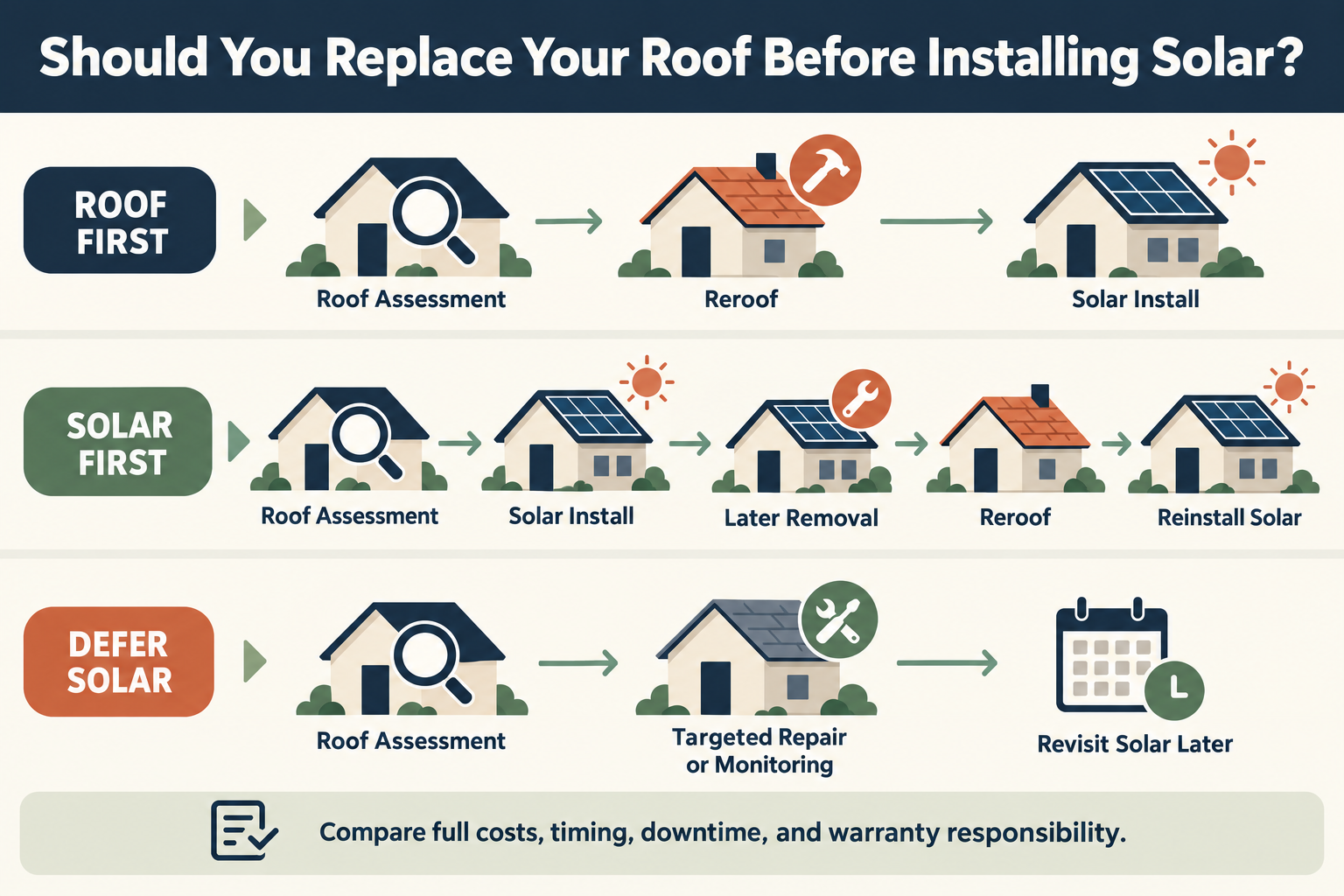
When roof-first is more credible
- Leaks, brittle materials, widespread deterioration, or recurring patches are already present.
- A roof or deck project is likely within the solar ownership horizon.
- The planned array covers most of the slope that needs access.
- Specialty materials or difficult access make future removal disproportionately disruptive.
- The roof and solar contractors can document one coordinated attachment and warranty plan.
When solar-first may be reasonable
- An independent assessment finds localized, repairable issues and a credible service horizon.
- The array can avoid vulnerable areas and the future removal process is priced or clearly assigned.
- Early reroofing would destroy significant useful roof life or cause harmful cash-flow strain.
- The owner accepts that future prices and equipment compatibility are uncertain.
Model the economics
Do not subtract a future removal charge from a roof-first quote and call the difference savings. Compare full timelines. The solar-first case includes current roof repairs, solar installation, future removal, storage, roof replacement, possible mount or flashing changes, reinstallation, approval work, downtime, and the risk of obsolete hardware. The roof-first case includes the earlier roof payment, coordinated solar work, and the value of service life surrendered.
Use local quotes and low, expected, and difficult cases. In the easy solar-first case, all hardware is reusable and the roof contractor works efficiently. In the difficult case, concealed damage, incompatible mounts, warranty disputes, or installer unavailability expands the scope. In the difficult roof-first case, the owner advances a large project that inspection might not have made necessary.
Coordinate the contracts
Get written answers about who designs and warrants roof attachments, who flashes penetrations, whether the roof warranty permits solar, who removes and reinstalls equipment, how damage is handled, and who pays for new hardware. Keep photographs, roof records, array layout, equipment models, and commissioning documents.
Roofing itself belongs to the roofing decision; solar itself belongs to this category. The useful question is whether coordinating the two changes the cost and risk of reaching the homeowner’s intended outcome. A solar deadline is not evidence that an aging roof is ready.
Decision threshold
Proceed over the existing roof when condition is documented, required repairs are complete, future access is understood, and the owner can absorb the range of later coordination cost. Reroof first when the roof is already a near-term capital project or when the array would make necessary work materially harder. If the assessment cannot distinguish those cases, purchase targeted roof investigation before either contract.
Ask what the array will hide
The planned array can cover roof areas that may later be difficult to inspect, flash, or repair. Ask the roof assessor to identify vulnerable valleys, penetrations, edges, skylights, chimneys, and areas with prior leaks relative to the proposed layout. This does not mean moving panels without a production or structural reason; it means acknowledging where future access will cost more.
Include cash-flow and disruption
The roof-first case may require a large payment before solar savings begin. The solar-first case may postpone the roof bill but create a second mobilization, a period without generation, and coordination between contractors who did not install the original system. Include financing cost, temporary protection, interior leak response, and the inconvenience of each timeline. A mathematically similar total can produce different practical risk.
Preserve the decision record
Keep the roof report, repair invoices, photographs, roof material and attachment records, solar layout, equipment models, warranty language, and future removal responsibility. If the roof is retained, record the inspection date and the conditions that would trigger reevaluation. If it is replaced, record where penetrations and flashings were installed before modules cover them.
The best answer is a documented timeline with a fallback price, not a blanket rule based on age. If either contractor will not state how its work interacts with the other system, the coordination problem remains unresolved.
Do not confuse roof warranty with solar warranty
Ask separately who warrants the roof covering, attachments, flashing, electrical equipment, and production. A roofing warranty may have conditions about penetrations or later access. A solar warranty may address modules or inverters but not the cost of removing equipment for roof work. Insurance and a home sale can introduce further documentation requirements. These are contract questions, not assumptions to be filled with a generic warranty period.
A roof-first quote should still be itemized
Even when the decision is to reroof, compare roof-only work with the coordinated roof-and-solar sequence. Record tear-off, deck allowance, flashing, disposal, access, solar attachment details, and who closes the roof before the modules return. Credit only the work that is actually shared. A “solar-ready” roof is not a substitute for a completed solar design.
If the two timelines differ only in when the same roof and solar purchases occur, the financial advantage may be small. The decisive value can instead be avoided rework, lower uncertainty, easier warranty responsibility, or preservation of useful roof life.
Use a sequence worksheet
Write down the roof’s current condition, likely repair horizon, solar design horizon, planned ownership period, financing dates, and the cost of temporary loss of production. Then compare roof-first, solar-first, and deferred-solar cases using the same roof scope and solar production objective. Include the work that is shared and the work that is merely adjacent. A coordinated schedule should receive credit for avoided mobilization or access only when the contracts actually share that work.
This worksheet is useful when the roof is neither clearly failing nor clearly new. It makes uncertainty visible: a low case may involve a sound deck and simple attachment work; an expected case may include ordinary restoration and a short outage; a difficult case may include deck repair, changed roof geometry, or a delayed solar inspection. The result is a better timing decision than a generic rule based only on roof age.
If roof work expands after removal
The homeowner should know who documents concealed damage, who approves extra roof work, how solar equipment is protected, and whether the solar schedule moves with the roofing change. A roof allowance without a decision process can turn a coordinated project into an open-ended delay. Ask for photographs, change-order responsibility, weather protection, and the condition required before the array returns.
If the expanded roof scope changes the solar attachment layout or usable area, require the production and price consequences in writing. The goal is not to prevent every change; it is to avoid discovering after tear-off that the original solar economics no longer describe the property.