
Approval costs are part of solar’s installed economics even though they may not appear in the panel or inverter price. A project can involve local permits, plan review, structural or electrical documentation, post-installation inspection, utility application, meter work, interconnection approval, and commissioning. Fees and requirements vary by jurisdiction, utility, system, and property.
The sequence matters
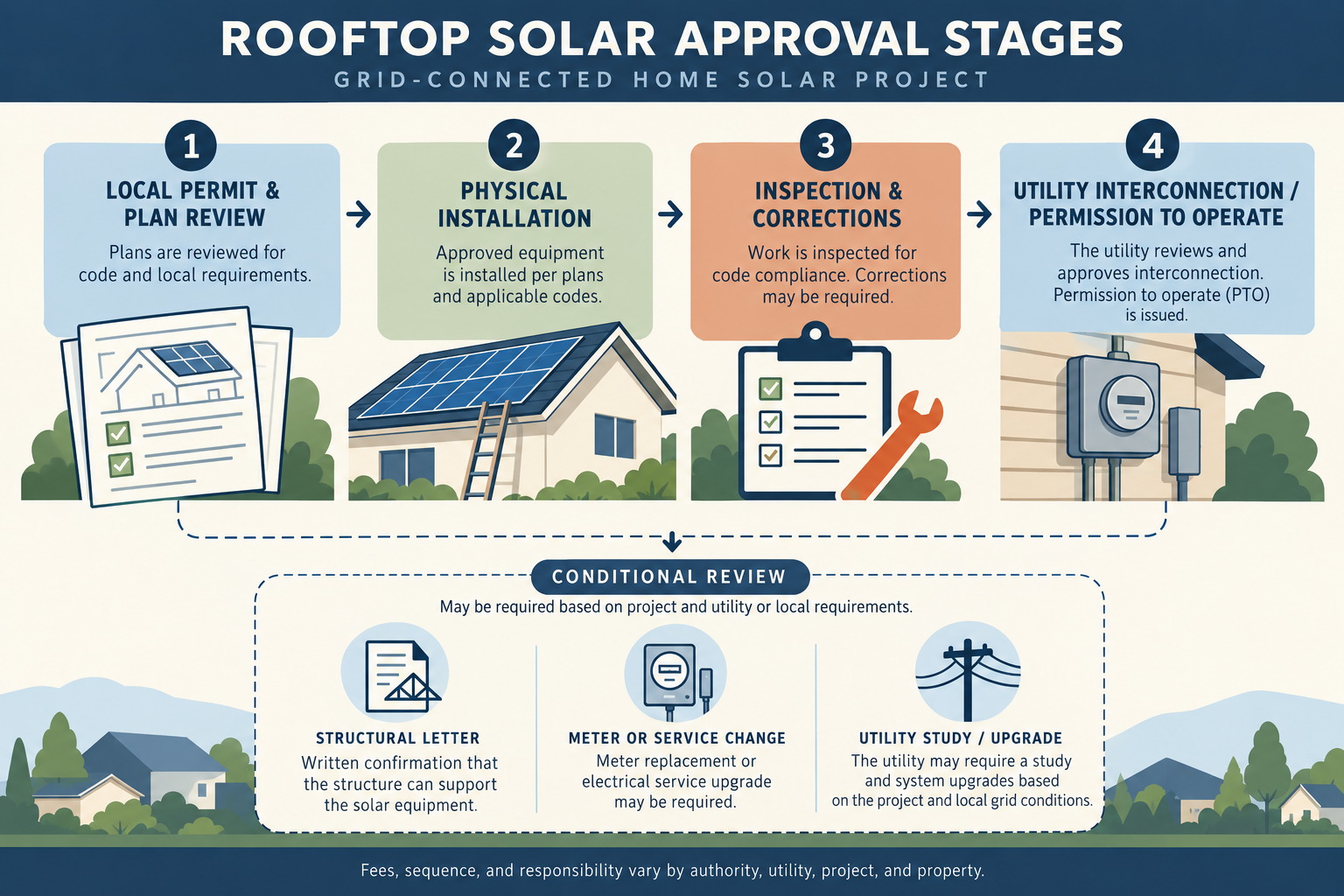
DOE describes a sequence in which local approval precedes installation, inspection follows the physical work, and utility connection or permission is required before grid operation. Some projects also need engineering review, a single-line diagram, approved equipment information, or evidence of successful inspection. A physical array is not the same as permission to operate it.
What a quote may include
Ask whether the installer includes permit preparation and fees, structural review, electrical drawings, inspection attendance, utility application, meter changes, interconnection study, commissioning, and correction visits. Separate ordinary included work from conditional work such as a transformer review, service upgrade, system-size change, or utility-mandated equipment.
If a bidder says “permits included,” ask which authority and which fee. If the utility rejects the design or requires an upgrade, the contract should state who pays, whether you can cancel, and how the schedule changes. Do not treat an allowance as a fixed fee.
Cost drivers and uncertainty
Simple jurisdictions and standardized residential designs may keep approval work predictable. Complexity increases with a larger array, unusual roof or ground structure, service constraints, battery or generator controls, historic or shared-property review, or utility infrastructure limits. Administrative backlog can add time even when the technical design is sound.
Ground-mounted projects may add site or land-use approvals and structural review. Storage and backup systems can add separate electrical, fire, or utility questions. A British Columbia utility example also shows that program terms and rates can change on a stated effective date; that illustrates why current local confirmation matters, not a universal fee rule.
Three planning cases
Routine approval: The design fits local processes, the service is adequate, the inspection passes, and the utility accepts the application as submitted.
Correction case: Drawings or installation need correction, an inspection is repeated, or equipment documentation is incomplete. Labor and delay may be chargeable depending on the contract.
Upgrade case: The utility or electrical review identifies a meter, service, transformer, or system-size issue. This can change project cost and viability substantially.
Questions to ask before signing
Which authority issues the permit? Who schedules inspection? What is the utility’s approval point? Is permission to operate included? What equipment and drawings are assumed? Are fees, meter work, studies, and customer-funded upgrades excluded? Who owns the risk of an application change? What happens to financing or incentives if approval slips past a deadline?
Available source material does not establish one current universal fee or interconnection price for the United States or Canada. Use local authority information and a written installer scope. A responsible budget carries approval uncertainty visibly instead of hiding it in a “turnkey” label.
Approval is part of schedule economics
Physical installation can finish before the system may operate for the grid. Carry financing, contractor coordination, temporary utility bills, and lost generation through the approval period when those consequences apply. DOE notes that local backlogs and administrative errors can delay projects; a quote should state who corrects an application or inspection issue.
Look for conditional branches
Ask what happens if the authority requires a structural letter, revised drawings, approved equipment, a meter change, a service upgrade, or a utility study. The contract should identify the allowance, trigger, responsible party, and right to approve additional work. “Permit included” should not be used to hide an unknown customer-funded upgrade.
Keep local examples local
BC Hydro’s current program and rate examples demonstrate that approval and export treatment can be specific to one utility and can change on a defined date. They are useful reminders to verify local terms, not a basis for a general North American fee or credit assumption. For a Canadian property outside that service area, obtain the actual utility and authority requirements.
Approval scope should have an owner
The contract should name who prepares drawings, submits the application, responds to corrections, attends inspection, and obtains permission to operate. It should also state whether a failed application is corrected at no extra labor and how customer-funded utility work is authorized. This is especially important when the solar contractor, electrician, roofer, and utility each control part of the sequence.
Schedule risk affects financing
If payments begin before permission to operate, include that period in the cash-flow model. A delay can also move an incentive deadline, roof coordination date, or seasonal production window. Ask which dates are commitments and which are estimates. DOE’s process guidance supports the distinction between installation, inspection, and utility connection; it does not promise a universal approval time.
A complete closeout
Request the approved drawings, inspection result, utility permission, meter status, commissioning record, and operating limitations. Without this closeout, the homeowner may not know whether the system is approved to operate, what equipment was accepted, or who must be called when a future change is proposed.
Distinguish predictable approval work from conditional work
Permit preparation, standard drawings, inspection coordination, and an ordinary utility application may be included in a base scope. A service upgrade, transformer review, engineering study, unusual structural condition, storage integration, or redesign after rejection is a different branch. Ask the installer to list the trigger, allowance, decision-maker, and homeowner responsibility for each branch. This is more informative than a single “permits included” line.
Approval also has a sequencing cost. A roof project, equipment delivery, financing start date, incentive deadline, and utility permission may depend on one another. A quote should show which work can begin before approval and which work must wait. If a contractor promises a fixed schedule without identifying the authority or utility dependency, treat that date as an estimate rather than a project guarantee.
Make closeout useful for the next change
The final record should connect the approved design to installed equipment: array layout, inverter and control models, circuit or service changes, monitoring credentials, inspection status, and operating limitations. This record lowers the cost of a future expansion, battery retrofit, repair, roof removal, or ownership transfer. It also makes a later quote more reliable because the next contractor does not need to reconstruct the original system from photographs.
The approval cost is therefore both a current project cost and a documentation opportunity. Paying for a complete closeout can be economically sensible when it prevents future diagnostic visits or an avoidable redesign.
Allow for a correction cycle
An approval process can produce comments, a requested drawing change, a failed inspection, a revised equipment list, or a utility condition. Ask whether the proposal includes ordinary correction visits and what event creates a change order. This does not mean every project will have a problem; it means the homeowner can distinguish a contractor’s included responsibility from an authority-driven branch that remains conditional.
The same distinction applies to schedule. Equipment delivery, roof coordination, inspection availability, utility permission, meter work, and incentive timing can interact. Put the critical dates and dependencies in the project record and ask what happens if one moves. Approval work has economic value when it reduces rework and establishes a lawful operating state, but no installer should represent a local authority’s decision as a universal guarantee.