
An old solar system is not automatically a replacement candidate. A functioning array can continue producing value, while repeated failures, weak output, obsolete controls, roof work, or a changed household load can justify a broader review. The decision is about future cost and service, not a universal replacement age.
Establish what the system is doing
Collect production records, utility bills, equipment models, array layout, warranties, repair history, and roof condition. Compare actual production with the original model while accounting for shade, weather, soiling, outages, and changes in household consumption. A monitoring alert alone does not prove that modules or an inverter have failed.
Inspect the roof and attachments before committing to a replacement. A new array over a marginal roof can repeat the same lifecycle problem. Conversely, replacing a sound system solely because its modules are older can discard working equipment without improving the homeowner’s economics enough.
Reasons to keep it
Keeping the system is more credible when output remains useful, repairable components are available, the roof is sound, warranties still help, and the array fits the home’s current and expected loads. Avoiding new design, equipment, permit, interconnection, and installation costs can matter, especially over a short remaining ownership horizon.
Keeping it does not mean ignoring alerts. Budget for monitoring, likely repairs, roof coordination, and eventual replacement. Obtain a service plan rather than assuming an old installer or platform will remain available.
Reasons to replace or redesign
A replacement review becomes more credible when the system has repeated failures, materially reduced production, incompatible or unavailable components, a major roof project, changed electrical loads, or a need for storage and outage operation. Expansion may solve a load problem without replacing everything; a focused inverter repair may solve an equipment problem.
New equipment may improve production or functionality, but a larger system also brings new permitting, interconnection, roof, wiring, and commissioning scope. Do not count projected savings without checking consumption, rates, export compensation, ownership, and current incentives.
Compare three paths
Keep and service: Include expected repairs, monitoring, roof work, and the value of present production.
Repair or selectively expand: Include compatibility, inverter capacity, new modules, controls, approval, and future service. This can be attractive when only one part of the system is weak.
Replace: Include removal, disposal or reuse, new design, equipment, roof attachments, electrical work, approvals, downtime, and any battery or backup architecture.
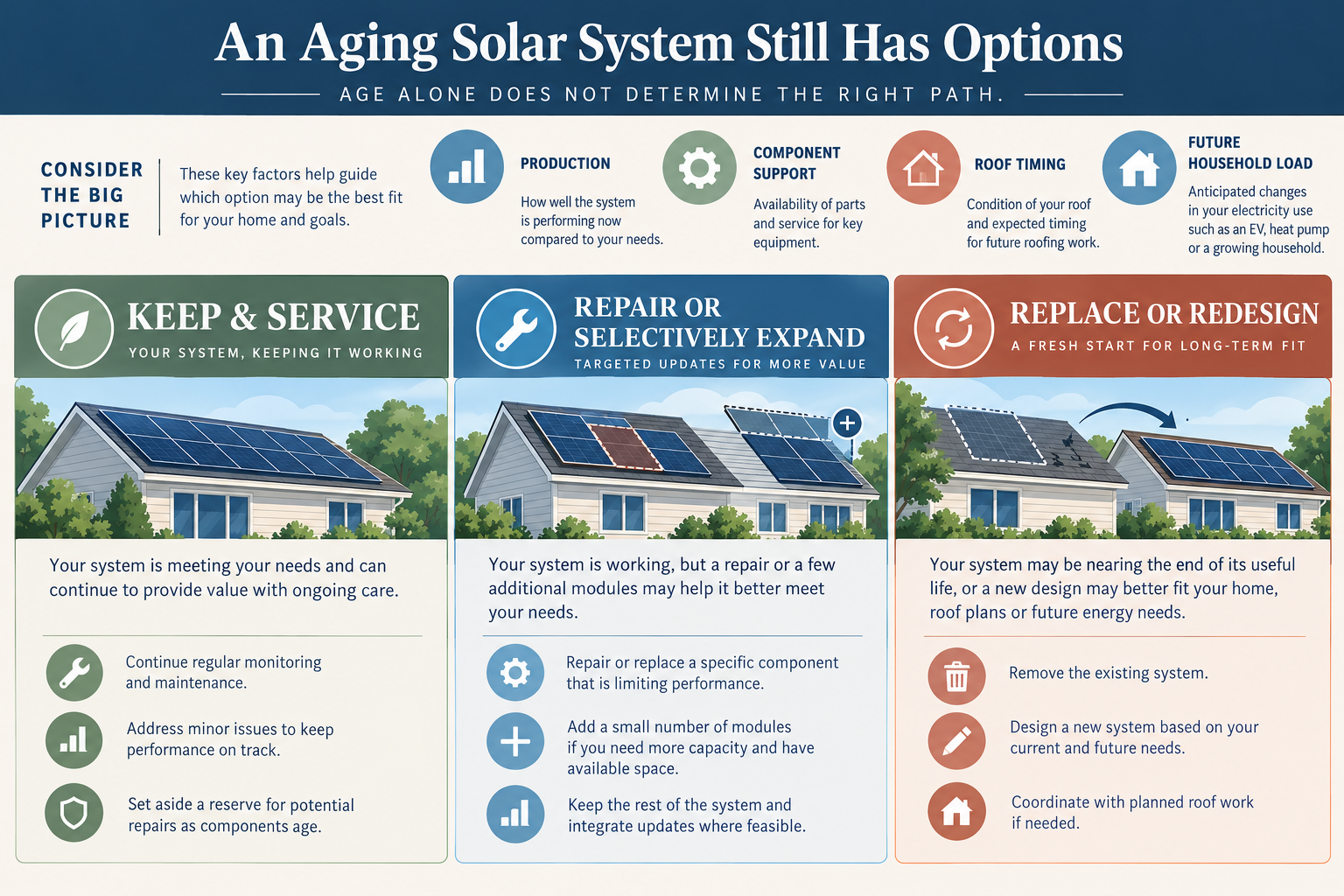
Use low, expected, and difficult cases. The difficult keep case includes an unavailable component or a second failure; the difficult replacement case includes roof or service upgrades and approval delays. Compare net cost over the period you will own and use the system.
If replacement is not the preferred path and the owner plans to retire the array permanently, compare a complete solar-system retirement quote rather than treating the old equipment’s destination as a minor line item. Alberta’s recycling program began panel collection on October 1, 2026; its current program update lists covered panel types and local terms. Confirm acceptance with the receiving depot. This example does not establish a removal price or a recycling route elsewhere in Canada.
Do not use age as a shortcut
Warranty duration is not a guaranteed service-life or economic threshold. Module degradation, inverter condition, roof condition, repair history, and equipment availability are separate questions. The available evidence supports lifecycle evaluation but not one universal replacement age or price.
Ask for a written condition assessment and two scopes: the least work that responsibly restores operation and the broader work that changes production or backup capability. Replace when the additional capital buys a meaningful, documented improvement over repair and continued operation—not merely because a salesperson describes the system as old.
Distinguish output loss from system failure
A lower bill can reflect lower household use rather than a failing array. A production decline can reflect shade from a new tree, a monitoring problem, weather, soiling, an inverter fault, or module behavior. Compare actual system data with the original design and site conditions before using low output as the replacement case.
Include roof and service timing
An aging roof, planned electrical-capacity work, or a battery decision can make a complete redesign more economical than a sequence of isolated repairs. Put those projects on the same timeline. A replacement array that must be removed for a near-term roof project is not a complete lifecycle solution, and a new array may expose service constraints created by future electrification.
Use a replacement reserve
Even when you keep the system, reserve for inverter or control failure, roof coordination, monitoring support, and eventual removal. The reserve is not a predicted invoice; it is a way to avoid treating continued operation as cost-free. Compare that reserve with the additional cost and benefits of replacement over the actual ownership period.
Use the home’s future load
A system that fit the original household may not fit added electrification, vehicle charging, or storage goals. A complete replacement can address these together, while a repair may preserve a system that cannot serve the new objective. Conversely, a larger array is not automatically useful if the home exports most of its additional production under a low-value program.
Examine ownership and records
For a short ownership period, include transferability, buyer comprehension, warranty assignment, and roof disruption. For a long period, include maintenance, support, control compatibility, eventual replacement, and future production. Keep the current equipment records even if you replace the system; they document roof attachments and prior work.
A defensible decision
Keep the system when current service remains useful and the repair path is supported. Repair selectively when one component is responsible and the rest has a credible horizon. Replace or redesign when multiple constraints converge. Ask for all three scopes in writing so the decision is not driven by the first contractor’s preferred product.
Compare the system’s remaining service horizon
List the condition and support path for modules, inverter or microinverters, racking, wiring, monitoring, roof attachments, and utility approval. A system can have older modules but a serviceable conversion platform, or newer modules paired with an unavailable control component. The useful question is how much reliable service the whole system can provide after the next repair, not whether one component has reached a marketing age.
For each component, note the cost and consequence of failure, the likelihood that access will require roof work, and whether a replacement would be compatible. This creates a replacement reserve without pretending to predict an exact failure date. It also shows why a seemingly cheap inverter repair may be poor value if the same system soon needs removal for roof work or cannot support the home’s planned load.
Use a staged replacement when it preserves choices
A staged path can be reasonable when production is acceptable but one component is failing, the roof is sound, and future storage or electrification is still uncertain. The replacement should not close off those options without an explicit tradeoff. Ask whether the new component supports the existing array, future battery controls, monitoring, and utility requirements, and what additional work would be needed later.
Conversely, staging is false economy when several trades must return, the system is unsafe or unsupported, or the property will soon undergo roof or service work. Compare the present repair with a coordinated redesign using the same ownership horizon and include downtime, disposal, approval, and documentation in both cases.
Put the decision on a timeline
For a short ownership horizon, weigh cash outlay, transfer records, disruption, and buyer understanding. For a long horizon, weigh service access, replacement reserve, supportability, roof timing, production, and future household load. A repair can be the right bridge when a larger property project is uncertain; a replacement can be the right sequence when several related mobilizations are already unavoidable.
Ask the contractor to state what would make each path uneconomic. These thresholds might be a failed second component, an unavailable part, a roof condition, a service constraint, or a production result that cannot be explained. A decision with explicit thresholds is easier to revisit than a one-time recommendation based on age alone.