
Adding panels can be cheaper than replacing a working system, but only when the roof, inverter, wiring, service, equipment compatibility, and utility approval support the expansion. A new module count is not a complete project description. Existing-system documentation and a design review are often the first costs.
Why expansion is not just a panel purchase
An installer must check available roof area, shading, attachments, conduit routes, module electrical characteristics, inverter capacity, string or microinverter architecture, shutdown equipment, monitoring, structural limits, and service capacity. The new array may need a different inverter, a second inverter, new racking, a new gateway, or a separate interconnection path.
The original system may also have a roof-timing problem. If the roof is near replacement, expanding now can increase later removal and reinstallation scope. If the original equipment is discontinued, matching panels may be unavailable and mixing products may require a redesign.
What drives the quote
The equipment package includes panels, mounting, wiring, controls, and perhaps an inverter or optimizer change. Labor depends on access, roof planes, conduit distance, and whether the installer can use existing pathways. Design and approval costs may be substantial for a small addition because they do not shrink in proportion to panel count.
Utility treatment is local and time-sensitive. An expansion may require a revised application, updated drawings, a meter review, or confirmation that the service and system-size limit still work. Ask who pays if the utility requires a study, equipment upgrade, or interconnection change.
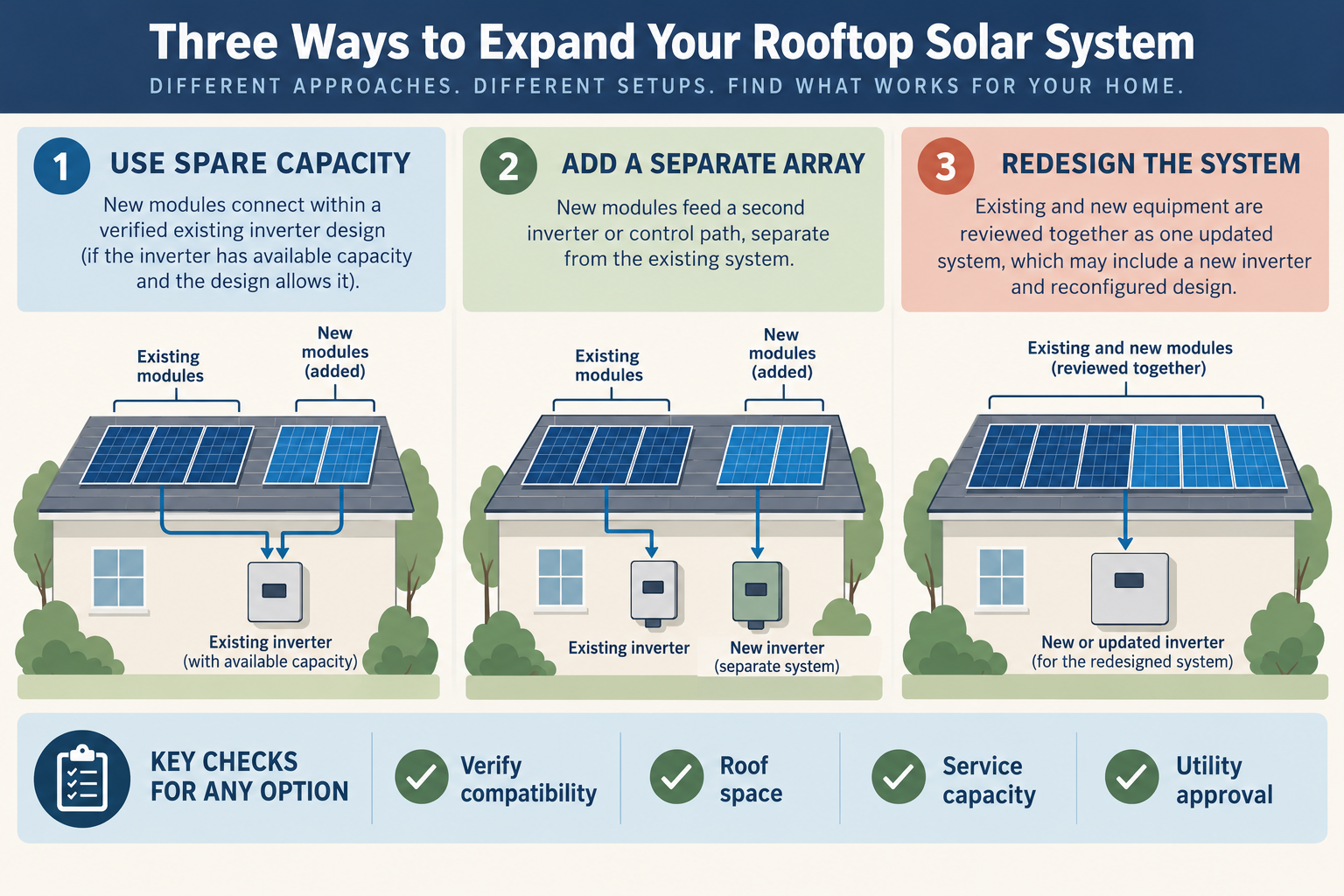
Three expansion paths
Use spare inverter capacity: If the original design intentionally leaves capacity and the equipment supports the proposed modules, the addition may be relatively focused. Compatibility and approval still need confirmation.
Add a separate array and inverter: This can preserve the original system but adds equipment, monitoring, wiring, space, and interconnection complexity. A separate system is not automatically simpler.
Replace or redesign the system: When the original inverter, modules, or monitoring are obsolete, a larger redesign may produce a more coherent system. Compare the cost and downtime with an incremental addition.
Is more production worth it?
Match the expansion to the reason for adding it. A household that added an electric vehicle, heat pump, or electric water heater may have a different load profile from one seeking more export. Solar savings depend on consumption, production, rates, export compensation, ownership, and local rules. More panels do not guarantee proportional bill savings when the home exports much of the additional generation at a lower value.
Compare the expansion with efficiency, load shifting, storage, or a tariff change where those are legitimate alternatives. Do not count an incentive until eligibility is confirmed for the added equipment and current program rules.
Normalize an expansion bid
Request existing equipment models and a one-line or equivalent design record. The quote should show current and proposed production, module count, inverter loading, racking, wiring, roof work, service work, monitoring, permits, interconnection, commissioning, and exclusions. Ask what happens if the original equipment cannot accept the addition.
Use a low case with compatible equipment and spare capacity, an expected case with added controls or approval work, and a difficult case involving inverter replacement or a full redesign. No single current expansion price applies across properties. Obtain local USD or CAD proposals appropriate to the property and do not treat currency conversion as Canadian market evidence.
Expansion makes sense when it solves a real load or production problem without creating disproportionate compatibility and rework costs. If the existing system is aging or the roof is uncertain, price the larger lifecycle decision before buying more modules.
Test whether the extra generation has value
Identify the load that motivated the expansion and when it occurs. New panels may help an added heat pump or vehicle, but export value may be lower than the value of energy used directly. A battery, load shifting, efficiency measure, or service-capacity project may solve the same problem differently. Compare alternatives using the same utility and ownership assumptions.
Existing records have a monetary value
A missing permit, layout, equipment list, or monitoring history increases diagnostic and design time. Ask the installer to locate the original equipment record and verify the as-built condition before proposing a new array. If the roof has changed, document attachments and available service paths. The cost of reconstructing the system should be visible, not hidden in a vague design allowance.
Expansion versus replacement threshold
Expansion is more credible when the existing system is productive, parts are available, the roof is sound, and the utility accepts the larger design. Replacement becomes more credible when the inverter is constrained or obsolete, modules are difficult to match, monitoring is failing, or the owner also wants storage and outage operation. Use those triggers to request two comparable scopes rather than allowing a panel-only proposal to decide by default.
Production, export, and service capacity
An expansion can be technically possible but economically weak if the added production is mostly exported under a low-value rate. It can also be financially useful but require a service upgrade that belongs in the project total. Ask the designer to show the current and expanded load, direct use, export, inverter loading, and utility limit in one comparison.
Physical roof constraints
Remaining roof space may not be the same as usable space. Setbacks, vents, valleys, shading, attachment spacing, conduit, roof condition, and access can limit placement. A separate ground array avoids some roof issues but introduces site work and longer wiring. Compare that alternative only when it serves the same production objective.
Commissioning and records
The completed system should identify old and new components, layout, monitoring, approval status, and production baseline. Without a new baseline, it can be difficult to tell whether the expansion delivered its intended value. Include testing and documentation in the quote, not just module installation.
Calculate the value of the added production
More generation has different value depending on when the home uses power, how exports are credited, and whether the added energy displaces purchases or is mostly sent to the grid. Compare a self-consumption case, an export case, and a conservative case with lower production or changed utility treatment. If a battery, vehicle, heat pump, or other future load is part of the reason for expansion, state whether the expansion is being bought for that future use or for current savings.
The marginal value can be poor when the expansion requires a new inverter, service work, a larger approval, or extensive roof access. It can be strong when compatible equipment and spare capacity already exist and the added modules serve a load that would otherwise be purchased at a higher rate. Do not count the same energy benefit again in a separate battery or payback model.
Ask where the expansion ends
The proposal should state the maximum supported array size, inverter and service limits, circuit or conductor changes, monitoring behavior, and utility approval path. A small first expansion may be sensible, but it should not consume the only spare capacity needed for a planned battery or electrification project without acknowledging that tradeoff. If the existing platform is near end of support, price a replacement or redesign alongside the expansion.
This is also a records project. Keep the original and revised layouts, component models, production baseline, approval documents, and warranty boundaries together. Good documentation lowers the cost of the next diagnosis and makes future bids genuinely comparable.