
An inverter replacement is sometimes a focused repair and sometimes the start of a wider system decision. The price depends on whether the array uses one central string inverter, multiple microinverters, or a design with optimizers and separate control equipment. Compatibility, access, warranty coverage, monitoring, approvals, and the age of the modules can matter more than the failed box itself.
What the inverter changes
The inverter converts the array’s electrical output into usable household and grid-compatible power and may also manage monitoring, shutdown, or battery interaction. A replacement must match the system’s electrical characteristics and control architecture. The fact that a new inverter has a similar label or output does not prove it is an acceptable substitute.
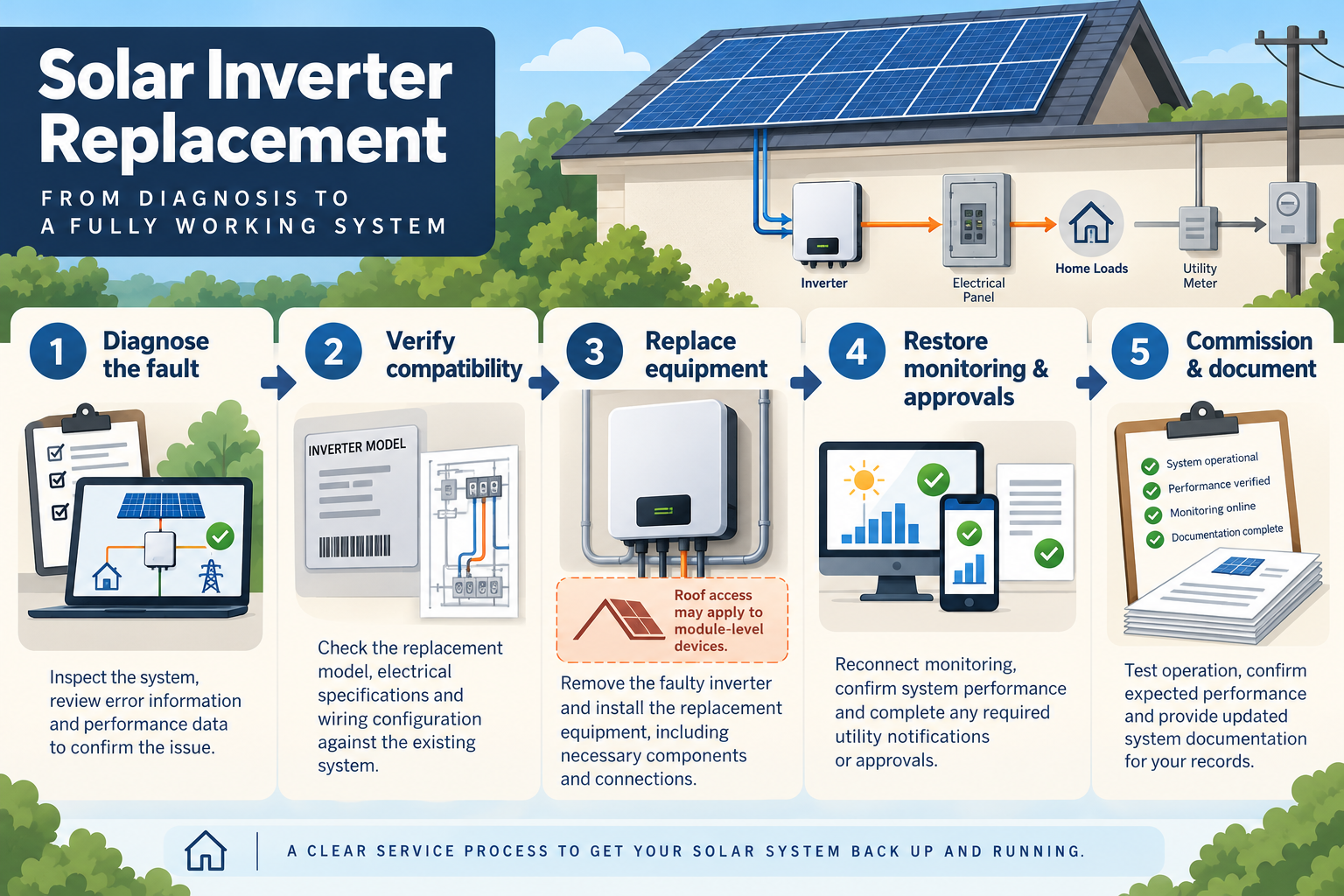
For a string system, the work may involve isolating the array, removing wall-mounted equipment, installing a compatible unit, reconnecting conductors and controls, restoring monitoring, and recommissioning. A microinverter problem may require roof access and module removal for one or more module-level devices. Optimizer, gateway, or rapid-shutdown components can create another compatibility branch.
The quote should separate these costs
Request line items for diagnosis, warranty administration, equipment, labor, access, replacement disconnects or wiring, monitoring, commissioning, permits or utility notification, and disposal. Confirm whether the quote is for the inverter only or includes related gateways, optimizers, roof work, or a new control platform.
If the system is still under an equipment warranty, ask whether the manufacturer supplies the part but excludes labor, shipping, access, or commissioning. A warranty-covered component can still leave a material homeowner cost. Get the coverage and exclusions in writing.
Compatibility is the central uncertainty
Check module electrical characteristics, array configuration, connectors, optimizer or microinverter platform, monitoring account, shutdown equipment, battery interface, service configuration, and local approval requirements. Do not assume a current product can replace a discontinued model without redesign. If the exact system record is missing, diagnosis and documentation become part of the project.
Repair or replace more of the system?
Replacement is more credible when the array is otherwise productive, compatible parts exist, the roof is serviceable, and the repair restores a reasonable service horizon. A broader system review is more credible when the modules are degraded, multiple components are failing, monitoring is obsolete, production is materially below expectation, or another roof mobilization is imminent.
Use a simple threshold: compare focused replacement, a revised array, and complete system replacement over the remaining ownership horizon. Include lost production during downtime, future service, incentives that may or may not apply, and the possibility that a new architecture changes expansion or battery options.
Three scenarios
Warranty-supported string replacement: The exact part is available, installation access is simple, and monitoring can be restored. The cost is mostly labor, incidental materials, and commissioning.
Legacy system: The original model is discontinued or the installer cannot document the architecture. Diagnosis, compatibility research, new control equipment, or a redesign may dominate.
Microinverter or optimizer cluster: One failed device may be a focused repair, but repeated failures can make roof access and repeated mobilization economically important. Compare a planned group replacement with repeated one-at-a-time visits.
The available research does not establish one universal current replacement price. Use a system-specific quote, keep USD and CAD market evidence separate, and require the installer to explain what is known, assumed, and conditional. A low equipment price is not a low installed cost if compatibility and access remain unresolved.
Diagnosis before replacement
Low production, an error message, or missing monitoring does not identify the failed component by itself. Ask what was tested and what alternative causes were ruled out: shade changes, soiling, wiring, communication, array isolation, utility status, and module-level faults can all change the repair path. A replacement proposal should identify the evidence for failure and the consequence if the proposed part does not resolve it.
Downtime has economic value
Estimate lost production during diagnosis, shipping, scheduling, installation, and approval. For a string inverter, a failure may affect the whole array; for a microinverter, a single device may affect less output but require roof access. Lost production is not a reason to exaggerate urgency, but it belongs in the comparison when one option takes materially longer.
Preserve future choices
Ask whether the proposed replacement leaves room for a battery, expansion, a changed monitoring platform, or a later roof project. “Compatible” should identify the exact array and control components, not just a product family. A focused repair is stronger when it restores a documented service path; a broader redesign is stronger when the old architecture is already creating repeated constraints.
Ask about replacement scope at the roof
Microinverter and optimizer replacement can require module handling, roof access, new connectors or labels, and a return visit. A central inverter may be accessible at the wall but still require updated controls or an approval step. The quote should state whether access equipment, weather delays, and restoration of the monitoring account are included.
Warranty and evidence of failure
Record the model, serial number, fault code, production history, and warranty contact. Ask whether the proposed replacement is new, refurbished, or an approved equivalent and what labor is covered. Do not let a warranty label replace a diagnosis: the wrong part can add another visit without resolving the underlying fault.
A practical repair threshold
Choose focused replacement when the rest of the system is productive, the roof is serviceable, and the new component has a credible compatibility and support path. Choose a broader review when the repair repeats, production is poor, the roof or array is aging, or storage and expansion would require the same controls to change. Price the alternatives over the remaining ownership period.
The box is rarely the complete replacement
The visible inverter price may sit beside diagnostic labor, disconnection, access, wiring changes, shutdown equipment, monitoring setup, permits, inspection, commissioning, disposal, and a return visit. An equivalent-looking component may use different connectors, controls, communications, or limits. Ask the installer to identify what remains unchanged and what must be recommissioned.
The difficult case is not limited to a high equipment price. It can involve a discontinued platform, inaccessible roof electronics, damaged conductors, a changed service, a failed monitoring gateway, or a system whose replacement cannot be approved without redesign. Those branches should appear as conditional lines in the quote rather than being treated as surprises after removal.
Compare service path, not only warranty length
Ask who will diagnose the replacement if production remains low, how parts are sourced, whether labor is covered, and whether the proposed platform can be supported by more than one local provider. A longer equipment warranty does not by itself guarantee affordable service or compatibility with the rest of the array. For a short ownership horizon, transfer documentation and buyer confidence may matter; for a long horizon, service access and future component availability deserve more weight.
Use a focused replacement, broader repair, and full redesign scope when the decision is uncertain. The cost of diagnosis is often worthwhile when it prevents replacing a component that was only reporting a wiring, shading, communication, or utility problem.
Price the consequence of downtime
An inverter replacement can interrupt production while the part is sourced, installed, approved, and commissioned. Ask whether the system can operate partially, whether monitoring returns with the replacement, and who confirms normal production. If roof access, weather, utility permission, or a return visit is involved, include those dependencies in the schedule and ownership model.
The cost of a missed production period will differ by household and season, but the question still belongs in the comparison. A supported replacement completed in one planned mobilization may be better value than a cheaper part that creates repeated diagnosis or leaves the system without a credible service path.