
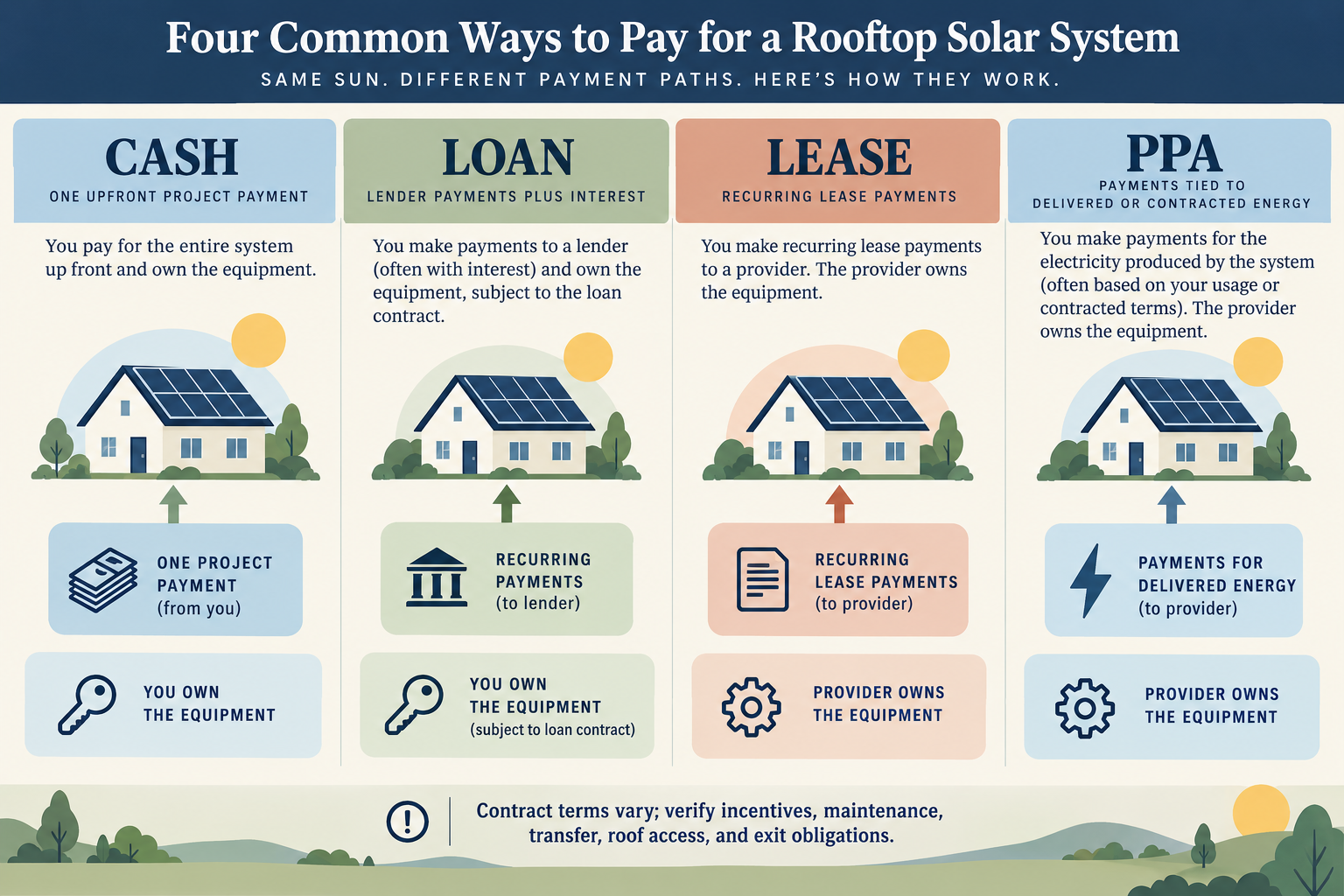
Cash, a solar loan, a lease, and a power-purchase agreement are different ownership decisions, not just payment plans. Compare total payments, who owns the equipment, who receives eligible incentives, who controls repairs and upgrades, how export value is handled, and what happens when the home is sold. A small monthly payment can conceal a larger lifetime obligation.
Cash purchase
Cash usually makes the project cost easiest to understand: pay the installed price and retain ownership, production value, and responsibility for future repairs. The opportunity cost is the money no longer available for roof work, debt reduction, or another investment. Include inverter, roof, monitoring, insurance, and eventual replacement planning rather than treating the installation invoice as lifetime cost.
Solar loan
A loan spreads payment but adds interest, fees, and contract conditions. Compare the financed total with cash price, term, rate, prepayment rules, dealer fees, collateral or transfer provisions, and the timing of any incentive. A low advertised monthly payment may use a long term or an assumed incentive that the household cannot actually claim.
Lease or PPA
Under a lease, the provider generally owns the equipment and charges for use. Under a PPA, payment is commonly tied to energy produced under the contract’s terms. The precise obligations control the economics: escalators, minimums, maintenance, roof access, production guarantees, insurance, equipment removal, buyout, and transfer on sale or refinance.
Third-party ownership can reduce upfront payment and may simplify some maintenance responsibilities, but it can also reduce control and complicate a home sale. Read the full contract, not the sales summary. Obtain an independent estimate of production and utility value before accepting the provider’s savings projection.
Incentives and geography
The IRS’s 2025 Form 5695 instructions state that residential clean-energy credits cannot be claimed for expenditures made after December 31, 2025; the instructions separately address carryforwards from prior-year credits. A 2025 tax form does not support assuming a new credit for a later project. Incentive treatment also depends on who receives the payment and the applicable tax year, so confirm current federal, provincial, state, utility, and contract-specific terms before subtracting anything from cost. This is not an individual tax determination.
Do not convert a U.S. financing result into a Canadian one. Interest, taxes, utility rates, export treatment, and contract norms require local review.
One current Canadian example is the federal Canada Greener Homes Loan: Natural Resources Canada labels it closed because its funding is fully committed, so new applications cannot be approved; previously approved loans remain funded. That status applies to this program, not to every Canadian financing option. Check other federal, provincial, municipal, and lender terms separately.
If a customer cannot own or install panels on the home, an off-site community-solar subscription is not a roof lease or PPA. Compare its bill-credit and cancellation terms separately from financing an on-site system.
Compare offers on one worksheet
Record cash price, financed total, monthly payment, term, escalation, production assumption, utility-rate assumption, export compensation, maintenance responsibility, warranty, insurance, roof removal, transfer or buyout, and sale/refinance conditions. Calculate an optimistic, expected, and difficult case. The difficult case may include lower production, lower export value, roof work, a move before contract end, or an incentive that does not apply.
The least expensive structure is the one with the lowest credible total cost for the value and control you need, not necessarily the lowest entry payment. If a contract cannot make ownership, repair, transfer, and performance assumptions visible, it is not ready for an economic comparison.
Separate price from risk transfer
A lease or PPA may transfer some equipment maintenance to the provider, but the homeowner still carries contract, roof-access, property-sale, and performance risks. A loan leaves the homeowner with equipment ownership and repair exposure, but may preserve more control. Cash avoids interest but uses capital. Write down which risk is being transferred and what that transfer costs.
Model a move before signing
Ask how the agreement is assigned, bought out, prepaid, or removed if the home is sold or refinanced. Include buyer qualification, lender requirements, notice timing, roof work, and any payment continuing after the system stops being useful to you. A contract that is inexpensive over a long horizon may be awkward when ownership changes early.
Check the savings baseline
The comparison should use the same system, production, utility rate, export, and maintenance assumptions for every payment structure. If a provider uses a different baseline for each option, the apparent savings are not comparable. Request the full payment schedule and identify escalators, fees, tax treatment, and incentive assumptions before deciding.
What ownership controls
Ownership determines who can decide on repairs, expansion, equipment removal, roof coordination, and operating settings. A provider may retain rights over the equipment or production while the homeowner retains responsibility for roof access and property conditions. Ask whether a new roof, insurance claim, or system failure needs provider approval.
Compare net cost with the same calendar
Use one timeline from installation through the planned ownership horizon. Include deposits, monthly payments, interest, escalators, incentives, maintenance, insurance, roof removal, buyout, and the value of production. A cash quote and a PPA quote cannot be compared by subtracting a PPA’s first-year payments from a cash invoice; their ownership and payment streams differ.
Red flags in a sales illustration
Be cautious when savings depend on an unstated utility-rate increase, a full export credit, an incentive not yet confirmed, or a payment that rises later. Ask for the base tariff, production assumption, contract term, and bad-case outcome. If the illustration cannot survive conservative assumptions, treat the financial result as uncertain rather than as a promise.
Model the homeowner’s actual alternatives
The comparison is not always cash versus a contract. Include doing nothing, improving efficiency first, repairing an existing system, adding panels later, or buying storage separately when those are realistic choices. Use the same electricity-use baseline and the same roof, service, maintenance, and utility assumptions. A financing offer can look attractive simply because its comparison case assumes electricity prices rise while the no-project case is held flat or because it assigns all production to a value the home cannot use.
A cash purchase usually gives the homeowner control over equipment and future operating choices, but it commits capital and leaves performance risk with the owner. A loan preserves cash but adds interest, security, and payment timing. A lease or PPA may transfer some equipment obligations while adding contract, escalator, buyout, transfer, and roof-access questions. The best structure depends on the value of those risks, not only on the first monthly payment.
Check who owns future choices
Ask who can approve a roof removal, add a battery, change the service, replace a failed inverter, claim an incentive, or transfer the agreement on sale. A contract that makes routine service simple may make a later property project slower or more expensive. Request the current payoff or buyout method, transfer process, insurance responsibility, production remedy, and end-of-term options in writing.
Then run a conservative case with lower production, delayed approval, no unconfirmed incentive, and a modest export value. If the decision still fits the household’s horizon and risk tolerance, the financing structure has a stronger basis. If it works only under the sales illustration, the unresolved risk should remain visible rather than being called savings.
Read contract events, not only payments
A solar agreement can create costs or decisions when the home is sold, refinanced, reroofed, damaged, transferred, or expanded. Ask what happens if production is lower than modeled, the equipment needs service, a roof contractor needs access, or the owner wants to add storage. Lease and PPA terms may allocate equipment maintenance differently from a cash purchase, but the homeowner still needs to know who controls timing and approval.
Include these events in the same worksheet as the payment stream. A lower monthly payment can transfer risk rather than remove it. A higher cash or loan cost can be defensible when it preserves ownership and future flexibility. The comparison is complete only when the homeowner understands both the normal calendar and the likely exception that would make the contract expensive.