
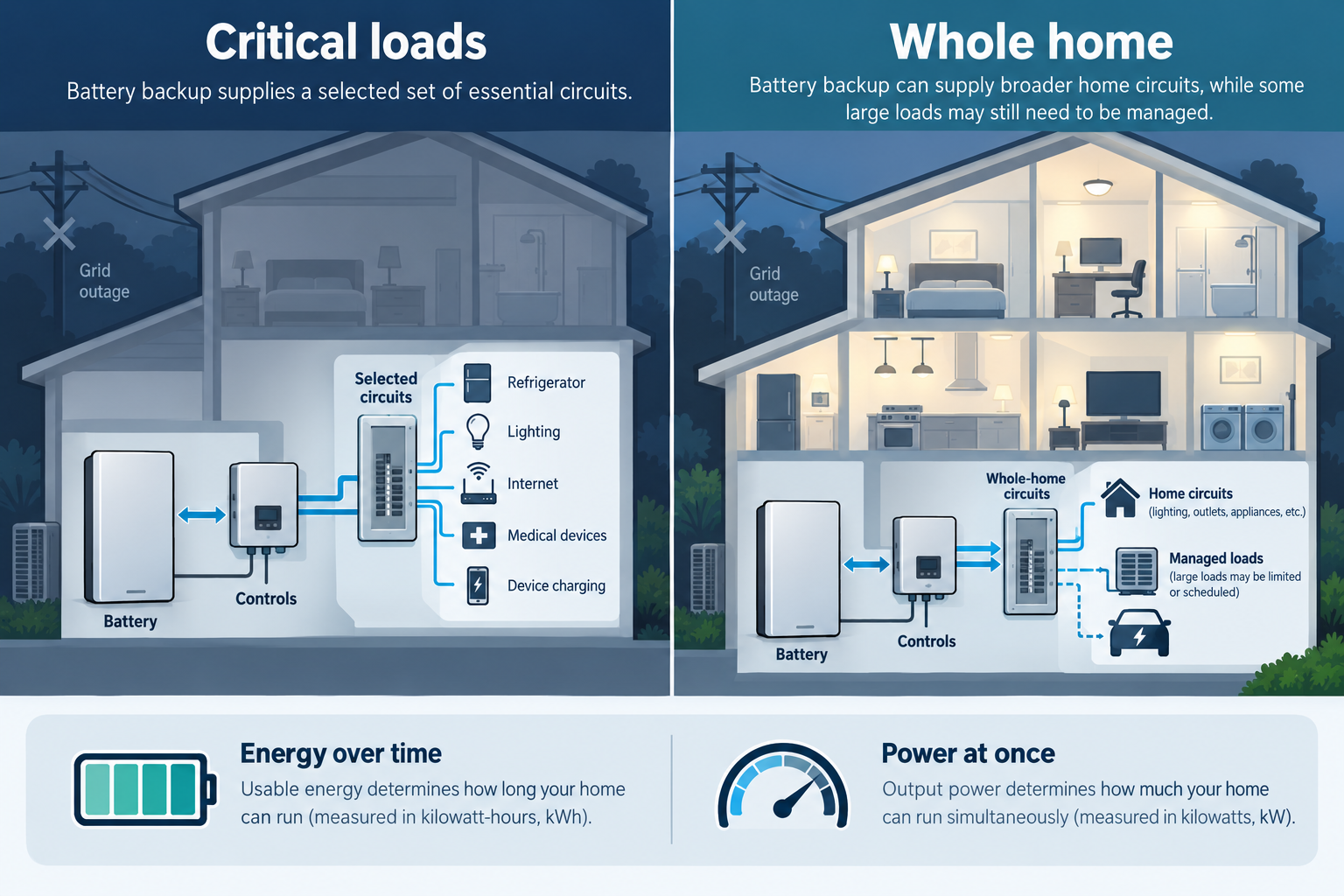
Critical-load backup usually costs less because it serves a deliberately limited set of circuits. Whole-home backup can cost more because the battery and controls must handle more simultaneous power, starting surges, transfer scope, and load-management complexity. The practical choice depends on which services must continue, not on the home’s floor area.
Define critical loads
Common priorities may include refrigeration, communications, lighting, selected receptacles, controls, a well pump, or a sump pump. Large electric heat, central air conditioning, ranges, dryers, and EV charging can dominate power demand. A load belongs on the backed-up list only after its electrical characteristics and the system’s limits are understood.
Do not confuse a code-required battery-ready circuit list with a tested backup design. California’s limited new-construction readiness rule specifies electrical provisions for future equipment; it does not establish battery capacity, simultaneous load capability, or runtime. The critical-load panel guide describes the covered scope.
Make two lists: must-run loads and convenient loads. State whether they may operate at the same time. A refrigerator and a pump may have modest daily energy but meaningful startup demand. A heating system may have moderate runtime but high continuous power.
What changes the quote
Critical-load architecture may require circuit relocation, a subpanel, transfer equipment, relays, load-management controls, labeling, and commissioning. Whole-home systems may use different transfer and control equipment and still need to shed loads when the battery cannot support everything. Existing service configuration, panel space, conductor routes, and access affect labor.
The battery must be sized for both usable kWh and continuous and surge kW. More stored energy cannot solve an insufficient power rating. Conversely, more power does not provide longer runtime. Solar recharge, grid recharge, weather, season, and outage duration change the result.
Three scenarios
Essential circuits: The battery carries a short list of priority loads. This is usually the clearest cost-control path when outages are rare or the homeowner wants refrigeration, communications, lights, and pumps rather than normal full-home operation.
Managed broader backup: The system serves more circuits but uses controls to prevent incompatible combinations. The quote should identify the managed loads and the circumstances in which they disconnect.
Whole-home objective: The design aims to maintain ordinary living but may still exclude or manage the largest loads. Ask the installer to define “whole home” by simultaneous load capability, not by the number of breakers connected.
Economic decision
Compare the cost of larger battery capacity, inverter power, transfer equipment, and service changes with the value of convenience and risk reduction. Critical-load design may require homeowner behavior during a long outage; whole-home design may reduce that burden but increase capital and replacement cost. A generator may provide a different long-outage tradeoff.
No universal savings percentage is supported. Use a local design and quote, document circuit scope, and model short, expected, and prolonged outages. Choose whole-home coverage only when its additional service is worth the additional equipment and ownership exposure.
A bigger circuit list can change the source
Adding one large load can change the design more than adding several small ones. Electric resistance heat, a heat pump, central air, a range, dryer, EV charger, well pump, or sump pump may have significant continuous or starting requirements. Ask the designer to show the load combinations and the first loads disconnected when power is limited.
Consider behavior as a cost
Critical-load backup can lower capital cost but may require the household to plan water use, avoid large appliances, or accept a manual priority decision. Whole-home systems reduce that burden only within their actual power and energy limits. A managed system may provide a middle path. Put these operating assumptions in the quote so the lower price does not depend on an unrealistic outage routine.
Check long-outage value
For a short outage, power and transfer speed may be the main concern. For a longer outage, usable kWh, recharge, weather, and load reduction matter. Compare the cost of expanding a critical-load system with the cost of whole-home output and future replacement. There is no universal savings percentage because the circuit list creates the economics.
Test the actual priority list
Write each selected circuit, its expected running load, starting load, and whether it can share power with another priority circuit. A refrigerator, well pump, sump pump, communications device, and lights may be manageable together in one case and not in another. The list should include a fallback if the battery reaches its reserve.
Compare resilience with convenience
Whole-home service buys less decision-making during an outage, but not unlimited energy. Critical-load service can reduce capital and replacement cost while requiring a more deliberate operating plan. Put the difference in practical burden and source limits beside the price difference. That is more useful than calling one design “better.”
Put a number on the inconvenience avoided
Whole-home backup may avoid moving appliances, changing behavior, or deciding which load gets priority. Critical-load backup may avoid a larger battery, inverter, service, and replacement cost. The value of convenience depends on occupancy, outage frequency, health or work requirements, and the home’s large loads. State those assumptions instead of hiding them behind a technology preference.
Recheck after electrification
Future heating, cooling, vehicle, water-heating, or cooking changes can shift a critical-load design into a broader source requirement. Ask what spare capacity, panel space, and control path remain. A smaller initial system can be sensible, but only when its future limits are documented.
Use simultaneous loads, not an appliance count
The economic difference between the two designs depends on which loads must operate together and which loads have high starting demand. A critical-load plan may support refrigeration, communications, lighting, a pump, and selected outlets while excluding heating, cooking, air conditioning, or vehicle charging. A whole-home plan may require a larger source, transfer arrangement, service review, or load management. Ask for the assumed simultaneous combination and the behavior when the source reaches its limit.
This also affects the human cost. Critical-load backup can require moving loads, changing routines, or accepting that an excluded appliance will not operate. Whole-home backup can reduce those decisions but may cost more at installation and replacement. Put the inconvenience avoided into the decision using occupancy, outage frequency, medical or work requirements, and the consequences of a failed priority load.
Compare the next unit of resilience
If a critical-load system is nearly adequate, the next dollar may be better spent on a larger inverter, load control, a second battery, or a different source. If a whole-home system is oversized for rare events, a smaller critical design plus a clear operating plan may preserve capital for maintenance and replacement. Request both scopes with the same event duration and recharge assumptions. That prevents the “whole home” label from being compared with a critical-load design that quietly assumes fewer hours or fewer simultaneous loads.
Document the excluded service
For a critical-load design, write down the loads that will not operate, the source limit, the expected reserve, and the behavior when a priority load exceeds the available output. Include seasonal changes: a circuit that is unimportant in mild weather may become important for heating controls, cooling, or a pump. This is not a reason to back up everything; it is a way to price the consequence of the boundary honestly.
The documentation also protects future choices. If the homeowner later adds a vehicle charger, heat pump, freezer, or pump, the next contractor can see whether the source, panel, and controls have room. A system that is smaller today can remain good value when its limits are explicit and the cost of crossing them is known.