
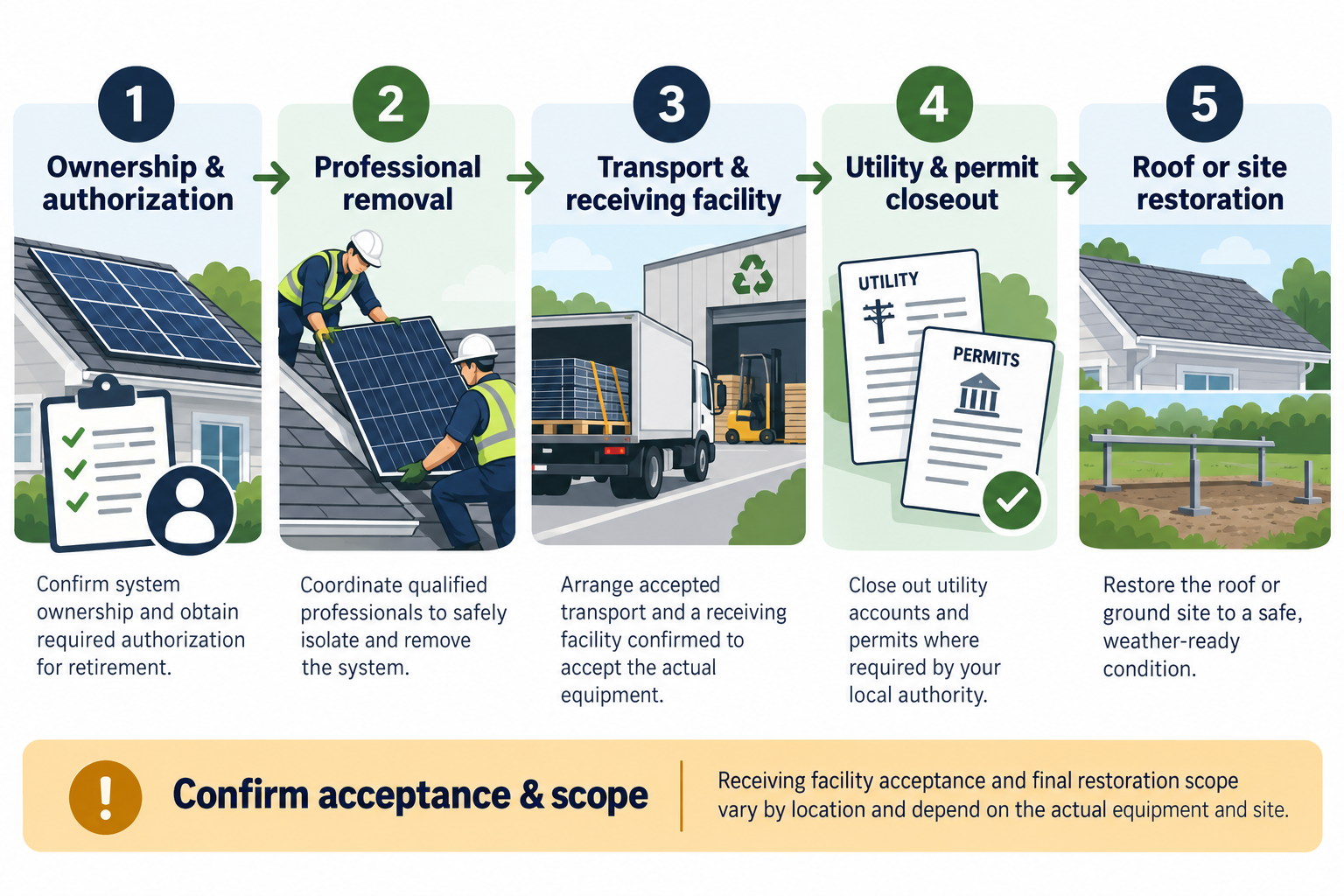
Permanently retiring a solar system is a larger decision than taking panels off for a reroof. A complete project can include authority to remove the equipment, professional electrical isolation, removal of the array and balance-of-system equipment, transport, recycler or disposal charges, utility closeout, and repair of the roof or ground site. There is no reliable current U.S. or Canadian household price range for that complete package. The useful budget is a property-specific quote that names each part and who owns it.
Decide whether this is final retirement
Temporary removal for a new roof assumes the array will be reinstalled; see solar panel removal and reinstallation. An aging but operating system may still be repaired, kept, repowered, or replaced; see whether to replace an old solar system. This guide covers the case where the owner plans to stop using the system and does not expect to reinstall it.
Before pricing work, check the system’s ownership and contract. A lease or power-purchase agreement can give the provider rights over the panels and specify removal, roof access, buyout, transfer, or end-of-term responsibilities. A utility interconnection agreement, permit, rebate agreement, property sale, or shared-roof arrangement may add a separate notice or closeout step. Ask the relevant counterparty what written authorization is required; don’t assume that being the homeowner means you can direct removal of equipment you do not own.
What a complete removal quote should include
Ask the contractor to describe the work from the existing system record through final closeout. The line items may include:
- A site review that identifies the array, inverter, racking, wiring, ground equipment, access, damage, and any missing records.
- Qualified isolation and removal of the rooftop or ground-mounted array, inverter, racking, wiring, controls, disconnects, and other balance-of-system equipment that is in the agreed scope.
- Protection, packaging, loading, transport, and storage if a receiving facility requires particular handling or the owner is considering reuse.
- Acceptance checks and charges from the recycler, collection program, or disposal facility, including separate treatment for damaged equipment if required.
- Roof attachment, flashing, and penetration repair, or removal of ground foundations and restoration of the site to the condition specified in the contract.
- Utility, meter, permit, inspection, monitoring, and interconnection paperwork where the local process requires it.
- Closeout records that identify what was removed, where components went, what remained in place, and who is responsible for the repaired surface.
These are separate scopes even when one contractor coordinates them. Ask whether the quote includes roof repairs or only removes the solar hardware, whether ground foundations are included, and whether utility or permit charges are included or conditional. A module-only fee is not a full retirement price.
What changes the cost
Array size matters because it affects handling, labor, packaging, and the number of components, but it is only one input. Roof height, pitch, covering, access, staging, distance from the driveway, and the attachment system can change the work. A ground array can require work around foundations, racking, trench routes, grading, drainage, or vegetation. Restoration should be described to a defined finish, not left as “make good.”
Condition and documentation create another branch. An intact, labeled array with equipment records may be simpler to assess than a damaged system with broken modules, altered wiring, missing permits, or equipment that is hard to identify. The receiving facility may accept some panel types or conditions and decline others. Ask the contractor to confirm acceptance with the actual destination before the removal date, rather than assuming that a general recycling program accepts every panel, inverter, or damaged component.
The price also depends on whether another project is coordinated at the same time. If the roof is being replaced, the roofing scope belongs in the roof quote, while the solar quote should identify its removal and closeout responsibilities. If a ground site is being redeveloped, separate generic earthwork and landscaping from the solar retirement work. Compare the combined project so duplicated access or mobilization is visible without treating unrelated property improvements as solar costs.
Recycling is a route, not a homeowner price
In the United States, the Environmental Protection Agency’s guidance says discarded solar panels can be hazardous waste depending on their composition and test results; some panels are hazardous and some are not, including products from the same model or manufacturer. It directs homeowners to state or local recycling agencies. Do not assume that every panel is hazardous, or that it can go in ordinary household trash. Ask the local authority and receiving facility about the exact panel type, condition, quantity, packaging, and accepted route.
The U.S. Department of Energy notes that recycling processes exist, but the general cost of recycling solar modules in the United States is still usually higher than landfill disposal. That industry observation does not predict a homeowner’s charge, any salvage value, or which route is lawful for a particular panel. Get the facility’s current acceptance and fee terms in writing. Do not count on sale proceeds or a recycling credit unless a buyer or program confirms the amount and conditions.
Canadian programs and rules are provincial or local. Alberta’s recycling program began collecting end-of-life solar panels on October 1, 2026, and the program operator’s current update lists covered panel families and program terms. Its FAQ gives household guidance for a limited number of panels at participating depots and advises confirming acceptance with the depot. This is an Alberta example; it does not establish a Canada-wide route or include professional removal, transport, roof repair, or ground restoration in the homeowner’s quote.
Three project scenarios
Straightforward rooftop retirement: The owner has the equipment schedule, access is uncomplicated, the panels are intact, a receiving facility confirms acceptance, and the roof contractor has separately priced the final surface repair. The solar quote should show removal, transport, destination charges, utility paperwork, and who certifies the roof handoff.
Complex roof or damaged system: The array spans several roof planes, access is restricted, equipment is damaged or unidentified, or the recipient requires special handling. The proposal may need conditional labor, a facility assessment, or a second visit. Keep unknown acceptance and restoration costs visible rather than treating a preliminary removal allowance as a complete total.
Ground-mounted array: The scope includes the array and its support structure plus a decision about foundations, wiring routes, grading, drainage, or reuse of the cleared land. The quote should define whether the site will be left safe, level, seeded, or ready for a new use. Those are different finish levels and can move work outside the solar contractor’s scope.
These scenarios are quote structures, not low, average, or high prices. No current evidence supports assigning a representative all-in amount to them.
Compare retirement with keeping or repowering
Retirement removes future maintenance and production from the household’s plan, but it can also give up remaining useful generation. Compare the total responsibility for retirement with the cost and value of continued operation, focused repair, or repowering over the same ownership period. Include service calls, output, export terms, roof timing, contract obligations, and the removal work that each path eventually requires. A functioning array does not have to be removed just because it is old, and repowering is not automatically cheaper than final removal.
For an aging system, replacement or continued operation is a separate decision. If the owner is still deciding whether to replace or retire a roof-mounted array, ask for both scopes using the same removal, utility closeout, and surface-restoration assumptions. That avoids comparing a complete retirement proposal with a replacement quote that leaves the old equipment’s destination unpriced.
Questions to ask before approving the work
- Who owns the equipment, and what lease, PPA, utility, lender, association, or property-sale terms must be cleared first?
- Which panels, inverters, wiring, racking, foundations, and controls are included in removal?
- Who confirms the receiving facility will accept the exact equipment and its current condition?
- Are packaging, loading, transport, facility charges, and any rejected-material contingency included?
- What roof or site finish is included, and who warrants that finish after the solar contractor leaves?
- Who handles the permit, meter, monitoring, and interconnection closeout, and what fees remain conditional?
- What happens if a component is damaged, missing from the equipment list, or declined by the receiving facility?
Request the final equipment and disposal records, permits or inspection closeout where applicable, utility confirmation, and roof or site handoff. The contractor should identify any equipment left behind and the party responsible for it. Keep the documents with the home’s solar and roof records so a future owner does not have to reconstruct the removal history.
The cost of permanent retirement is the full work package: authority, safe professional removal, accepted component handling, utility closure, and restoration. Because local routes, system condition, and property work differ, use a detailed quote and verified receiving-facility terms instead of a national price guess.