
Solar value depends on what the household uses directly and what the utility does with excess generation. Net-metering and export programs can differ in eligibility, credit value, billing period, system-size limit, customer class, storage treatment, and rate changes. A solar payback calculation that assumes every exported kilowatt-hour is worth the retail rate can be materially wrong.
Self-consumption and export are different
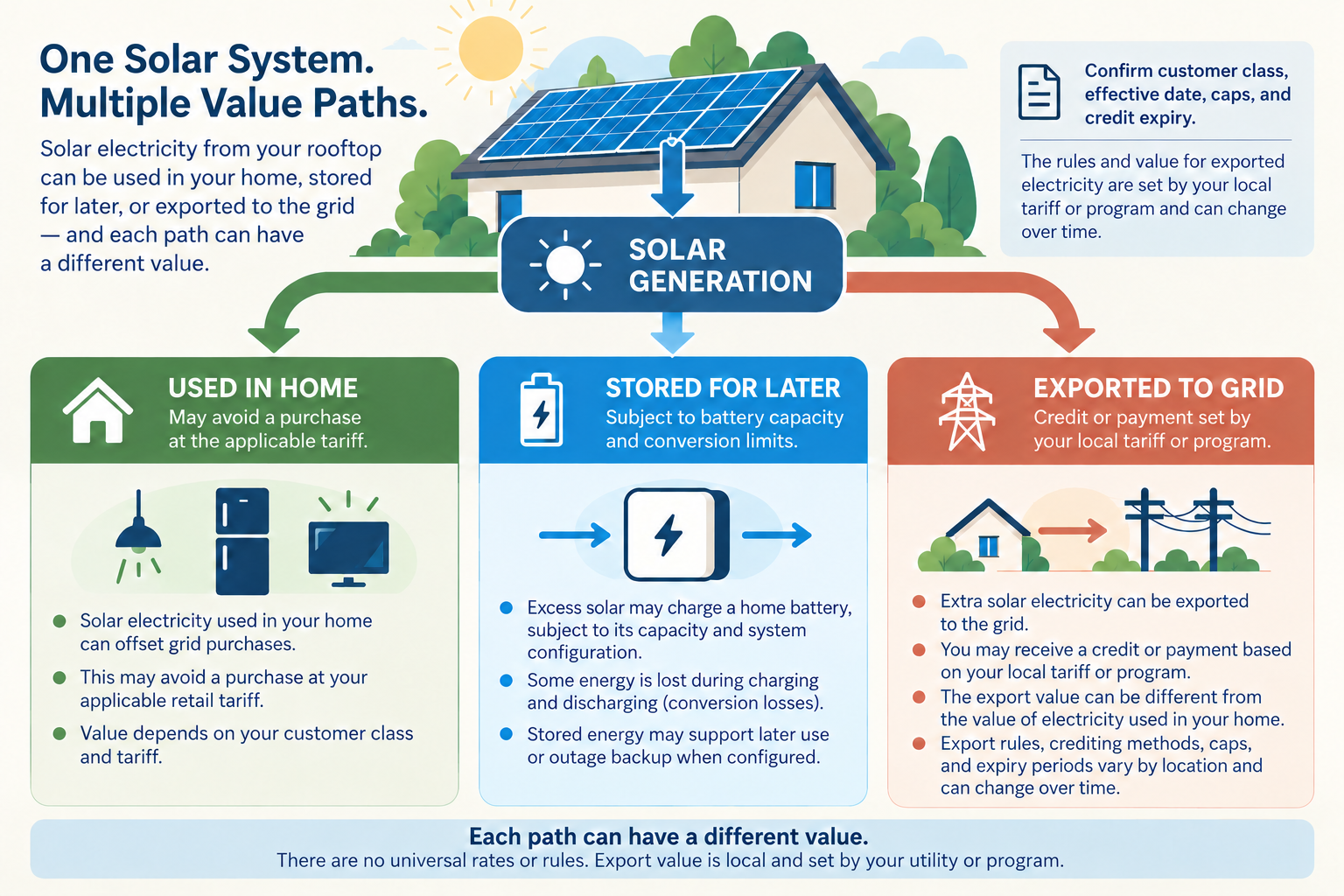
Energy used in the home can avoid a purchase under the applicable tariff. Excess generation may flow to the grid under a credit, payment, rollover, or other program. The value depends on timing and rules. A larger array can therefore produce more energy without producing proportionally more bill savings if the additional output is exported at a lower value.
Storage changes timing but does not automatically change the tariff. It may move generation to a period when the home would otherwise buy electricity, and a properly configured system may support outage loads. Equipment, controls, capacity, and program eligibility remain system- and utility-specific.
What to verify locally
Ask the utility or program administrator to confirm the current tariff or agreement, eligibility, interconnection approval, system-size cap, meter treatment, export compensation, credit expiry, billing period, storage rules, and what happens when the property changes hands. Confirm the effective date of any rate change and whether existing customers receive transitional treatment.
The available evidence includes a current British Columbia example: BC Hydro identifies a Rate Schedule 2289 for new self-generation customers, with a stated payment for excess generation and a per-phase limit, while existing Rate Schedule 1289 customers retain that earlier treatment for a defined period. That is a local example, not a U.S. or Canada-wide rule. Verify the current terms before making a financial commitment.
Ontario illustrates a different structure. The Ontario Energy Board says net-metering credits offset electricity-consumption charges, not other bill charges, and unused credits can carry forward for up to 12 months before being reduced to zero. Eligibility depends on a utility agreement, a connection application, and the utility’s technical, safety, and inspection requirements. Confirm the current rules with the utility before investing; these are Ontario terms, not a Canadian-wide export rate.
Other U.S. examples show why the effective schedule and credit treatment belong in the model:
| Example checked against the current source | What the rule changes | What the homeowner still needs to confirm |
|---|---|---|
| Rocky Mountain Power Schedule 137 in Utah | A Public Service Commission approval effective March 1, 2026 lists export credits of 4.855¢/kWh for June–September and 4.033¢/kWh for October–May. | The schedule applies to eligible Rocky Mountain Power customers; it is not a statewide Utah rate or the customer’s retail purchase rate. |
| Illinois net-metering law | Current law distinguishes legacy customers from later entrants and defines credits differently by the customer’s supply arrangement. A supply credit does not erase every delivery charge or tax. | Confirm the current statute, utility tariff, supplier, billing method, and the customer’s eligibility dates. |
| Oregon net-metering summary | Residential projects can be up to 25 kW; excess kWh credits can carry for up to 12 months, after which remaining surplus is transferred to the utility’s low-income assistance customers. The page does not promise a cash payment to the solar customer. | Check the serving utility’s tariff and account-specific interconnection terms. |
These examples are not a matched rate comparison. The Utah schedule gives seasonal cents per exported kWh, Illinois describes customer billing cohorts and credit components, and Oregon describes the timing and disposition of unused credits. Use them to identify which local term changes a payback model, then replace them with the utility’s current tariff for the actual account.
If the household cannot install or own rooftop equipment, community solar is a separate off-site subscription and credit decision. It should not be modeled as if the home exported its own electricity under the rooftop tariff.
Put export into the model
Separate annual production into direct use and export. Apply the household’s avoided purchase value to the first and the actual program value to the second. Then test seasonal mismatch, rate changes, consumption growth, curtailment, storage losses, and outages. Include fixed charges and any demand or time-of-use features that affect the result.
High-value export case: The program credits exports near the avoided retail value and the system is within its conditions.
Mixed case: Household use captures some output, exports receive a lower value, and storage improves timing only within its usable capacity.
Low-value export case: Most additional production is exported under a lower or changing rate, a cap is reached, or eligibility conditions are not met.
How the decision changes
When export value is low, load shifting, right-sizing, energy efficiency, or storage may be more useful than adding panels. When export value is supportive, a larger system may be reasonable if roof, service, interconnection, and ownership costs still fit. Neither conclusion is automatic because local rates and household behavior are decisive.
Do not use a historic net-metering promise in a new quote. Require the installer to identify the rule used in its savings model and the homeowner to confirm it with the utility. If the rule cannot be confirmed, present payback as a range with the export assumption clearly labeled rather than as a guaranteed result.
Rate changes create timing risk
A new customer and an existing customer may not receive the same treatment. A program can close to new applicants, change its credit calculation, impose a system-size cap, or move from an annual credit to a billing-cycle payment. The relevant date may be application, interconnection approval, installation, or permission to operate. Ask the utility which event controls eligibility.
Storage can change the value split
Storage may increase the share of solar used in the home, but it also has losses, capacity limits, controls, replacement cost, and possibly different program treatment. Model charging and discharging under the actual tariff rather than assuming every exported unit can be saved. A battery sized for outages may not be optimized for daily rate management.
Quote questions
Ask the installer to show current consumption, direct use, export, credit value, fixed charges, and future rate assumptions separately. Keep a copy of the utility tariff or program terms used. If a salesperson cannot identify the source and effective date of an export assumption, exclude that value from the firm case and treat it as upside only.
What happens when export value falls
Recalculate direct use, exported units, storage operation, and the remaining utility bill. A system sized for high export may have a different economic case from a system sized around the home’s daytime load. The alternatives may be right-sizing, shifting loads, adding storage, or delaying expansion. None should be selected without the actual tariff and equipment scope.
Existing customers and new customers
Do not assume a neighbor’s credit or an older proposal applies to a new installation. Confirm the customer class, application date, interconnection status, system ownership, and effective rate. A local example can illustrate how treatment changes while still leaving the homeowner responsible for obtaining the current utility document.
Put the tariff in the contract file
Keep the rate schedule, program terms, application correspondence, and model date with the solar records. Ask the installer to disclose assumptions that are outside its control. This does not guarantee future export value, but it makes a later change visible and prevents a historic rate from being mistaken for a permanent return.
Stress-test a lower export value
Run the solar model with three uses for each unit of generation: energy used immediately in the home, energy stored and used later, and energy exported under the confirmed tariff. Then reduce the export credit or change the export limit in a sensitivity case. The result shows whether the project depends on sending surplus power to the grid or whether the home can use enough generation directly. A battery may improve timing but adds purchase, conversion, replacement, and control cost; it is not automatically an economic response to a lower export rate.
The same method applies to an expansion. Additional modules can have less value when they increase midday exports, require a new approval, or exceed a service or inverter limit. A smaller system paired with load shifting, efficiency, or a future battery may deliver a better use profile. Conversely, a household with daytime loads may receive more value without storage.
Protect the assumptions from a sales worksheet
Record the tariff version, customer class, application date, system ownership, export limit, demand or time-of-use treatment, and any eligibility condition. Ask the installer to identify which values are guaranteed by the utility and which are only modeled. Recalculate when the utility changes the application or approval terms. The economic decision should remain understandable even if the credit changes, because a homeowner cannot purchase a permanent export rate from an installer.
Separate current tariff from forecast value
Use the confirmed tariff for the current case and treat future rate changes as scenarios. A forecast may help compare risk, but it is not a utility promise. Test the project if export value falls, if an application limit reduces system size, or if more of the home’s load moves to a different time of day. These changes can affect an expansion, battery, or financing decision without changing the physical solar price.
The homeowner should be able to identify which benefit is already available and which depends on future behavior, utility approval, or a program renewal. That separation prevents a favorable historic rate from carrying an entire payback calculation and makes it easier to choose a smaller system, load-shifting strategy, or staged project when the tariff is uncertain.