
Replacing a septic tank does not automatically mean replacing the drainfield, but neither does a new tank prove that the field is healthy. A tank-only project may include pumping, removal, excavation, a new tank, inlet and outlet reconnection, access risers, inspection, backfill, and restoration. If the field, distribution, site, or approved design also fails, the scope becomes a larger system project.
Tank-only U.S. price observation
Angi’s September 2026 U.S. repair guide lists a new septic tank at $3,000–$9,500. That is a tank-replacement observation, not a price for replacing both the tank and drainfield, and its exact inclusions may differ from a local bid. Access, removal, soil conditions, design, permits, disposal, and restoration can change the project total. This specialist range is not a Canadian price.
What tank-only replacement means
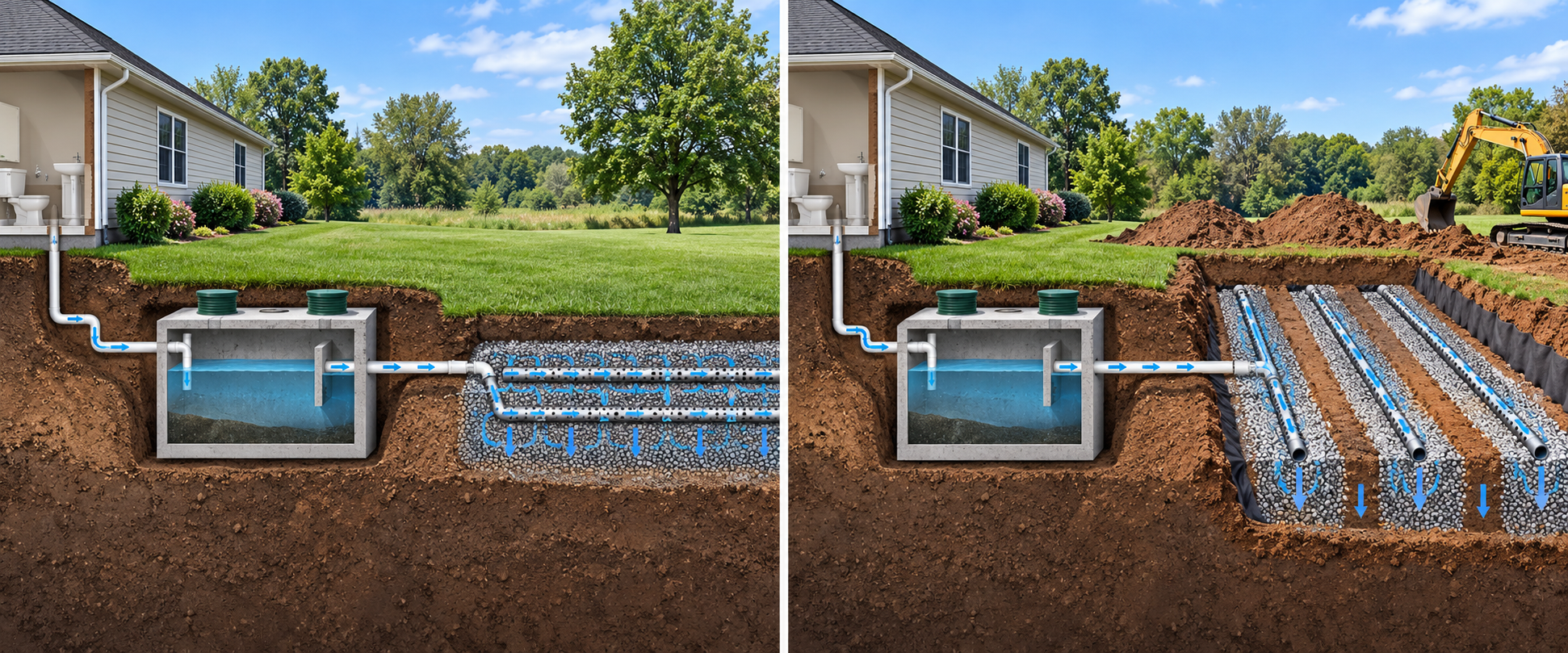
The tank settles solids and sends liquid effluent to a separate distribution and soil-absorption system. A tank-only quote assumes those downstream components can remain and can be reconnected in an approved way. The assumption should be stated, not implied.
Ask for an assessment of the outlet, distribution box or pump equipment, drainfield condition, and available access before comparing tank prices. The replacement estimate is incomplete if it prices the tank while leaving the field condition unknown.
Main cost layers
- pumping and safe preparation;
- locating, exposing, and removing or abandoning the old tank;
- new tank capacity, material, fittings, baffles, and access risers;
- excavation, rock, groundwater, soil handling, and equipment access;
- inlet/outlet reconnection and any distribution changes;
- pump chamber or controls if the system is pumped;
- permit, inspection, engineering, testing, backfill, grading, and restoration.
U.S. specialist market estimates provide a directional signal for tank-and-field replacement, but not a universal tank-only price. Canadian readers need local CAD quotes. A tank delivery price excludes most of the layers that make a buried replacement expensive.
When the existing field may remain
The field may be retained when inspection and site evidence support continued function, the new tank matches the approved hydraulic and structural arrangement, distribution is serviceable, and the authority accepts the work. A field that is dry and functioning is not necessarily proven by the fact that the tank has failed; it should be evaluated on its own terms.
The field should not be treated as retained merely because replacing it is expensive. Recurrent backup, ponding, surfacing wastewater, unequal distribution, saturated soil, or evidence of soil-treatment failure may require a field decision. See drainfield repair and drainfield replacement.
Three project scenarios
Tank-only replacement: Known access, conventional tank, dry site, sound outlet and field, and clear authority process. The principal uncertainty is excavation and restoration.
Tank plus associated components: The tank replacement exposes a damaged outlet, baffle, riser, distribution connection, or pump-chamber issue. Bundling can be efficient, but the quote should show each addition.
Whole-system redesign: The field is failing, the lot no longer supports the prior layout, current use has changed, or the authority requires an alternative design. The work may include site evaluation, design, a new field, pumps, controls, fill, electrical, and restoration. This is not a tank markup.
Current requirements and property records
Replacement may trigger a permit, inspection, design review, or current-standard assessment depending on local rules. Requirements differ by state, province, municipality, system class, and whether the work is a repair or alteration. Preserve the old design, maintenance records, tank location, and approved field information.
Questions to ask before approving
- What evidence supports retaining the existing field?
- Is the tank capacity and configuration based on the approved design or a new load calculation?
- Are removal, disposal, excavation, dewatering, rock, reconnection, and restoration included?
- Are risers, lids, filters, baffles, alarms, or pump components included?
- Who obtains permit and inspection approval?
- What is the price and decision if the field is found to be unsound?
Compare the proposal against the complete risk boundary. A tank-only quote can be the right economical repair, but only when the field and distribution assumptions are explicit.
What “reuse the field” should mean
Ask for the evidence behind field reuse: records, observed drainage, current use, distribution condition, and any required local inspection or design review. “We can connect to the old field” describes a plumbing action, not field capacity. A field that has been overloaded or is saturated may not accept the output of a new tank.
Also ask whether the new tank changes access or maintenance. A riser, filter, pump chamber, or outlet configuration can make future service easier, but it can add today’s scope. The right upgrade is the one supported by the approved design and future service plan, not a generic list of accessories.
Comparing bids with unknown excavation
Have each bidder state whether rock, groundwater, buried utilities, removal, disposal, and restoration are fixed, unit-priced, or excluded. If the tank sits under a finished surface, compare the surface-repair standard. If the site is wet or flooded, ask whether work must wait and who determines safe timing. These conditions can overwhelm small differences in tank material or delivery price.
If the tank replacement is triggered by a sale, addition, or authority notice, include the deadline and required documentation in the decision. A compliant, documented scope may be more valuable than a cheaper informal replacement that creates a future transfer problem.