
Drainfield repair is plausible when the problem is a localized line, distribution, connection, or site condition and the soil-absorption function remains viable. It is a different decision from replacing a field whose soil can no longer accept and treat wastewater. U.S. replacement pricing is only a directional market signal; localized repair and Canadian pricing are highly site-specific.
Directional U.S. line-cost observations
Angi’s September 2026 U.S. repair guide reports septic-line repairs at an average of $1,500 and new line installation at $1,000–$4,200. Its line category can cover the runs between the home, tank, and field; it is not a price for repairing failed soil treatment in the drainfield. Excavation, length, access, and restoration affect scope. Treat these as specialist estimates, not Canadian prices or local quotes.
Diagnose the field layer first
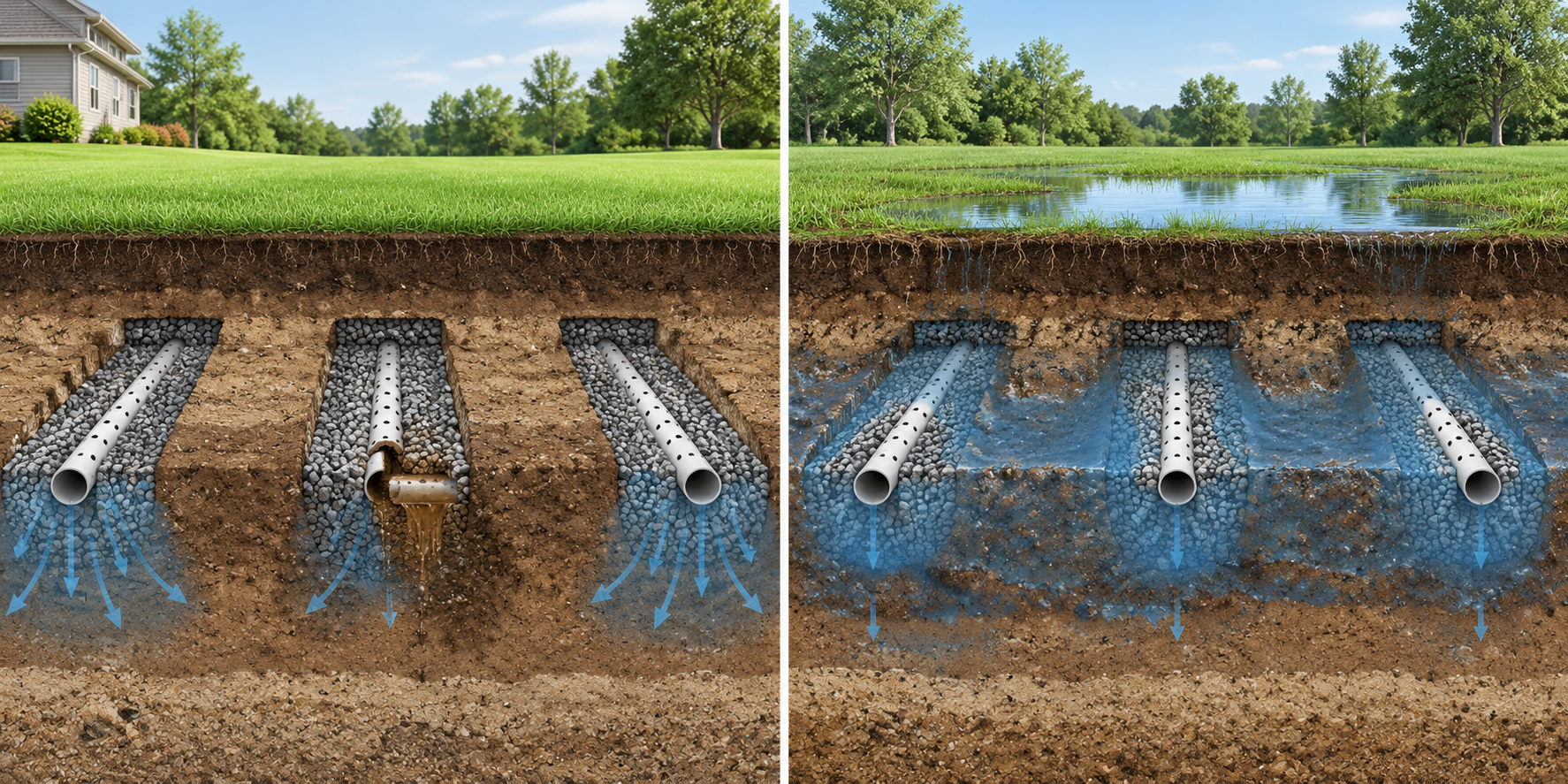
The drainfield receives effluent and treats and disperses it through soil. Wet areas, surfacing wastewater, slow drains, or backups can also result from a tank outlet, pump, distribution box, excessive water, surface drainage, groundwater, or a saturated site. A professional assessment should identify the evidence before excavation expands.
Repairable problem classes
- crushed, broken, settled, or disconnected distribution piping;
- a localized connection or outlet problem;
- unequal distribution from a box or dosing component;
- a pump, float, or control failure that mimics field failure;
- surface water entering the field area or causing localized saturation;
- erosion or restoration damage that has not destroyed the treatment area.
Available source material does not establish a reliable general drainfield-rejuvenation method or outcome. Treat claims that a chemical, aeration, jetting, or proprietary treatment will restore any failed field as a separate claim requiring strong, site-appropriate support.
Cost layers
- diagnostic visit, records review, and field observation;
- camera, locating, test pits, or targeted excavation where justified;
- line, connection, distribution, pump, or control repair;
- soil handling, groundwater management, rock, equipment access, and disposal;
- backfill, grading, planting, and landscape restoration;
- design, permit, inspection, or authority coordination if the repair changes the approved system.
A repair quote that omits restoration can understate the homeowner’s actual cost. A quote that labels a field “failed” without showing what was tested leaves the replacement decision under-supported.
Three scenarios
Localized physical damage: One line or connection is accessible and evidence shows a discrete break or collapse. A focused excavation and repair may preserve the rest of the field.
Distribution or pump cause: The field appears wet because flow is uneven or a dosing component is not working. Correcting that subsystem may be less disruptive than replacing the field, but the field must still be assessed.
Soil-treatment failure: Persistent ponding, surfacing untreated wastewater, recurrent backup, or loss of absorption across the field may require replacement or redesign. A minor line repair does not restore lost soil capacity.
Quote questions
- What observation distinguishes a line problem from soil-treatment failure?
- How much field will be opened, and what is the restoration standard?
- Are tank outlet, distribution, pump, surface drainage, and groundwater included in diagnosis?
- Is the proposed repair an approved alteration in this jurisdiction?
- What remains unknown, and what result would trigger replacement?
Keep repair and replacement as separate options until diagnosis supports the boundary. The cost-saving opportunity is real when the failure is localized; premature certainty can make either choice more expensive.
What a repair quote should prove
The proposal should identify the affected line, connection, box, pump, or site condition and explain why the remaining field is expected to continue working. If excavation is proposed, state how much area will be opened and how the field will be protected. If the recommendation is based on ponding or surfacing alone, ask what alternatives were considered and whether groundwater or surface drainage has been ruled in or out.
Do not treat a treatment additive, aeration service, or “rejuvenation” promise as a standard repair. The research did not establish a reliable general rehabilitation method. If a provider proposes one, request product evidence, applicability, expected outcome, limitations, and what happens if the field still fails.
Repair versus field replacement economics
Repair can be attractive when it avoids redesign and preserves a documented functioning field. Replacement may be more economical when the same area will be excavated repeatedly, the field is failing across its usable area, or a current design review is already required. Include restoration and future service in both options, and ask what condition changes the proposal.
Surface water is a separate cost decision
Roof runoff, grading, groundwater, irrigation, or a changing drainage path can keep a field wet without being the root treatment failure. If the professional identifies a site-water contributor, ask whether correcting it belongs to the septic quote or to separate site drainage work. A field repair that leaves an external water source in place may not change the symptom.
Likewise, do not drive or stage heavy equipment over a field simply to reduce mobilization. Saturated soil is vulnerable to compaction, and access planning is part of the repair economics. Include protection, equipment route, and restoration in the proposal.